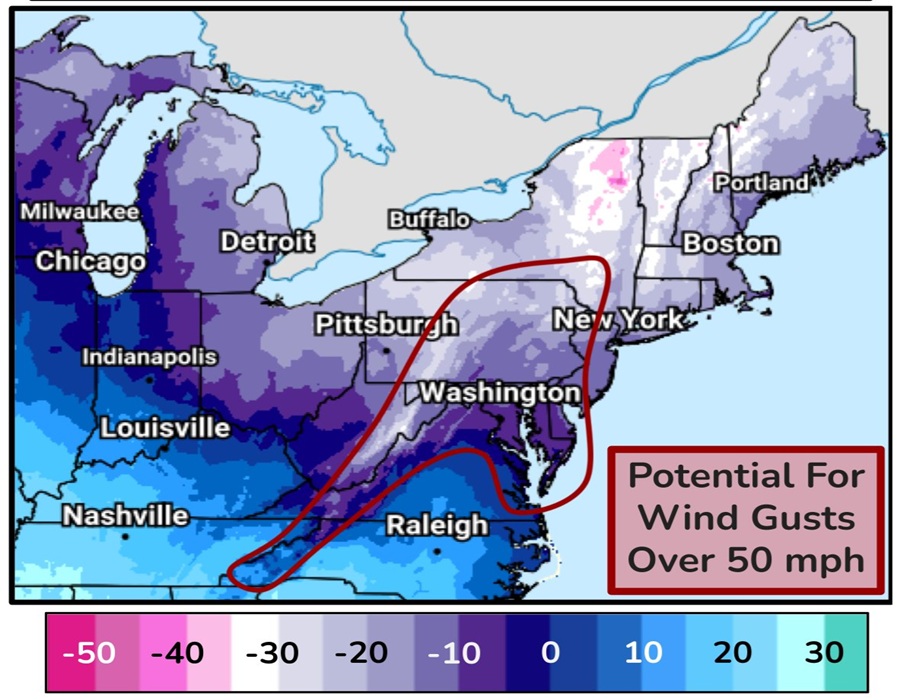
An Arctic front will plunge temperatures to some of the coldest levels yet while also setting the stage for extremely strong winds. Those strong winds will help dive wind chill factors to near-lethal levels to those exposed to the elements; the strong winds may also be damaging, taking down utility lines, trees, or both. There is also a risk of hazardous snow squalls over the northeast at the same time too.
A significant Arctic outbreak will bring frigid temperatures and dangerously cold wind chills to the Northeast and Mid-Atlantic this weekend. Coldest wind chills in the -30s are forecast across the interior northeast and New England. Bitterly cold daytime temperatures will struggle to rise above the teens and single digits.
Temperatures this cold can lead to frostbite on exposed skin in as little as ten minutes. For much of the Northeast and New England, these frigid temperatures will remain locked over the region into Wednesday morning as a strong high pressure system slowly swings over the eastern United States.
Exposure to cold temperatures can be fatal, causing over 1,000 deaths annually in the U.S. due to hypothermia, which occurs when the body loses heat faster than it produces it, dropping core temperature below 95 degrees. Once a human body drops below 82 degrees, the body shuts down, causing coma and death.
Strong winds, with some gusts potentially exceeding 50 mph on Saturday, will exacerbate the dangerous widespread below zero wind chills and potentially produce isolated tree damage and power outages. This is most likely across the southern and central Appalachians, Mid-Atlantic, and Northeast, with the highest risk zone being in New Jersey, Pennsylvania, Maryland, northern Virginia, and eastern West Virginia.
There is also a threat of snow squalls throughout this area. Brief periods of intense snowfall and blowing snow are possible with the arrival of the Arctic air on today and Saturday. A snow squall is a sudden moderate to heavy burst of snow that typically is joined by strong, gusty winds which in turns blows that falling snow. Snow squalls can create white-out conditions similar to a blizzard, but a snow squall is extremely localized in time and location. Squalls can form over portions of towns and can move in and out in a period of minutes rather than hours. Snow squalls could quickly coat the ground and untreated surfaces, making travel very slippery very quickly.
