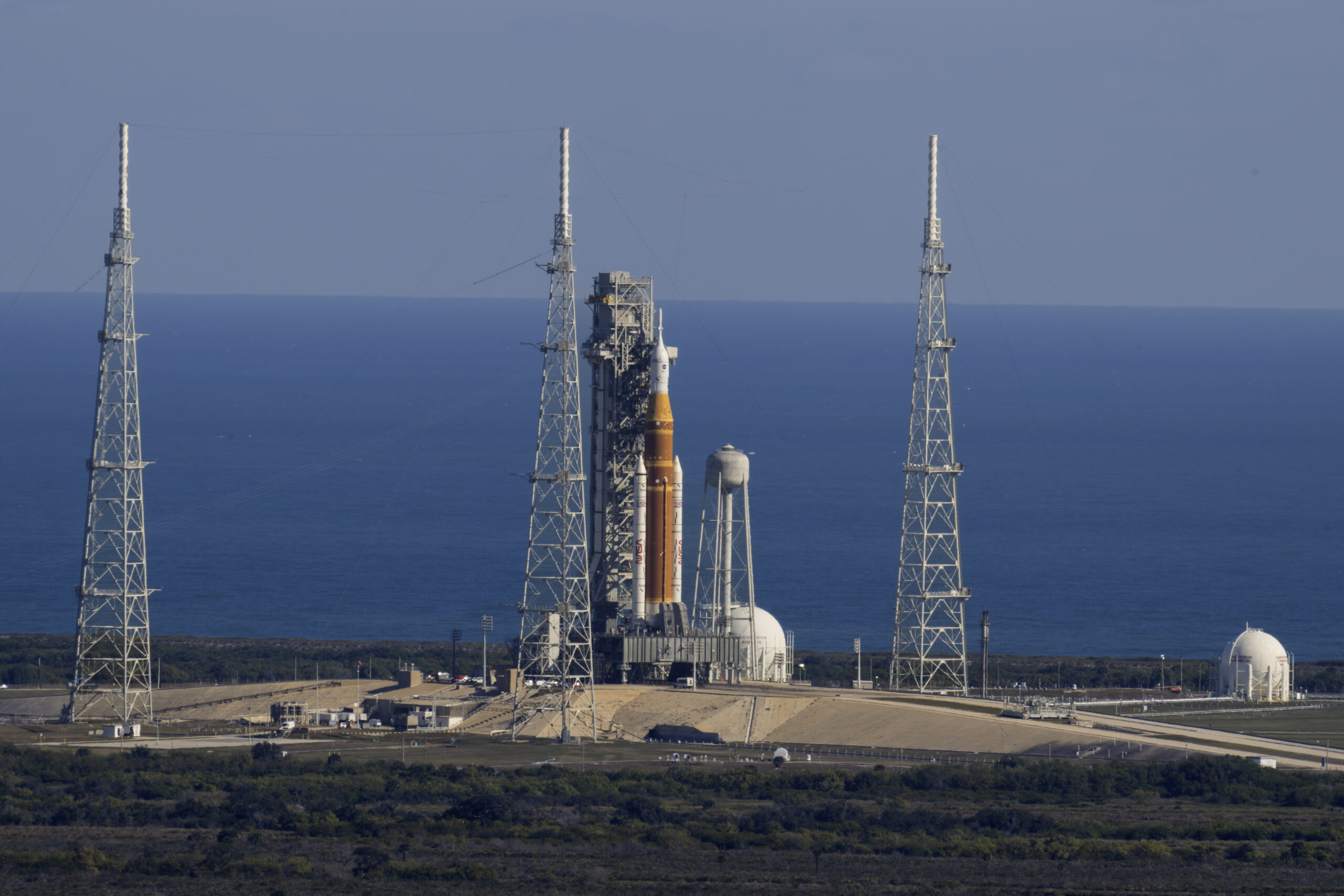
Florida is facing a frigid weekend with temperatures below freezing and wind chill factors below 0; there’s even a chance of snow flurries on the central Gulf Coast. Unfortunately, NASA says this same cold air is forcing it to encounter a weather delay for the upcoming launch of the Artemis II mission which will launch a crew towards the Moon. And the earliest date such a launch could happen would be on Superbowl Sunday, February 8. The earliest it would launch would be 11:20 pm.
Artemis is the follow-up series of missions involving the Moon from the Apollo missions in the 1960s and 1970s. According to Greek mythology, Artemis was the daughter of Leto and Zeus, and the twin of Apollo. She is the goddess of the wilderness, the hunt and wild animals, and fertility; Artemis is also considered as one of the helpers of midwives as a goddess of birth. The original Moon landing project was known as the “Apollo Mission.”
In a statement to the media, NASA said, “Over the past several days, engineers have been closely monitoring conditions as cold weather and winds move through Florida. Managers have assessed hardware capabilities against the projected forecast given the rare arctic outbreak affecting the state and decided to change the timeline. Teams and preparations at the launch pad remain ready for the wet dress rehearsal. However, adjusting the timeline for the test will position NASA for success during the rehearsal, as the expected weather this weekend would violate launch conditions.”
During the current cold weather, engineers have kept Orion powered and have configured its heaters for the colder temperatures. Purges, used to maintain proper environmental conditions for elements of the spacecraft and rocket, including the booster aft skirts, are also configured for the weather. The spacecraft is waiting for launch on its launchpad at NASA’s Kennedy Space Center.
This upcoming Artemis II launch is part of a 10-day mission that will carry NASA astronauts Reid Wiseman, Victor Glover, Christina Koch, and Canadian Space Agency astronaut Jeremy Hensen on a free-return trajectory around the Moon and back to Earth. This flight will take the crew farther from Earth than any previous human mission before re-entering the Earth’s atmosphere at a record speed of approximately 25,000 mph. On January 18, the SLS rocket topped with the Orion capsule was rolled-out from the Vehicle Assembly Building to Launch Complex 39B at NASA’s Kennedy Space Center.
NASA has emphasized that it will launch the astronauts only when all systems are ready, as safety comes before any schedule.
NASA has been extra cautious about launching rockets since the Space Shuttle Challenger disaster 40 years ago. Components of that spacecraft could not tolerate freezing temperatures which lead to a catastrophic explosion of the space shuttle shortly after lift-off, killing all on-board. Artemis II is using the same launch complex that Space Shuttle Challenger did on that fateful day January, 1986.
After Artemis II comes an even more ambitious mission: Artemis III will send the first humans to explore the region near the South Pole of the Moon.
And more ambitious yet will be Artemis IV, which debuts humanity’s first lunar space station, a larger, more powerful version of the SLS rocket, and a new mobile launcher.
