This morning shortly after sunrise, the nation’s most famous groundhog, Phil, in Punxsutawney, Pennsylvania was pulled out for waiting cameras to see if he’d see his shadow or not. If he sees his shadow due to sunny skies, tradition holds that six more weeks of winter will follow. If he does not see his shadow on a cloudy day, early spring is expected. Today marks the 139th time the holiday tradition was celebrated in Punxsutawney, Pennsylvania. While these annual forecasts are full of folklore fun, there is little link between what happens here and how the weather will evolve in subsequent weeks. However, today’s outlook from the groundhog does concur with NOAA’s Climate Prediction Center Outlook.
According to folklore, when the groundhog can see its shadow, there will be another 6 weeks of winter. If he doesn’t see his shadow, folklore says spring will arrive early.
While the club claims high accuracy, others dispute the findings: the National Weather Service says he only has a 50-50 track record.
A former president of the Groundhog Club spoke with a Weatherboy meteorologist to discuss the tradition, adding additional color to the holiday: “The tradition of Phil started in our homeland of Germany. Our ancestors were farmers and eagerly awaited the end of the long German winter so we could begin the process of getting our fields ready for planting our crops. In Germany there were no groundhogs but we did have hedgehogs. They served the same purpose as Phil here. Unfortunately, in the middle of the cold Germanic winter, our hedgehog usually ended up on someone’s dinner plate.”
As these German farmers settled in Pennsylvania, they wanted to hold on to this tradition of the hedgehogs predicting the end of winter. But, finding no hedgehogs in the United States, they settled on a much bigger and furrier rodent, the groundhog. “Our ancestors found this particularly handsome groundhog here and named him Phil Sowerby. We treat him like gold.”
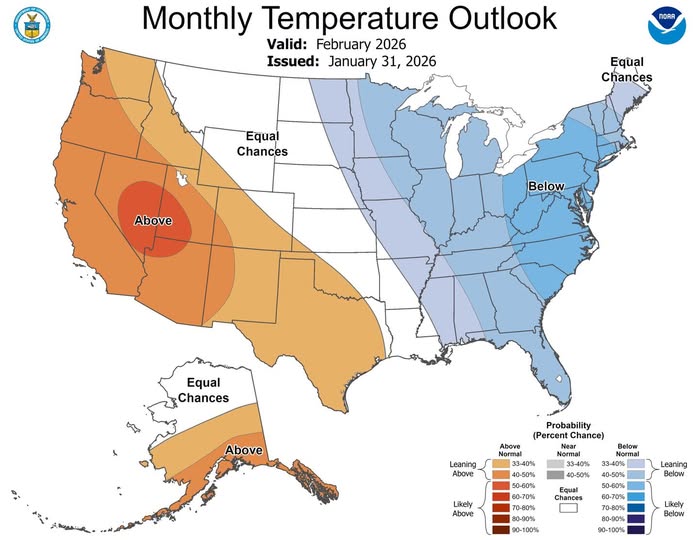
When Phil saw his shadow this morning and proclaimed six more weeks of winter, that aligned with the existing NOAA Climate Prediction Center (CPC) forecast.
“Bitterly cold temperatures and dangerous wind chills target the Northeast and Mid-Atlantic, with a High Risk of much below-normal temperatures February 7-8, with record breaking temperatures possible for some regions. High winds are also possible over these areas February 7-10, creating subzero wind chills,” writes the CPC in their latest outlook. They add, “Moderate risks of much below normal temperatures linger over the Mid-Atlantic and Northeast through February 10 and cover the Florida Peninsula February 7-8 with a slight risk of covering the entire eastern U.S. February 7-13.”
The CPC also says that cold air will continue, albeit moderate some over time. The CPC describes “increased probabilities for below-normal temperatures” through the eastern U.S. into the second week of the month, but temperatures “may moderate in mid-February as a pattern change is possible.”
“Low temperatures and high winds can lead to dangerous wind chills,” advises the CPC. “Minimize outdoor time, dress in layers, and make sure pets and animals have protection from the cold.”
