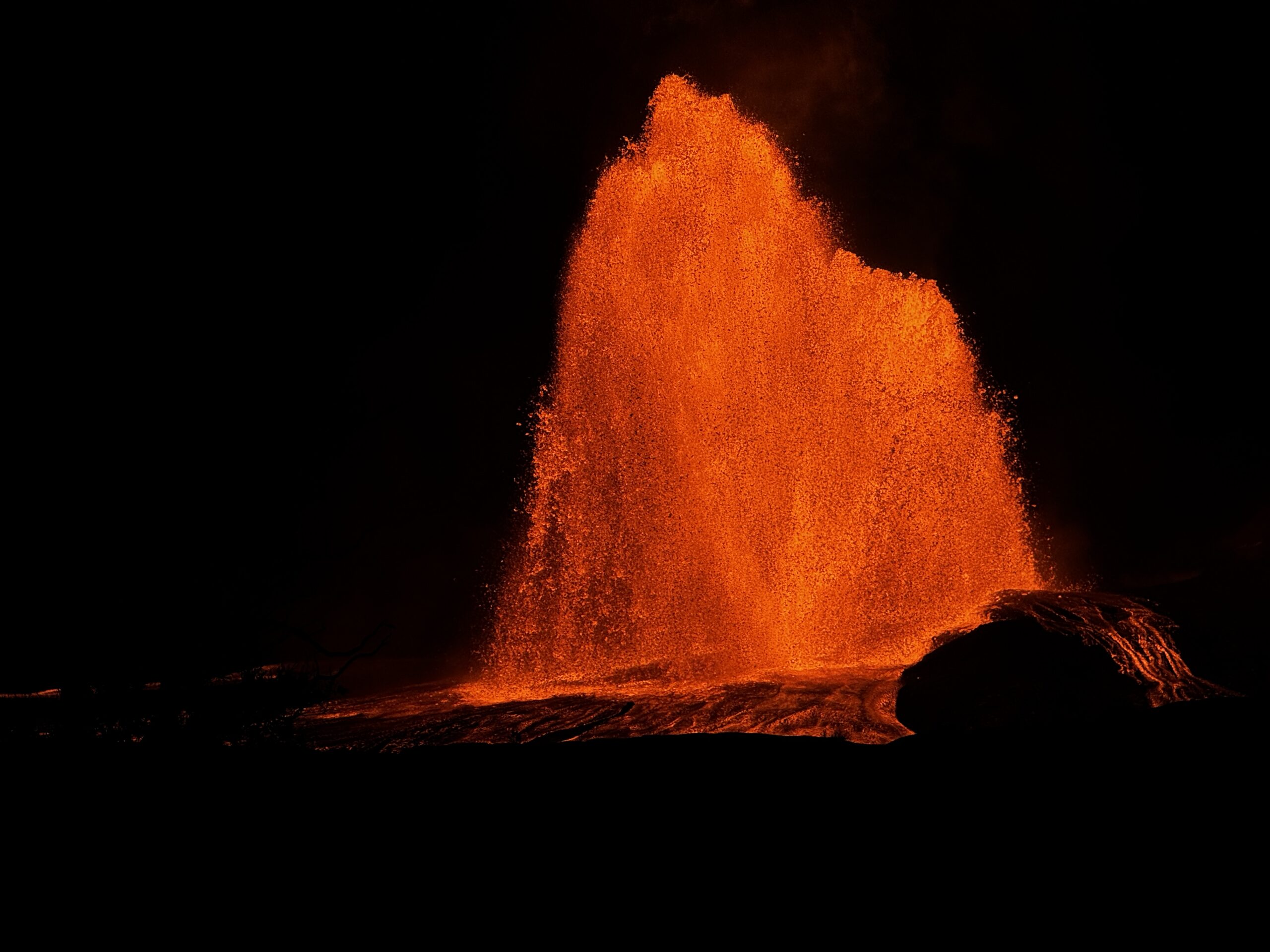
Kilauea’s summit was quiet but swelling again early Saturday, two days after the volcano’s 56th lava fountaining episode sent a fountain about 660 feet into the air and buried much of the Halemaumau crater floor under fresh lava. Scientists said the next outburst is likely several weeks away.
Episode 56 began at 12:10 p.m. Thursday and ended abruptly at 6:01 p.m., the U.S. Geological Survey’s Hawaiian Volcano Observatory said. That was 4:10 p.m. to 10:01 p.m. CST. All lava stayed inside the crater, in an area of Hawaii Volcanoes National Park that has been closed to the public since early 2008.
The observatory lowered Kilauea’s volcano alert level from watch to advisory and its aviation color code from orange to yellow at 2:50 p.m. Friday, Hawaii time, according to its volcanic activity notice.
A Steady Build to a 660-Foot Fountain
Overflows from the north vent grew more vigorous Thursday morning and built into a continuous low fountain by late morning, the observatory said in its Friday update. Scientists declared the start of episode 56 at 12:10 p.m. as the fountain intensified.
The fountain rose quickly after that. The observatory said heights peaked at about 660 feet between 1:30 and 2 p.m. Fountaining was limited to the north vent, with only sporadic spattering from the southwest vent early in the episode.
Lava poured across the crater floor in several long channels and in what the observatory called “impressive sheet-like flows” down the shield that has built up around the vent. New lava covered much of the western and northern parts of the crater floor, and some flows reached its eastern end.
Fountain heights declined steadily after 2 p.m. The fountain was down to about 330 feet by 4:43 p.m., according to an observatory message. It fluctuated shortly before 6 p.m. and then shut off at 6:01 p.m. Lava kept moving for about another hour before the flows stalled.
Tiltmeter data indicate the episode erupted about 8 million cubic yards (6 million cubic meters) of lava, the observatory said, with a peak rate of about 690 cubic yards per second around 2 p.m.
Plume reached 18,000 feet
National Weather Service radar showed the eruption plume climbed to about 18,000 feet above sea level, the observatory said.
Strong northeast winds at the surface carried most of the falling tephra southwest into the closed part of the park. Higher up, winds from the east and southeast pushed the upper plume northwest toward the summit of Mauna Loa.
Observatory geologists reported trace amounts of Pele’s hair, thin strands of volcanic glass, west of the summit on Highway 11 and in the town of Pahala. An observatory message Thursday afternoon also noted light tephra fall at the park’s Footprints area.
The National Weather Service issued a special weather statement Thursday warning of possible light ashfall near and west of the volcano, the Honolulu Star-Advertiser reported.
“Low-level trade winds will push ash toward the west, and any ash fallout will likely occur over the Kau District and Highway 11 west of the town of Volcano and possibly as far southwest as Pahala,” the statement said.
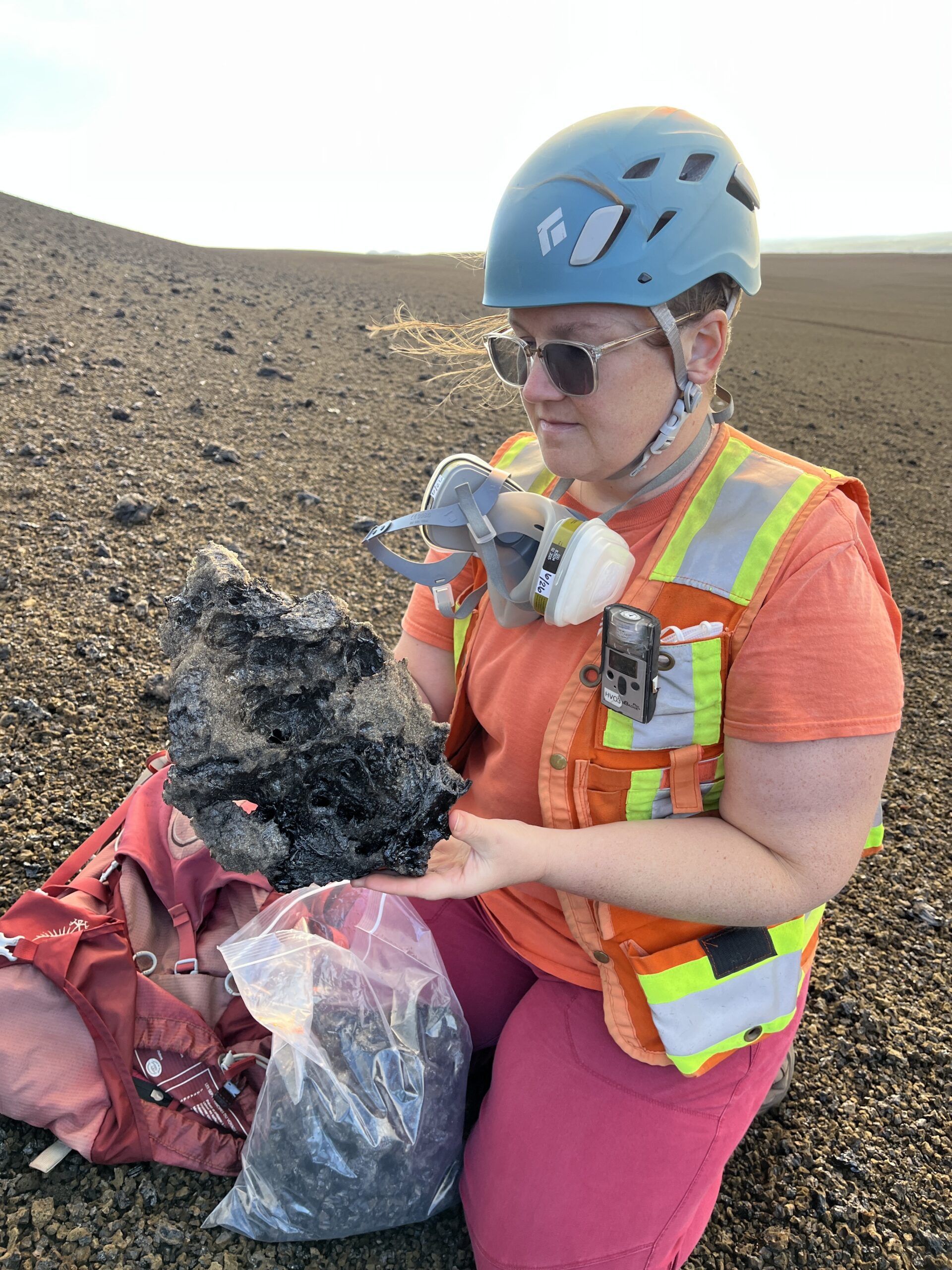
Frothy chunks of tephra landed near the vents. On Thursday, observatory field crews collected one clast more than 20 inches long for laboratory analysis, according to a USGS photo released Friday.
Ground Starts to Swell Again
Each episode has followed the same cycle: Magma inflates the ground beneath the summit, then pressure drops sharply once fountaining begins, tracing a saw-tooth pattern in tilt records, the observatory says.
The Uekahuna tiltmeter, on the western rim of Kilauea’s summit caldera, recorded 17 microradians of deflation during episode 56. Inflation resumed as soon as the fountain shut off. By Friday morning, the instrument had regained about 3 microradians.
“Based on previous episodes, the next lava fountaining is likely several weeks away,” the observatory said in its Friday update.
Volcanic tremor rose quickly during the fountaining and dropped off sharply when it ended, the observatory said. Tremor was still elevated Friday morning, with sporadic spikes that scientists said suggest gas pistoning, the repeated rise and fall of gas and lava in the volcano’s conduit. Only one small earthquake was located at the summit over the previous day.
Earthquake activity and ground deformation remained low in Kilauea’s East Rift Zone and Southwest Rift Zone, the observatory said. Sulfur dioxide emissions from the East Rift Zone were below the detection limit.
Gas and Lingering Hazards
Lowering the alert level does not mean the summit is safe. The observatory said gas emissions can remain hazardous immediately downwind of the vents even when they are not erupting. Sulfur dioxide reacts in the atmosphere to form vog, a volcanic smog that can cause respiratory problems at high concentrations.
During fountaining episodes, the summit typically releases about 100,000 metric tons of sulfur dioxide per day, the observatory said. On Friday morning, trade winds were carrying volcanic gas southwest toward the Kau District.
Glassy fragments left by the fountains can be picked up again by strong winds and can irritate skin and eyes, the agency said. Lava on the crater floor remains hot and may move slowly in the days after an episode.
Scientists also warned of crater wall instability, ground cracking and rockfalls around the caldera.
Nearly Two Years of Episodic Eruptions
The current eruption began Dec. 23, 2024, and has been episodic ever since. According to the observatory, most fountaining episodes last less than 12 hours and are separated by pauses of two weeks or more.
Episode 56 came 19 days after episode 55, which lasted about six hours on the morning of Oct. 17 and produced a north vent fountain of about 720 feet, according to the USGS timeline of eruptive episodes. Before that, Kilauea went 52 days without fountaining after episode 54 on Aug. 25.
The pause was not entirely quiet. Six new vents opened in and near the base of Halemaumau’s northwest wall from Sept. 14 to 16 and fed lava flows across the crater floor without fountaining, the timeline shows. A magma intrusion northeast of the vent complex on Sept. 30 and Oct. 1 opened new cracks on the upper caldera floor.
In a Nov. 2 image release, the observatory said webcam images show the south and west vents have merged into a single “southwest” vent, a real geologic change that does not significantly alter hazards.
Through episode 50 in late June, the observatory estimated the eruption’s lava covered about 1,116 acres.
Elsewhere in U.S. Volcano and Earthquake Monitoring
In Alaska, Great Sitkin Volcano in the central Aleutian Islands remained at watch and orange, the Alaska Volcano Observatory said in its weekly update Friday. A slow lava eruption there that began in July 2021 continues within the summit crater with low-level seismicity.
The Alaska observatory lowered Shishaldin Volcano on Unimak Island to normal and green on Nov. 2 after more than a year of elevated unrest, saying an eruption is not expected at this time.
The largest earthquake in or near the United States in the past week was a magnitude 5.0 quake about 69 miles offshore, west of Petrolia, California, at 8:56 p.m. PST Wednesday, according to USGS catalog data. The USGS assigned it a green PAGER alert, its lowest impact level.
