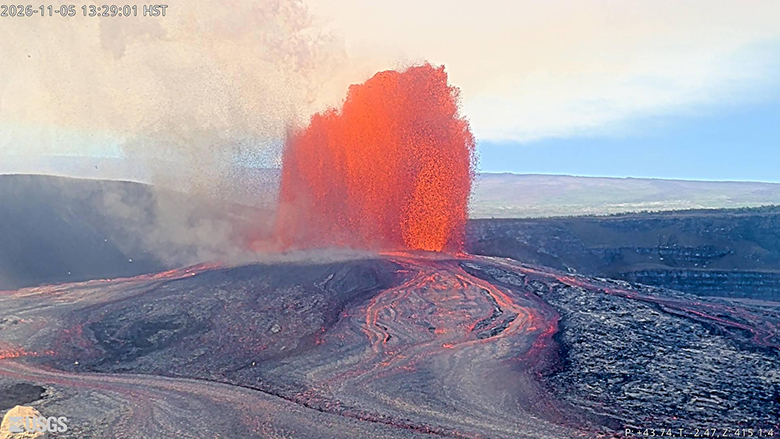
Episode 56 of Kīlauea’s ongoing Halemaʻumaʻu summit eruption ended abruptly at 6:01 p.m. HST on Thursday after about six hours of continuous lava fountaining, the U.S. Geological Survey’s Hawaiian Volcano Observatory said.
The episode began at 12:10 p.m. HST Nov. 5 inside Halemaʻumaʻu crater at the summit of Kīlauea within Hawaiʻi Volcanoes National Park. Early fountain heights were relatively low near 100 feet, HVO said, then climbed through the afternoon. By about 1:23 p.m., fountains were reaching roughly 500 feet. Observatory messages later put the peak near 650 to 660 feet, or about 200 meters, around early afternoon.
The National Weather Service and the Washington Volcanic Ash Advisory Center reported an eruption plume rising to about 18,000 feet above sea level based on radar data. HVO said surface-level winds from the northeast and upper-level winds from the east-southeast pointed toward gas and tephra transport between the southwest and northwest of Halemaʻumaʻu. A National Weather Service special weather statement warned that light ashfall was likely near and west of the volcano, with fallout possible over the Kaʻū District and Highway 11 west of Volcano and possibly as far southwest as Pāhala while fountaining continued.
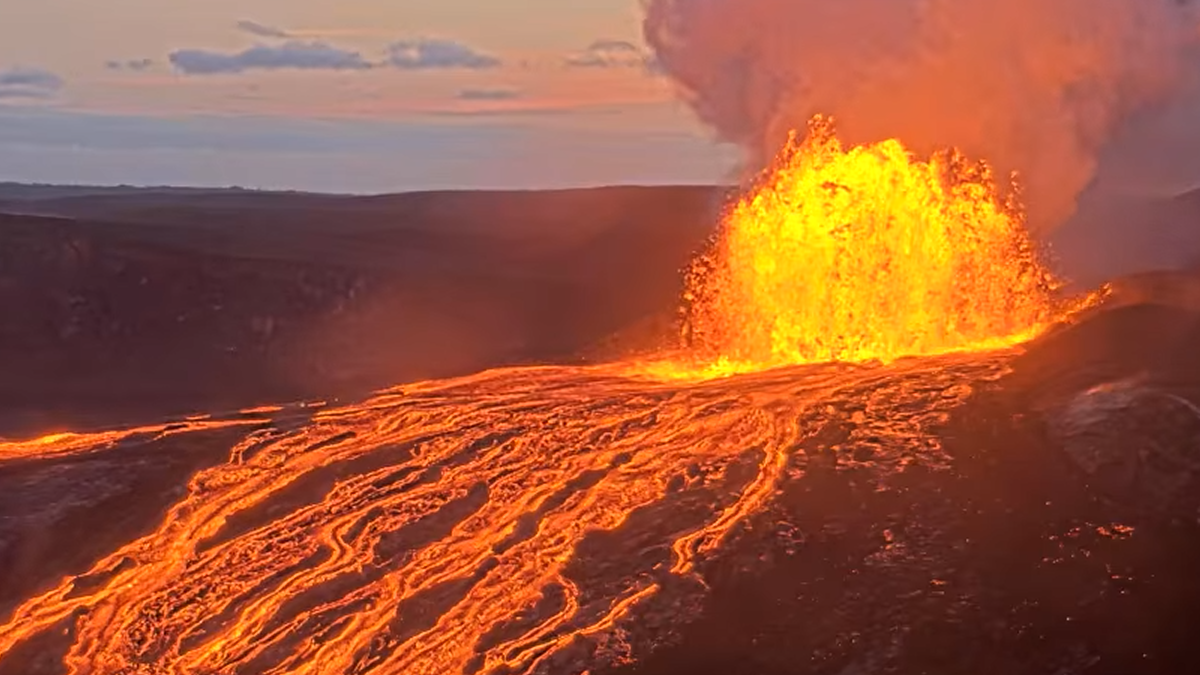
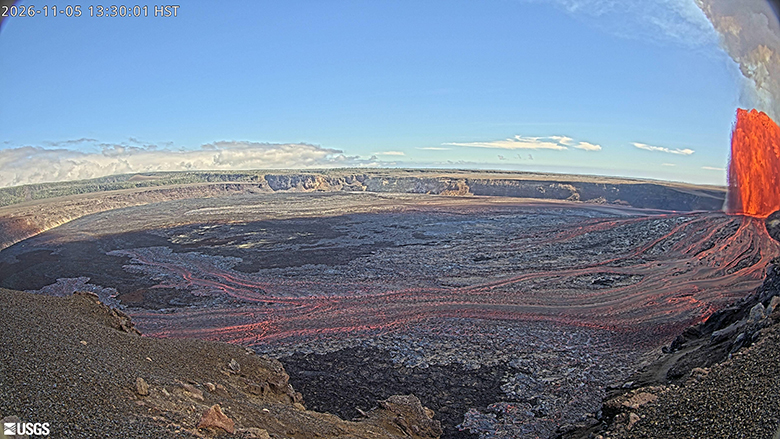
All eruptive vents and lava flows remained confined to Halemaʻumaʻu crater within the national park, HVO said in successive volcanic activity notices. Tephra fall from volcanic ash clouds is greatest within about 3 miles of the vents, the observatory said, while lighter ash and Pele’s hair may remain suspended and travel farther downwind.
By midafternoon Thursday, HVO reported that Episode 56 had already erupted about 5 million cubic yards of lava, with a peak effusion rate of about 690 cubic yards per second around 2 p.m. Fountain height later eased to roughly 330 feet by 4:43 p.m., and light tephra was reported at the Footprints area and in Pāhala even as most fallout continued to land in closed portions of the park.
After the episode ended, tiltmeter analysis filled out the volume picture. At 7:31 p.m. HST, HVO said tiltmeter data indicated approximately 8 million cubic yards — about 6 million cubic meters — of lava erupted during Episode 56, with an average effusion rate of about 260 cubic yards per second. Minutes earlier, the observatory reported that the Uēkahuna tiltmeter, known as UWD, recorded 17 microradians of deflationary tilt during the episode and that inflationary tilt resumed immediately after fountaining stopped. That sawtooth pattern of inflation before an episode and deflation during fountaining has become a hallmark of the summit eruption that began Dec. 23, 2024.
Kīlauea remained at Volcano Alert Level WATCH and Aviation Color Code ORANGE after the end-of-episode notice issued at 6:21 p.m. HST Thursday. In the accompanying Volcano Observatory Notice for Aviation, HVO said lava fountain Episode 56 ended at 6:01 p.m. HST and that fountain activity in the summit area was unlikely for the next several weeks. The aviation notice referred aviators to the National Weather Service for information on any drifting plume and listed a residual cloud height near 5,600 feet above sea level after the fountains stopped.
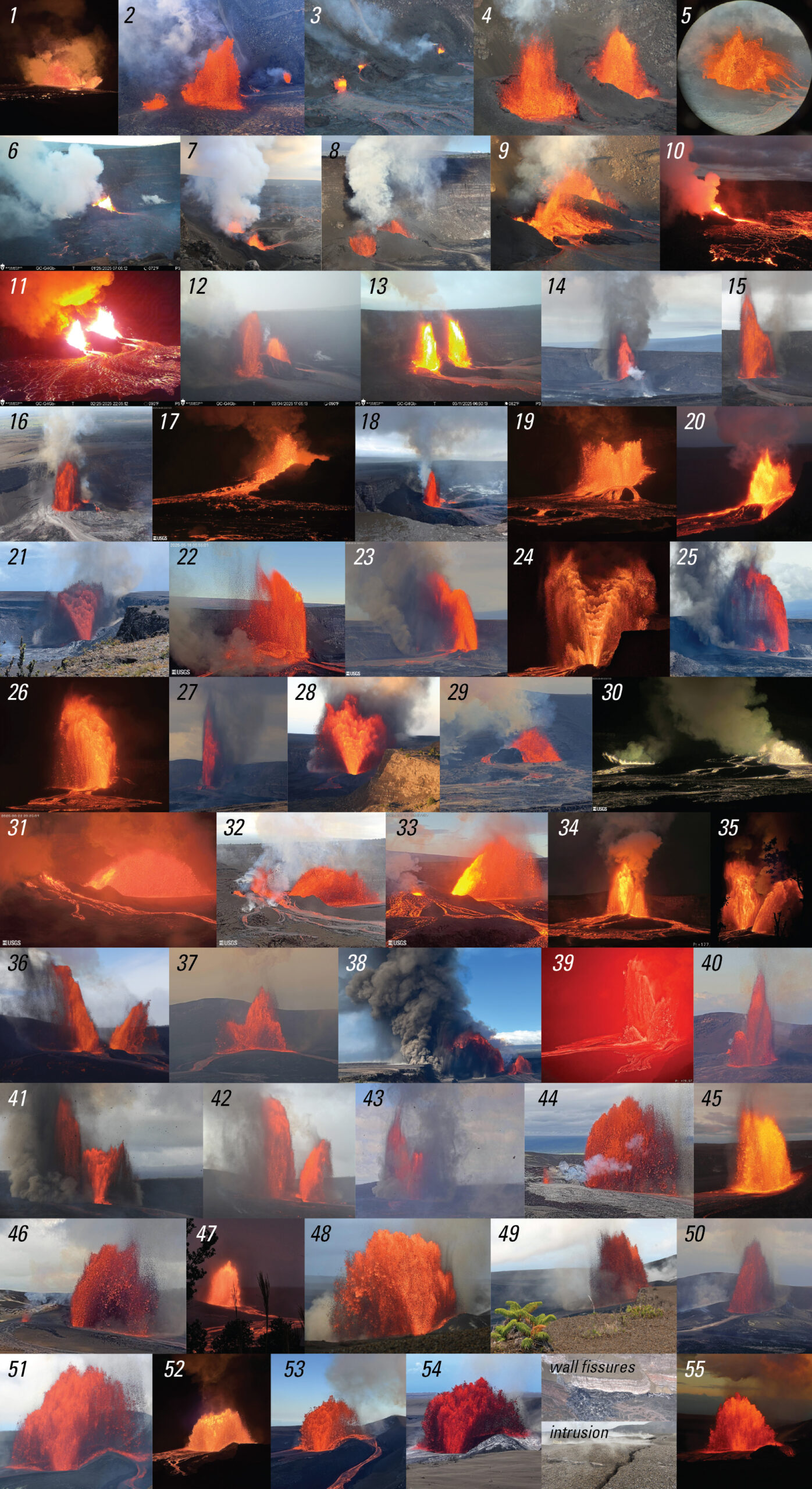
The pause language matters for residents and visitors planning around the park. Most lava-fountaining episodes since December 2024 have lasted a day or less, and Episode 56 fit that pattern at roughly six hours. Episode 55, the previous numbered fountaining pulse, began at 3:19 a.m. HST Oct. 17 and paused the same morning after about six hours, according to HVO’s eruption timeline. Between those numbered episodes, September brought additional non-fountaining fissure activity on the northwest wall of Halemaʻumaʻu and a late-September intrusion that cracked portions of the upper caldera floor, underscoring that summit unrest can take more than one form even when tall fountains are quiet.
Hazards did not vanish when the fountains shut off. HVO said volcanic gas emissions — water vapor, carbon dioxide and sulfur dioxide — can remain locally hazardous immediately downwind of the vents even when they are not actively erupting. Sulfur dioxide reacts in the atmosphere to form vog, which may cause respiratory and other problems at high concentrations. Small glassy tephra fragments can also be remobilized by wind after an episode and irritate skin and eyes. Lava on the Halemaʻumaʻu crater floor and the southwest side of Kaluapele, Kīlauea’s summit caldera, remains hot and may move slowly in the days after an episode. The caldera rim surrounding Halemaʻumaʻu has been closed to the public since late 2007 because of wall instability, ground cracking and rockfall hazards.
During the episode itself, webcams and field observations tracked the rising plume and tephra curtain. HVO said tephra could be seen falling on the V3 camera site in the livestream while gusty north-northeast winds pushed the plume into closed park land. North vent fountaining fed sheet flows cascading onto the crater floor earlier in the afternoon. Big Island Video News and the Honolulu Star-Advertiser relayed the same official timeline as fountain heights climbed from about 100 feet near onset toward the 660-foot peak before the abrupt evening stop.
For communities southwest of the summit, Thursday’s NWS guidance was the practical bottom line while the plume was up: minimize unnecessary ash exposure, and take extra care if you have respiratory sensitivities. Catchment water users and anyone handling Pele’s hair were reminded that glassy strands can irritate skin and contaminate water supplies. HVO continued to invite public tephra reports through its community reporting form to help map fallout.
Scientists will refine Episode 56 volume, fountain-height and deposit maps in later reviewed products. HVO emphasizes that rapid episode messages and the public eruption timeline are preliminary and subject to revision. Even so, Thursday’s numbers already place Episode 56 among the more vigorous recent pulses by fountain height, with a plume tall enough to draw aviation attention and a lava output measured in millions of cubic yards over only about six hours. Peak fountain heights near 200 meters were comparable to other mid-range episodes in the sequence; Episode 55’s public timeline listed an approximate 220-meter maximum on Oct. 17, and HVO may revise Episode 56 figures after full review of webcam, laser and field measurements.
The broader eruption remains an episodic summit sequence rather than a continuous open-vent fountain. Magma pressure rebuilds beneath the caldera between pulses, ground tilt inflates, and another fountain episode can follow days to weeks later — though the end-of-episode aviation notice said the next summit fountain activity is unlikely for several weeks. Park overlooks have offered dramatic views of prior episodes when winds and closures allow, but HVO and park managers continue to stress that gas, tephra and unstable ground make close approach to the crater rim unsafe. As of early Friday, no new fountaining had resumed. Residents of Volcano, Pāhala and Kaʻū communities downwind of the summit were left with cooling lava inside a closed crater, a resumed inflation signal on the Uēkahuna tiltmeter and official guidance that the next tall fountain show is not expected in the immediate days ahead. Anyone who finds remobilized ash or Pele’s hair around homes or vehicles should minimize handling of the glassy fragments and follow county and HVO health guidance linked from the observatory’s hazard pages.
Key Takeaways
-
- – Episode 56 timeline: Fountaining began at 12:10 p.m. HST Nov. 5 and ended abruptly at 6:01 p.m. HST after about six hours, with peak fountain heights near 660 feet and a plume to about 18,000 feet above sea level.
- – Lava output and tilt: HVO estimated about 8 million cubic yards of lava erupted at an average rate near 260 cubic yards per second; the Uēkahuna tiltmeter recorded about 17 microradians of deflation during the episode before inflation resumed.
- – Status after the pause: Kīlauea remains at Alert Level WATCH / Aviation Color Code ORANGE with activity confined to Halemaʻumaʻu; HVO’s aviation notice said summit fountain activity is unlikely for the next several weeks.
