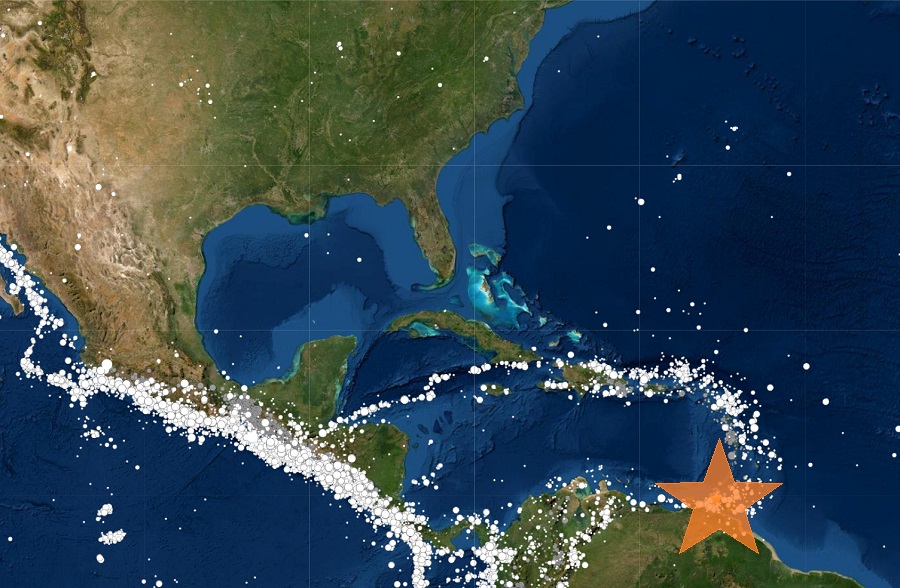
Both the USGS in the United States and the University of the West Indies Seismic Research Centre are reporting that a moderate 4.8 earthquake struck a short time ago in the eastern Caribbean. The earthquake struck at 10:59 pm local time, roughly 75 miles northwest of Port of Spain, Trinidad and Tobago and roughly 75 miles southwest of St. George’s in Grenada. The epicenter is roughly 67 miles northeast of the coast of Venezuela, with the town of Carupano the closest city in Venezuela to the earthquake. The earthquake struck at a depth of 42 miles.
It does not appear the earthquake was strong enough to generate a tsunami; as such, there is no tsunami threat to the Caribbean or the U.S. East Coast at this time.
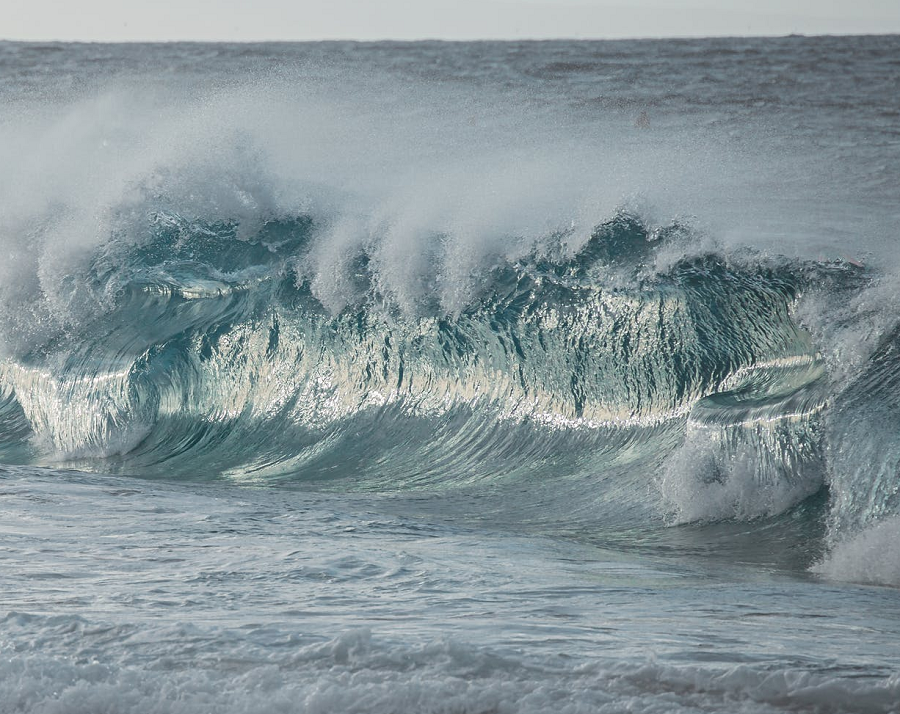
Tsunamis are giant waves caused by earthquakes or volcanic eruptions under the sea. Out in the depths of the ocean, tsunami waves do not dramatically increase in height. But as the waves travel towards land, they build up to higher and higher heights as the depth of the ocean decreases. The speed of tsunami waves depends on ocean depth rather than the distance from the source of the wave. Tsunami waves may travel as fast as jet planes over deep waters, only slowing down when reaching shallow waters. While tsunamis are often referred to as tidal waves, this name is discouraged by oceanographers because tides have little to do with these giant waves.
The Eastern Caribbean is an example of an island arc system formed at a convergent plate boundary. In this case, there’s a subduction zone where two plates meet, with the denser plate forced beneath the lighter one. With this dynamic activity, earthquakes and volcanoes can become quite common in this part of the world.
Most of the earthquakes occurring in the Eastern Caribbean are either tectonic or volcanic in origin. Tectonic earthquakes are generated when plates move and accumulated energy is released in the form of ground shaking. When magma moves around within the Earth’s lithosphere, volcanic earthquakes can occur. In this case, because magma is less dense than the rock it surrounds, it rises to the surface, breaking the rock as it moves. As these rocks break, earthquakes are generated.
Just last April, the eastern Caribbean saw a significant volcanic eruption. La Soufriere erupted on St. Vincent; it the only active volcano on that island in the Caribbean.
