
The National Weather Service’s Space Weather Prediction Center is now warning that a severe geomagnetic storm, rated 4 on a 5 point scale, could impact Earth on November 12, prompting them to issue a SEVERE Geomagnetic Storm (G4) Watch for the planet. There are technically three watches in effect: G2 MODERATE for November 11, G4 SEVERE for November 12, and G3 STRONG for November 13.
These Geomagnetic Storm Watches are in response to potential geomagnetic storm effects related to coronal mass ejections (CME) that have erupted from the Sun over the past several days. These events include CME activity from November 9 through the early morning of November 12.
The most recent CME occurred early on November 11 and is the most energetic and fastest of the CMEs. This CME was associated with an X5.1 solar flare that peaked at 5:04 am ET on November 11. This CME is also associated with a moderate level solar radiation storm that is currently in progress.
“The forecast is tough due to this latest CME’s predominant ejecta aimed north and ahead of Earth’s orbit; additionally the previous CMEs are in the mix and anticipated to have some Earth-arrival influences prior to the November 12 CME arrival,” says the Space Weather Prediction Center (SWPC.) They add, “Confidence in an Earth-component to the most recent CME is high, while timing has a moderate level of certainty. As always with these events, the intensity of the CME will not be know with better certainty until it arrives 1 million miles from Earth and is observed by the solar wind observatories at that location. It is at that point that any needed Warning decisions can be made by SWPC forecasters. So, for now, SWPC believes there is a potential for G4 levels upon CME arrival and/or as the CME passage progresses.”
Coronal mass ejections (CMEs) are eruptions of solar material and strong magnetic fields. When they arrive at Earth, a geomagnetic storm can result. Fast wind streams from features called Coronal Holes can also drive geomagnetic storms. According to the SWPC, Earth is currently experiencing the impacts from both.
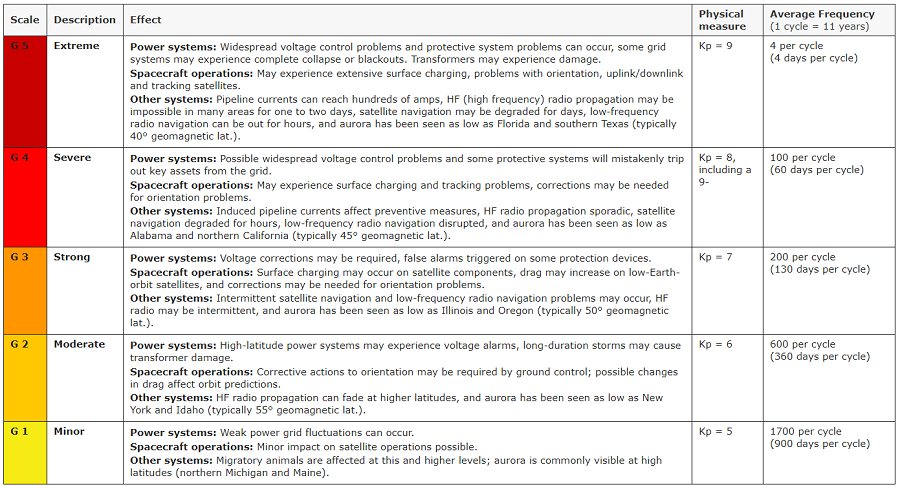
Geomagnetic storms are rated on a 1-5 scale by the SWPC, with 1 considered minor and 5 considered extreme. Geomagnetic storms can disrupt electronics and electrical systems, interfere with spacecraft and satellite communication, and also trigger brilliant displays of the aurora in the night sky. Currently a 4 level storm is expected but a more impactful storm is possible.
According to the SWPC, the current geomagnetic storm could allow for aurora to be visible in the pre-sunrise skies in areas that usually don’t see them. One frequent side effect of these geomagnetic storms is the presence of aurora. The probability and location of aurora displays is based on the Kp index of the storm. The K-index, and by extension the Planetary K-index, are used to characterize the magnitude of geomagnetic storms. The SWPC says that Kp is an excellent indicator of disturbances in the Earth’s magnetic field and is used by SWPC to decide whether geomagnetic alerts and warnings need to be issued for users who are affected by these disturbances. Beyond signifying how bad a geomagnetic storm’s impact can be felt, the Kp index can also help indicate how low, latitude-wise the aurora will be. Currently a Kp of 8 is forecast but that could grow depending on the intensity of the storm.
Coronal Mass Ejections (CMEs) are large expulsions of plasma and magnetic field from the Sun’s corona. They can eject billions of tons of coronal material and carry an embedded magnetic field, frozen in flux, that is stronger than the background solar wind interplanetary magnetic field (IMF) strength. CMEs travel outward from the Sun at various speeds, with some reaching the Earth as quickly as 15-18 hours and others requiring days to arrive. According to the SWPC, CMEs expand in size as they propagate away from the Sun and larger ones can reach a size comprising nearly a quarter of the space between Earth and the Sun by the time it reaches our planet.
As the CME interacts with Earth and its magnetosphere, a variety of things could unfold based on the amount of energy hitting and the angle it impacts the Earth. Power system voltage irregularities are possible and false alarms may be triggered on some protection devices. Minor impacts on satellite operations could also be possible, with intermittent satellite navigation (GPS) problems likely. Should the geomagnetic storm become stronger, aurora could be brighter and could appear even more south while impacts to electrical systems could be more severe.
NOAA forecasters analyze a variety of solar data from spacecraft to determine what impacts a geomagnetic storm could produce. Analyzing data from the DSCOVER and ACE satellite is one way forecasters can tell when the enhanced solar wind from a coronal hole is about to arrive at Earth. A few things they look for in the data to determine when the enhanced solar wind is arriving at Earth:
• Solar wind speed increases
• Temperature increases
• Particle density decreases
• Interplanetary magnetic field (IMF) strength increases
While these solar events can help illuminate the sky with stunning aurora, they can also do considerable harm to electronics, electrical grids, and satellite and radio communications.
The 1859 incident, which occurred on September 1-2 in 1859, is also known as the “Carrington Event.” This event unfolded as powerful geomagnetic storm struck Earth during Solar Cycle 10. A CME hit the Earth and induced the largest geomagnetic storm on record. The storm was so intense it created extremely bright, vivid aurora throughout the planet: people in California thought the sun rose early, people in the northeastern U.S. could read a newspaper at night from the aurora’s bright light, and people as far south as Hawaii and south-central Mexico could see the aurora in the sky.

Image: NASA/Mary Pat Hrybyk-Keith
The event severely damaged the limited electrical and communication lines that existed at that time; telegraph systems around the world failed, with some telegraph operators reporting they received electric shocks.
A June 2013 study by Lloyd’s of London and Atmospheric and Environmental Research (AER) in the U.S. showed that if the Carrington event happened in modern times, damages in the U.S. could exceed $2.6 trillion, roughly 15% of the nation’s annual GDP.
While typically known for their weather forecasts, the National Oceanic and Atmospheric Administration (NOAA) and its National Weather Service (NWS) is also responsible for “space weather.” While there are private companies and other agencies that monitor and forecast space weather, the official source for alerts and warnings of the space environment is the Space Weather Prediction Center (SWPC). The SWPC is located in Boulder, Colorado and is a service center of the NWS, which is part of NOAA. The Space Weather Prediction Center is also one of nine National Centers for Environmental Prediction (NCEP) as they monitor current space weather activity 24/7, 365 days a year.
