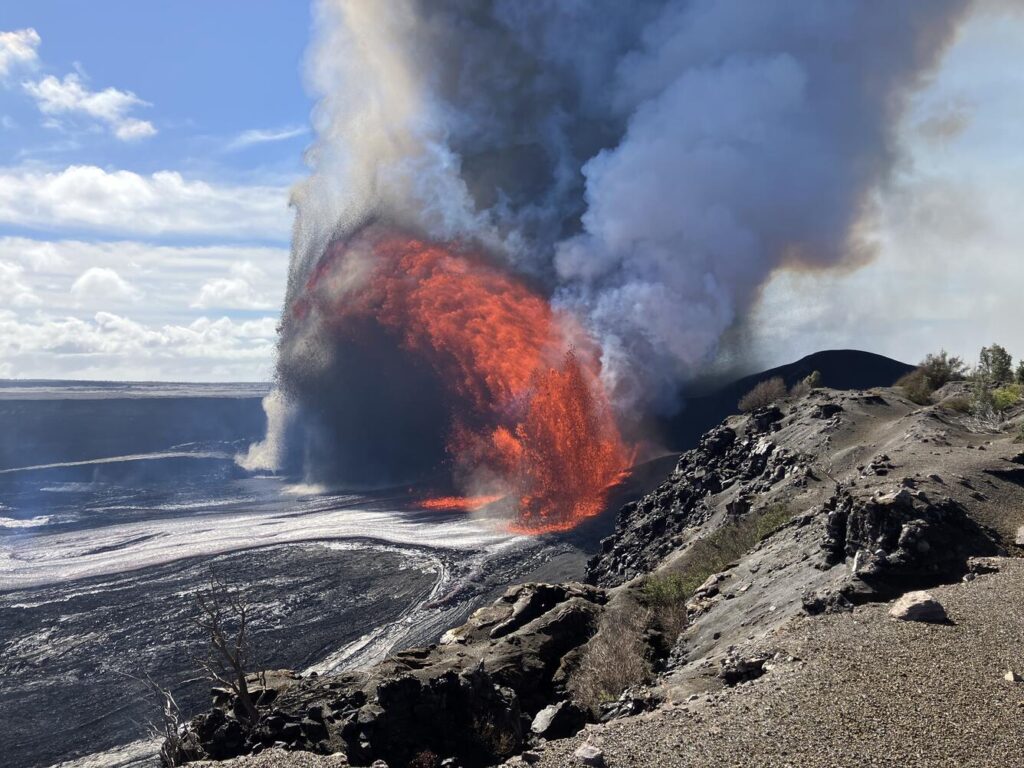
USGS and their scientists at the Hawaii Volcano Observatory (HVO) have updated their volcanic eruption forecast, now calling for lava to erupt from Kilauea at some point between Monday, December 22, and Saturday, December 27, next week. With the threat of an eruption in the coming days, the Volcano Alert level there is WATCH while the aviation color code is ORANGE.
Kilauea started to erupt at its summit last year on December 23; since then, it has had 38 eruptions with lava and volcanic debris shooting high into the sky with most.
The USGS Hawaiian Volcano Observatory (HVO) is responsible for issuing Aviation Codes and Volcanic Activity Alert Levels. Aviation Codes are green, yellow, orange, or red. When ground-based instrumentation is insufficient to establish that a volcano is at a typical background level of activity, it is simply “unassigned.” While green means typical activity associated with a non-eruptive state, yellow means a volcano is exhibiting signs of elevated unrest above known background levels. When a volcano exhibits heightened or escalating unrest with the increased potential of eruption, it jumps to orange. Finally, when an eruption is imminent with significant emission of volcanic ash expected in the atmosphere or an eruption is underway with significant emission of volcanic ash into the atmosphere, the code becomes red. Volcanic Activity Alert levels are normal, advisory, watch, or warning. As with aviation codes, if data is insufficient, it is simply labeled as “unassigned.” When the volcano is at typical background activity in a non-eruptive state, it is considered normal. If the volcano exhibits signs of elevated unrest above background level, an advisory is issued. If a volcano exhibits heightened or escalating unrest, a watch is issued while a warning is issued when a hazardous eruption is imminent.
In today’s update, HVO scientists said that glow continued overnight from a south vent with little to no glow from the north vent. Tremor is punctuated by pronounced spikes related to gas pistoning at regular intervals this morning, but otherwise nothing is out of the ordinary is going on for now while the eruption is paused. But since the end of eruption episode 38 which ended last week, Kīlauea has inflated 21.3 microradians as recorded on the UWD tiltmeter this morning with an increase of 1.4 microradians over yesterday. These tiltmeter readings are indicative of the volcano swelling with magma. Meanwhile, volcanic gas emissions have greatly decreased with the end of the eruption and are back in the normal range of 1200 to 1500 tonnes per day of SO2.
It was just last week on December 6 that one of the most significant events hit at Kilauea during this nearly year-long eruption period. The December 6 eruption featured 12.1 hours of sustained lava fountaining. The south vent fountain began at 8:49 AM local time and within 10-20 minutes all three fountains were about 500 feet high creating a rare triple fountain. By 9:40 am, the south vent fountain grew to about twice as high as the north vent fountains. According to USGS, the highest peak or instantaneous effusion rate of 1,300 cubic yards per second occurred just before 10 AM when the south vent exploded. The enlarged south vent produced an inclined fountain over 1,000 feet tall that sprayed the south wall of Halemaʻumaʻu crater.
Hot pumice and molten spatter from this fountain destroyed the HVO “V3” streaming camera site.
The south fountain gradually dropped in height throughout the afternoon to about 500 feet high along with declining effusion rates. Episode 38 ended with an average effusion rate of 250 cubic yards per second about 12 hours after it started. An estimated 16.5 million cubic yards or 12.6 million cubic meters of lava erupted and covered about 50-60% of the floor of Halemaʻumaʻu crater. The Uēkahuna tiltmeter recorded about 33.1 microradians of deflationary tilt during episode 38.
But it looks like episode 39 may be about to start before the end of the month. While not currently erupting, Kīlauea is showing moderate glow in the flow field and from cracks near the north vent.
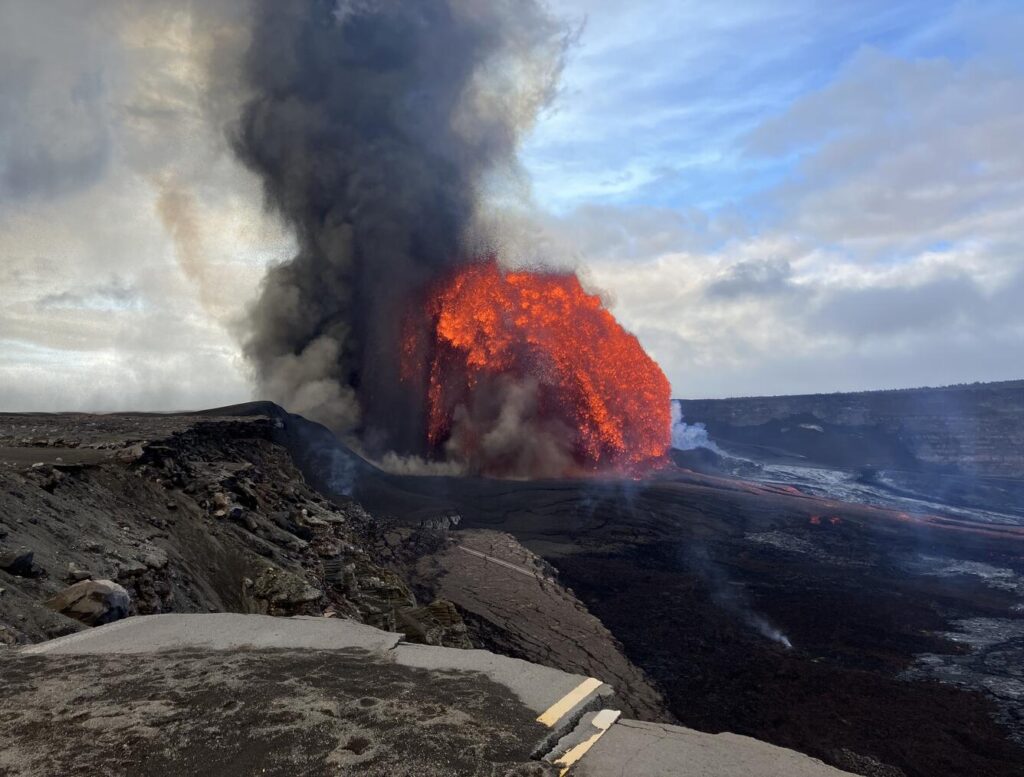
In today’s analysis, HVO wrote, “The rapid rebound of inflationary tilt, continued tremor indicative of gas pistoning, and glow from the south vent all indicate another fountain episode will occur. There are some discrepancies between the inflation models, but the onset of episode 39 is most likely between December 22 and 27. The forecast interval may change if the inflation rate varies.”
USGS continues to communicate the latest developments with local officials on the Big Island of Hawaii where Kilauea lives. Today they said they are “in contact with Hawai‘i Volcanoes National Park and the Hawai‘i County Civil Defense Agency about eruptive hazards.”
This episodic eruption is occurring within a closed area of Hawai’i Volcanoes National Park. High levels of volcanic gas—primarily water vapor (H2O), carbon dioxide (CO2), and sulfur dioxide (SO2)—are one major hazard of concern, as this hazard can have far-reaching effects downwind. As SO2 is continuously released from the summit during an eruption, it will react in the atmosphere to create the visible haze known as vog (volcanic smog) downwind of Kīlauea. SO2 and vog may cause respiratory and other problems at high concentrations. The vog is visible across much of Hawaii Island.
Before the next eruption, HVO is also advising people to be prepared: “Another major hazard is fallout of Pele’s hair and other volcanic fragments from lava fountains. Pele’s hair is strands of volcanic glass often produced by lava fountaining activity that can be carried well over 10 miles from the vent. Other hot glassy volcanic fragments including volcanic ash, pumice, scoria, and reticulite can fall on the ground within 1–3 miles of the eruptive vent(s), with the highest concentrations immediately downwind of the vent(s). Various volcanic fragments have fallen on Highway 11 west of Hawai’i Volcanoes National Park at times, depending on wind and eruption conditions. Strong winds may waft light particles, including Pele’s hair, to greater distances downwind. Once on the ground, Pele’s hair can sometimes cluster and tangle together, giving it the appearance of a tumbleweed. The extent of Pele’s hair deposition is dependent on lava fountaining activity and wind conditions. Residents and visitors should minimize exposure to Pele’s hair and other glassy volcanic fragments, which can cause skin and eye irritation and can also contaminate catchment water supplies. “
