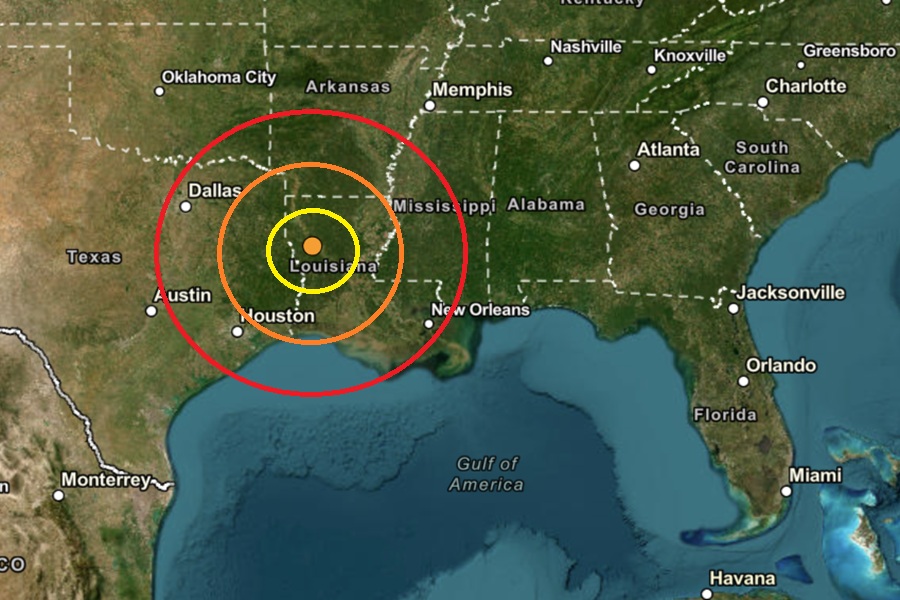
Another earthquake struck northwestern Louisiana this morning, shaking up the area in northwestern part of the state in time for breakfast. The 9:38 am earthquake struck near Powhatan which is between Alexandria and Shreveport, Louisiana. The magnitude 2.7 earthquake struck from a depth of 5 km. This is one of a series of earthquakes to rock the area in recent days and geologists say it’s likely due to fracking or oil/gas relates processes in the region.
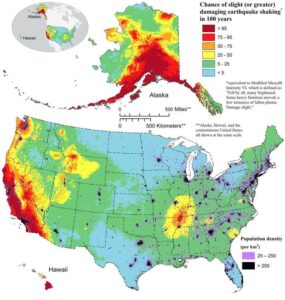
Fracking-generating earthquakes have been a concern in places like Oklahoma and could also become problematic for Louisiana. Beginning in 2009, Oklahoma experienced a surge in seismicity according to USGS. “This surge was so large that its rate of magnitude 3 and larger earthquakes exceeded California’s from 2014 through 2017,” writes USGS in a report analyzing the increase in seismicity here. “While these earthquakes have been induced by oil and gas related process, few of these earthquakes were induced by fracking. The largest earthquake known to be induced by hydraulic fracturing in Oklahoma was a M3.6 earthquakes in 2019. The largest known fracking induced earthquake in the United States was a M4.0 earthquake that occurred in Texas in 2018. The majority of earthquakes in Oklahoma are caused by the industrial practice known as “wastewater disposal”. Wastewater disposal is a separate process in which fluid waste from oil and gas production is injected deep underground far below ground water or drinking water aquifers. In Oklahoma over 90% of the wastewater that is injected is a byproduct of oil extraction process and not waste frack fluid.”
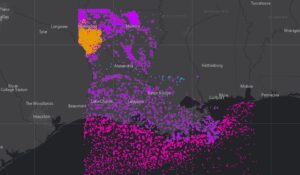
Over the last 3 weeks there have been 4 earthquakes Today’s earthquake was the weakest with the others rated as 3.1, 3.1, and 2.9 magnitude events.
According to USGS, earthquakes with a magnitude of 2.0 or less are rarely felt or heard by people, but once they exceed 2.0 , more and more people can feel them. While damage is possible with magnitude 3.0 events or greater, significant damage and casualties usually don’t occur until the magnitude of a seismic event rises to a 5.5 or greater rated event.
USGS says that his is not a seismically active part of the country. According to the Fractracker Alliance, though, the area of this seismicity is in an area rich of fracking and oil and gas production.
