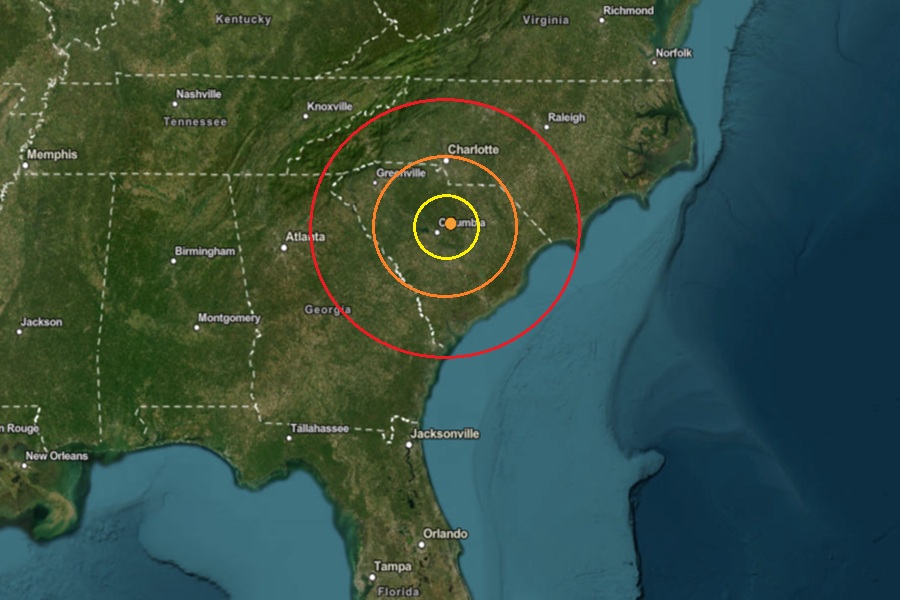
A fresh earthquake struck central South Carolina today, with hundreds of people reporting to USGS that they felt it. According to USGS, at 6:33 am this morning, a magnitude 2.7 earthquake struck the town of Elgin from a depth of 8.8 km; as of press time, 668 people reported to USGS via their online website reporting tool that they felt the earthquake. The area rattled by today’s earthquake has been seismically quiet for the last 3 weeks; beyond that, the area has been relatively quiet much of last year in the wake of an unusual swarm that impacted this very region in 2021, 2022, and 2023.
Earthquakes with a magnitude of 2.0 or less are rarely felt or heard by people, according to USGS, but once they exceed 2.0 more and more people can feel them. While damage is possible with magnitude 3.0 events or greater, significant damage and casualties usually don’t occur until the magnitude of a seismic event rises to a 5.5 or greater rated event.

On Monday, December 27, 2021 at 2:18 pm in the afternoon, an unusual earthquake struck in this same general area and the quakes have continued on and off since, with dozens reported in 2022 and 2023. That first 3.3 magnitude earthquake hit 30 miles north of Columbia, South Carolina at a depth of only 3.1 km. More than 3,100 residents reported to USGS they felt it at the time, with one report of shaking coming from as far away as Rock Hill, which is at the North/South Carolina state border. While many felt the earthquake, there was no reported damage in the Palmetto State. That earthquake was followed by 10 more ranging in intensity between a magnitude 1.5 to a magnitude 2.6 event. The second earthquake struck three hours twenty minutes after the first one. The last earthquake in that series struck on the morning of January 5, bringing a temporary end to the earthquakes there. But the swarm returned many times throughout 2022, rattling locals and unnerving local officials that weren’t sure of their source or cause.
According to USGS, a swarm is a sequence of mostly small earthquakes with no identifiable mainshock. “Swarms are usually short-lived, but they can continue for days, weeks, or sometimes even months,” USGS adds. However, the South Carolina event doesn’t fit the typical definition of a swarm since the first event was substantially larger than the rest.
USGS has been unable to say with certainty why either of these swarms northeast of Columbia are occurring.
According to the South Carolina Emergency Management Division (SCEMD), there are approximately 10-15 earthquakes every year in South Carolina, with most not felt by residents; on average, only 3-5 are felt each year. Most of South Carolina’s earthquakes are located in the Middleton Place-Summerville Seismic Zone. The two most significant historical earthquakes to occur in South Carolina were the 1886 Charleston-Summerville quake and the 1913 Union County quake. The 1886 earthquake in Charleston was the most damaging earthquake to ever occur in the eastern United States; it was also the most destructive earthquake in the U.S. during the 19th century.
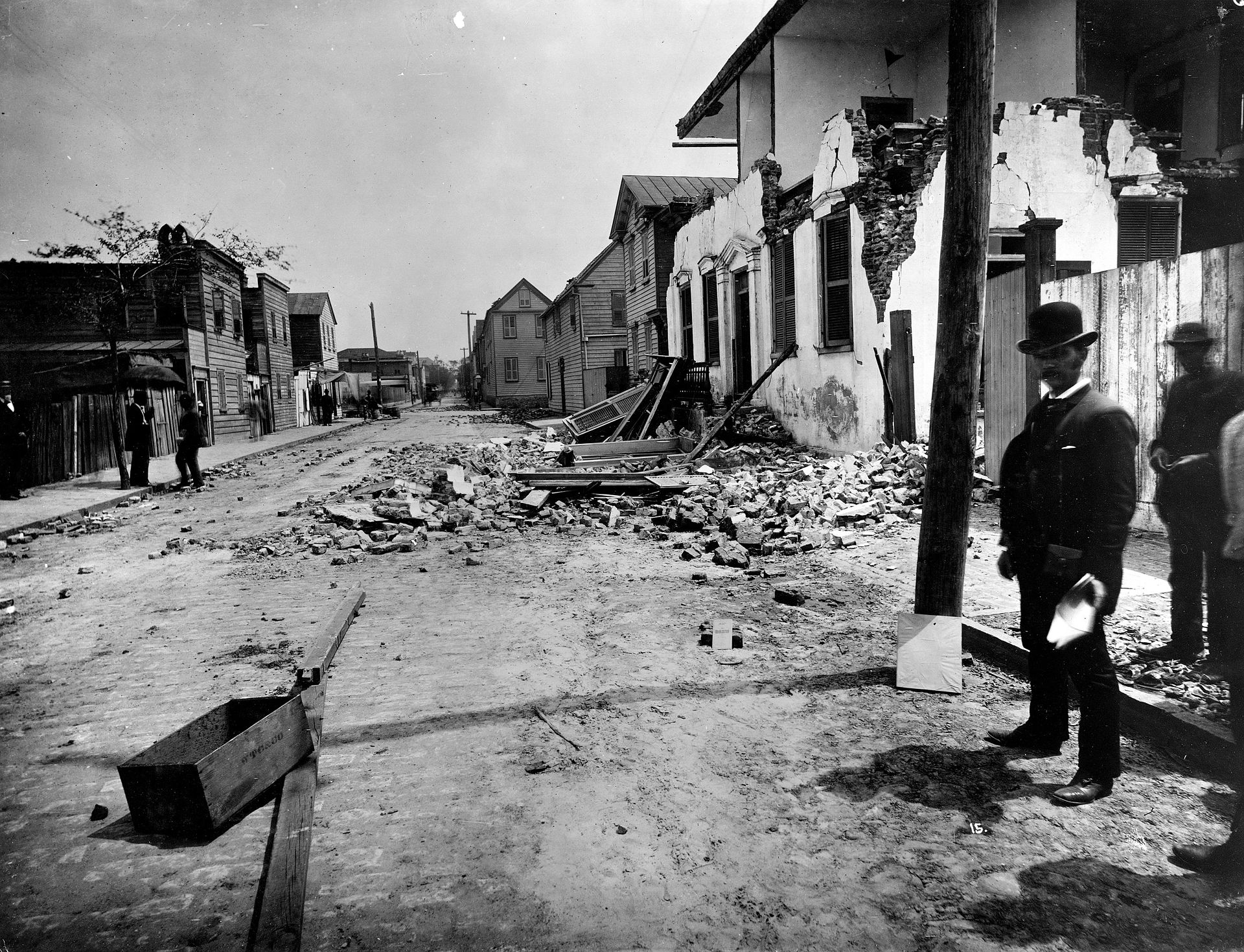
The 1886 earthquake struck at about 9:50 pm on August 31; it was estimated to have been rated a magnitude 6.9 – 7.3 seismic event. The earthquake was felt as far away as Boston, Massachusetts to the north, Chicago, Illinois and Milwaukee, Wisconsin, to the northwest, and New Orleans, Louisiana to the south. The earthquake energy even traveled as far away as Cuba and Bermuda, where some shaking was felt too. The initial earthquake lasted about 45 seconds.
The 1886 Charleston earthquake was responsible for 60 deaths and over $190 million (in 2023 dollars) in damage. The area of major damage extended out 60-100 miles from the epicenter, with some structural damage even reported in central Alabama, Ohio, eastern Kentucky, southern Virginia, and western West Virginia from the initial quake.
A study published in 2008 in the Journal of Geotechnical and Geoenvironmental Engineering hypothesized that if such an earthquake were to strike the region today, it would lead to approximately 900 deaths, 44,000 injuries, and damages in excess of $20 billion in South Carolina alone.
The initial earthquake was followed by an aftershock 10 minutes later; over the first 24 hours, seven additional strong aftershocks hit. Over the following 30 years, a total of 435 aftershocks were measured.
