• Skip to primary navigation
  • Skip to main content
  • Skip to primary sidebar

Weatherboy

Weatherboy Weather News, Maps, RADAR, Satellite, and Forecasts.

  • Local
  • Earth Science News
  • RADAR
  • Current Warnings
  • Satellite
  • Current Maps
  • Forecast Maps
  • Video

Pair of Earthquakes Shake North Carolina

by Weatherboy Team Meteorologist - March 24, 2026

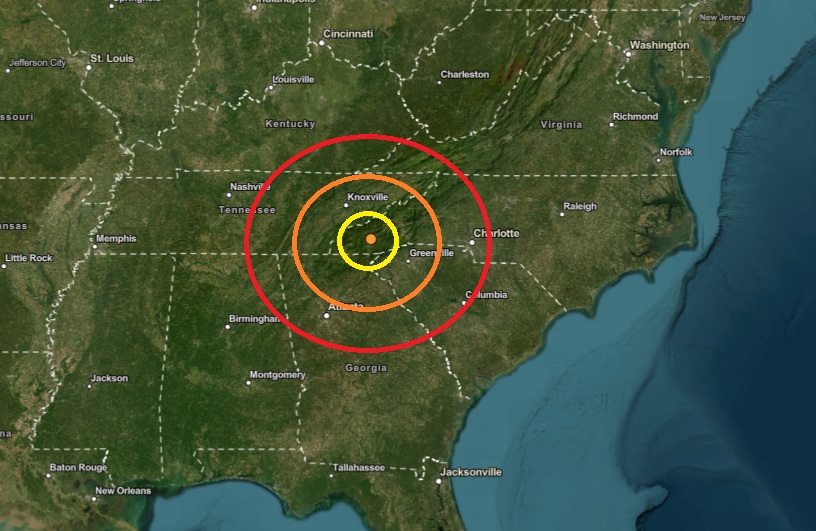
Both earthquakes struck near the orange dot on this map inside the colored concentric circles. Image: USGS

According to USGS, two earthquakes struck western North Carolina less than a mile apart from each other last night; both were relatively weak.  The first struck at 8:04 pm and was rated a magnitude 2.7 quake; it had a very shallow epicenter of only 0.1 km. The second struck at 11:22 pm; it was a magnitude 2.2 quake and also had a shallow depth of only 0.2 km. The earthquakes struck a seismically active area of western North Carolina.

According to USGS, earthquakes with a magnitude of 2.0 or less are rarely felt or heard by people, but once they exceed 2.0 , more and more people can feel them. While damage is possible with magnitude 3.0 events or greater, significant damage and casualties usually don’t occur until the magnitude of a seismic event rises to a 5.5 or greater rated event.
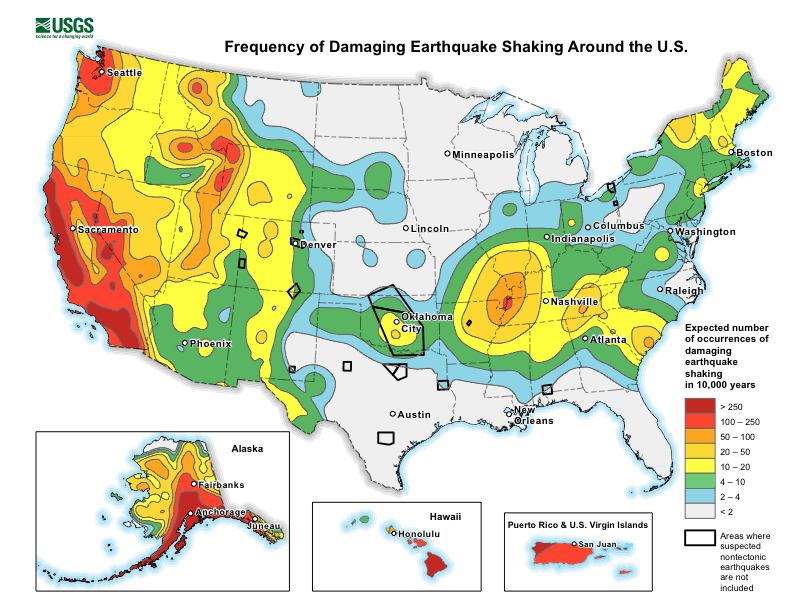
 

While the U.S. West Coast is best known for their earthquakes, there is considerable earthquake risk elsewhere in the country. Image: USGS
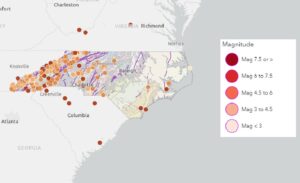
Noteable earthquakes in North Carolina from 1874-Present. Image: North Carolina Department of Environmental Quality

Earthquakes are not common in North Carolina, but they do occur, with most being small and not causing damage. While the state isn’t known for frequent or strong seismic activity, occasional tremors can be felt, and some larger earthquakes have been recorded in the past. While the mountains and foothills of western North Carolina are not located along an active tectonic plate boundary, the region still has minor earthquakes linked to old fault lines along the Appalachian Mountains.

According to the North Carolina Department of Environmental Quality, while North Carolina is no stranger to earthquakes, large, damaging earthquakes are rare. Large, damaging seismic events are rare and the few felt in North Carolina had epicenters outside of the state. Most quakes in North Carolina originate from the East Tennessee seismic zone to the west, the Charleston, South Carolina seismic zone to the south, or the Central Virginia seismic zone to the north.  The most common and strongest earthquakes to strike the state have been in the western part along the Appalachian Mountains.

Primary Sidebar

Sponsored Ad

Search

Latest News

  • Pair of Earthquakes Shake North Carolina
  • No East Coast Tsunami Threat from Magnitude 5.1 Mid Atlantic Ridge Earthquake
  • Winter Storm Warning Up in Hawaii as Kona Low Brings 10″ Snow, 60 mph+ Winds
  • PM Thunderstorms Breaking Out Across Pennsylvania And Nearby Areas
  • Morning Quake Rattles New York
  • Another Catastrophe in Hawaii; Epic Flooding, Heavy Snow Returns; Dam Failure Imminent; Evacuations Ordered
  • Overnight Earthquake Rattles Alabama
  • Today Wraps Up Winter; Spring 2026 Arrives Tomorrow
About | Careers | Contact | Contests
Terms | Privacy | Ad Choices
Weatherboy is a (R) Registered Trademark of isarithm LLC, All Rights Reserved.
All content herein is Copyright by Isarithm LLC 1997-2022

Insert/edit link

Enter the destination URL

Or link to existing content

    No search term specified. Showing recent items. Search or use up and down arrow keys to select an item.