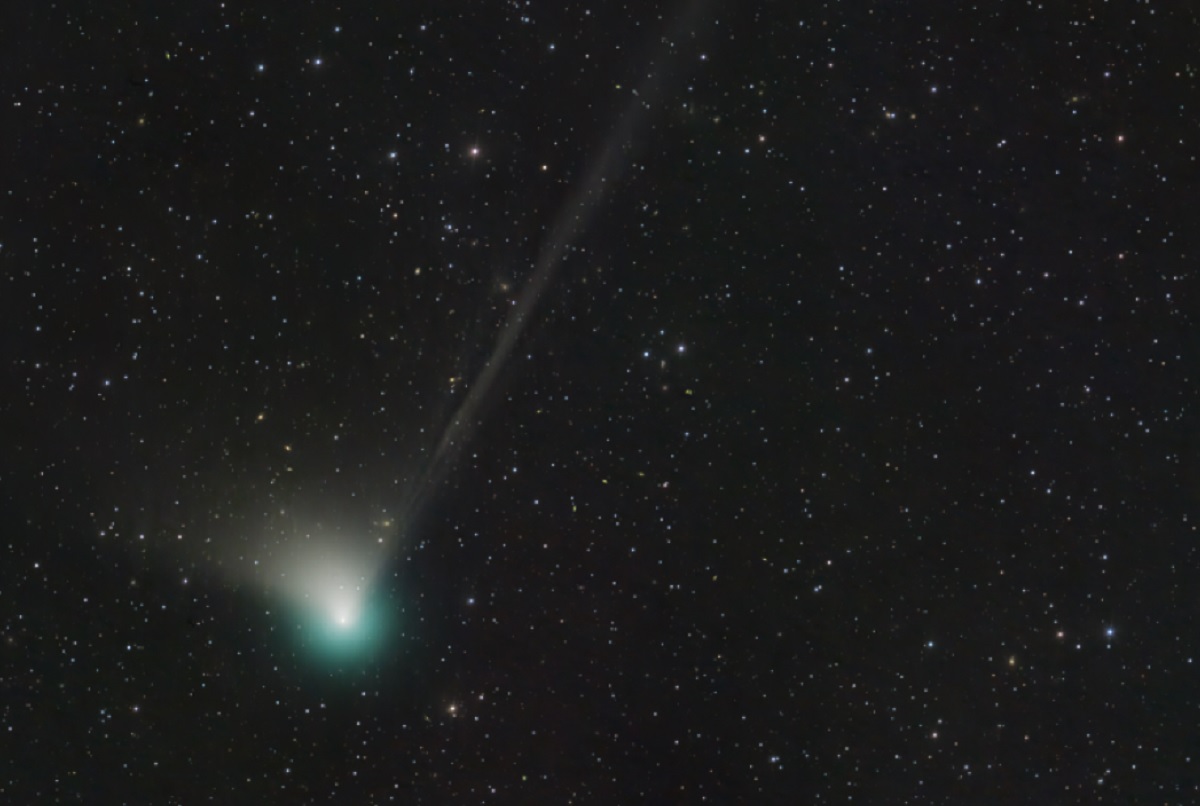
Look up tonight: a comet with a green hue will be making its most closest pass by Earth tonight, making it visible to the naked eye in skies free of light pollution and clouds. And if you miss it tonight, it’s unlikely you’ll ever see it again: it won’t pass Earth again for another 45,000 years.
Officially known as Comet C/2022 E3 (ZTF), it was discovered by astronomers using the wide-field survey camera at the Zwicky Transient Facility last year in early March. According to NASA, since that discovery, the new long-period comet has brightened substantially and is now sweeping across the northern constellation Corona Borealis in predawn skies.
Views via telescope show the comet’s brighter greenish coma, short broad dust tail, and a long faint ion tail stretching out in the night sky. On a voyage through the inner Solar System comet 2022 E3 will be at perihelion, its closest to the Sun, in the new year on January 12 and at perigee, its closest to Earth, later tonight. The comet will be located between the Big and Little Dippers, in the northern sky. Using binoculars or a telescope would help improve the view. The best time to view is during the early morning hours after moonset. While the comet will be at its closest point tonight, it will remain visible for the next few weeks.
The bright moon will be interfering with comet viewing as the moon heads toward its full phase, between February 3-5. While the comet will be moving away, more good viewing times will arrive after sunset before the moon rises between February 6 and 22.
The comet is green because its coma, the gassy shroud surrounding its nucleus, contains a reactive compound called diatomic carbon (C2), which is bright in green wavelengths of light. Human eyes do a poor job of differentiating color at night; for most, rather than appear green, it’ll simply appear as a small fuzzy ball in the sky. Using instruments like binoculars and telescopes will do a better job of showing off the comet’s true colors.
