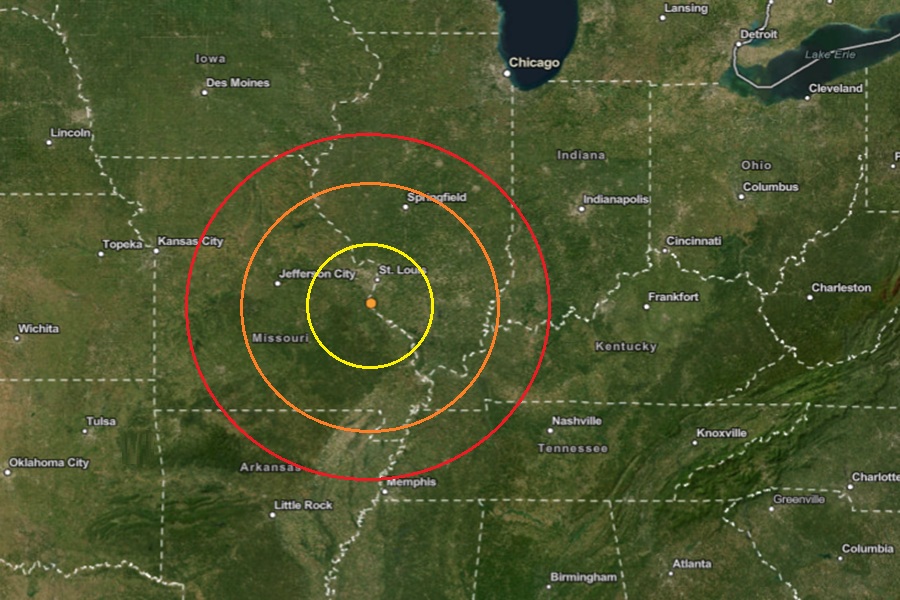
Another relatively weak earthquake rattled Illinois last night adding to other recent seismic events in the area. According to USGS, the magnitude 2.0 event struck near the Illinois/Missouri border near Monroe City which is south of St. Louis, Missouri. The earthquake, with a depth of 11.2 km, struck at 8:23 pm local time yesterday. People that reported they felt and/or heard the quake were in both states.
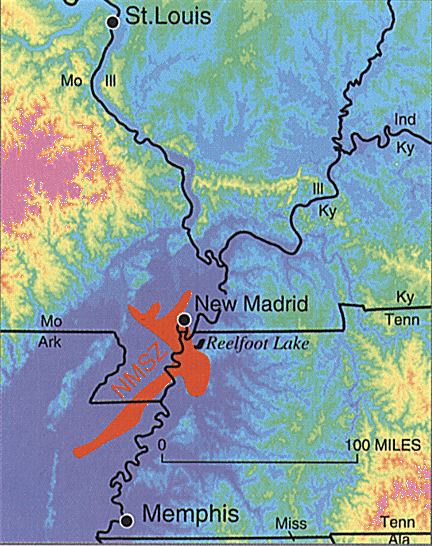
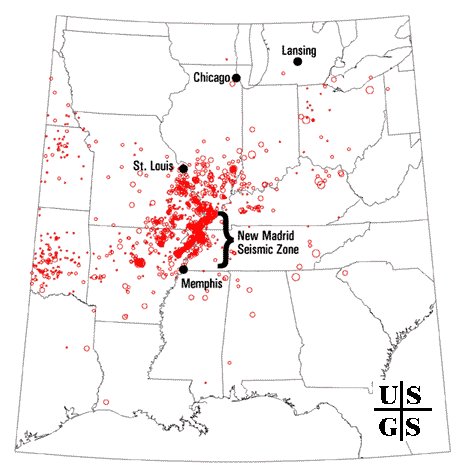
There have been steady earthquakes about 100 miles south, but that area is closer to the heart of the New Madrid Seismic Zone, or NMSZ for short, where seismic activity has been elevated in recent months.
Earthquakes with a magnitude of 2.0 or less are rarely felt or heard by people, according to USGS, but once they exceed 2.0 more and more people can feel them. While damage is possible with magnitude 3.0 events or greater, significant damage and casualties usually don’t occur until the magnitude of a seismic event rises to a 5.5 or greater rated event.
Illinois is at risk from two major seismic zones, the Wabash Valley Seismic Zone and the New Madrid Seismic Zone. The Wabash Valley Zone is located between southeastern Illinois and southwestern Indiana. According to USGS, the largest earthquake in recent years occurred on the Wabash Valley Seismic Zone. This earthquake registered a magnitude of 5.4 and occurred in Mt. Carmel, Illinois on April 18th, 2008.
But the NMSZ, which has seen recent seismic activity, is no stranger to big earthquakes. Over the winter of 1811-1812, a series of violent earthquakes struck the region. And scientists say more significant seismic events in this region will be repeated again.
While the US West Coast is well known for its seismic faults and potent quakes, many aren’t aware that one of the largest quakes to strike the country actually occurred near the Mississippi River. On December 16, 1811, at roughly 2:15am, a powerful 8.1 quake rocked northeast Arkansas in what is now known as the New Madrid Seismic Zone. The earthquake was felt over much of the eastern United States, shaking people out of bed in places like New York City, Washington, DC, and Charleston, SC. The ground shook for an unbelievably long 1-3 minutes in areas hit hard by the quake, such as Nashville, TN and Louisville, KY. Ground movements were so violent near the epicenter that liquefaction of the ground was observed, with dirt and water thrown into the air by tens of feet. President James Madison and his wife Dolly felt the quake in the White House while church bells rang in Boston due to the shaking there.
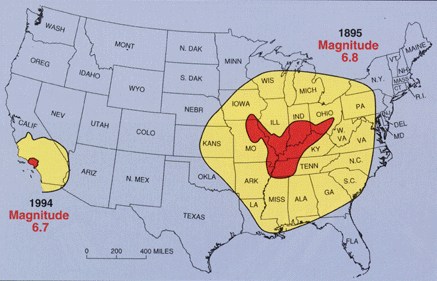
But the quakes didn’t end there. From December 16, 1811 through to March of 1812, there were over 2,000 earthquakes reported in the central Midwest with 6,000-10,000 earthquakes located in the “Bootheel” of Missouri where the New Madid Seismic Zone is centered.
The second principal shock, a magnitude 7.8, occurred in Missouri weeks later on January 23, 1812, and the third, a 8.8, struck on February 7, 1812, along the Reelfoot fault in Missouri and Tennessee.
The main earthquakes and the intense aftershocks created significant damage and some loss of life, although lack of scientific tools and news gathering of that era weren’t able to capture the full magnitude of what had actually happened. Beyond shaking, the quakes also were responsible for triggering unusual natural phenomena in the area: earthquake lights, seismically heated water, and earthquake smog.
Residents in the Mississippi Valley reported they saw lights flashing from the ground. Scientists believe this phenomena was “seismoluminescence”; this light is generated when quartz crystals in the ground are squeezed. The “earthquake lights” were triggered during the primary quakes and strong aftershocks.
Water thrown up into the air from the ground, or the nearby Mississippi River, was also unusually warm. Scientists speculate that intense shaking and the resulting friction led to the water to heat, similar to the way a microwave oven stimulates molecules to shake and generate heat. Other scientists believe as the quartz crystals were squeezed, the light they emit also helped warm the water.
During the strong quakes, the skies turned so dark that residents claimed lit lamps didn’t help illuminate the area; they also said the air smelled bad and was hard to breathe. Scientists speculate this “earthquake smog” was caused by dust particles rising up from the surface, combining with the eruption of warm water molecules into the cold winter air. The result was a steamy, dusty cloud that cloaked the areas dealing with the quake.
The February earthquake was so intense that boaters on the Mississippi River reported that the flow of the water there reversed for several hours.
The area remains seismically active and scientists believe another strong quake will impact the region again at some point in the future. Unfortunately, the science isn’t mature enough to tell whether that threat will arrive next week or in 50 years. Either way, with the population of New Madrid Seismic Zone huge compared to the sparsely populated area of the early 1800s, and tens of millions more living in an area that would experience significant ground shaking, there could be a very significant loss of life and property when another major quake strikes here again in the future.
