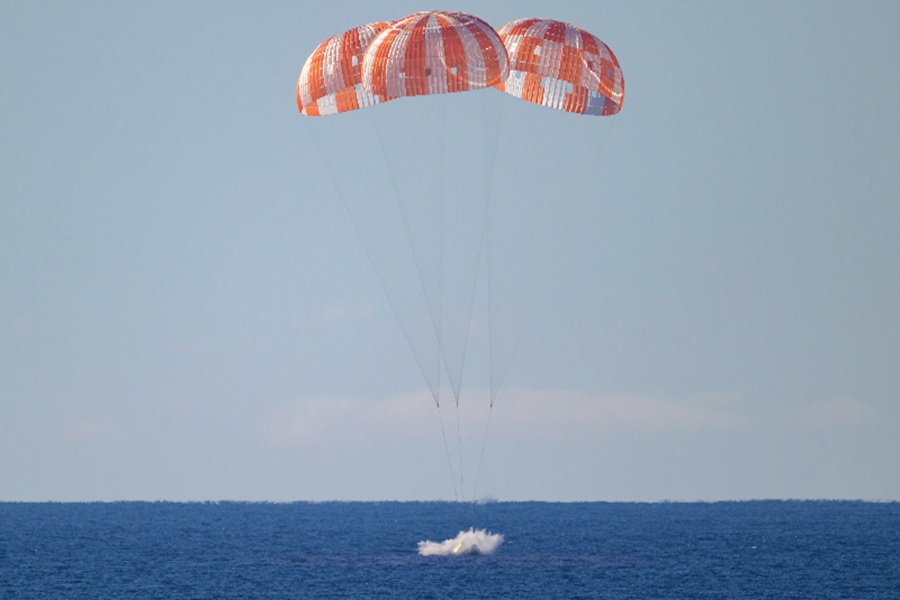
NASA’s Artemis II mission wrapped up a successful mission around the Moon by splashing down in the Pacific Ocean yesterday, wrapping up a crewed journey through space that broke human spaceflight records.
NASA astronauts Reid Wiseman, Victor Glover, and Christina Koch, and CSA (Canadian Space Agency) astronaut Jeremy Hansen splashed down at 5:07 pm Pacific Time Friday off the coast of San Diego, completing a nearly 10-day journey that took them 252,756 miles from home at their farthest distance from Earth. They traveled inside an Orion space capsule named Integrity.
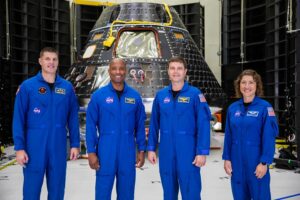
“Reid, Victor, Christina, and Jeremy, welcome home, and congratulations on a truly historic achievement. NASA is grateful to President Donald Trump and partners in Congress for providing the mandate and resources that made this mission and the future of Artemis possible,” said NASA Administrator Jared Isaacman. “Artemis II demonstrated extraordinary skill, courage, and dedication as the crew pushed Orion, SLS (Space Launch System), and human exploration farther than ever before. As the first astronauts to fly this rocket and spacecraft, the crew accepted significant risk in service of the knowledge gained and the future we are determined to build. NASA also acknowledges the contributions of the entire NASA workforce, along with our international partners, whose expertise and commitment were essential to this mission’s success. With Artemis II complete, focus now turns confidently toward assembling Artemis III and preparing to return to the lunar surface, build the base, and never give up the Moon again.”
After splashdown in the Pacific Ocean, the astronauts were met by a combined NASA and U.S. military team that assisted them out of the spacecraft in open water and transported them via helicopter to the USS John P. Murtha for initial medical checkouts. The crew members are expected to return to NASA’s Johnson Space Center in Houston on Saturday, April 11.
During their mission, Wiseman, Glover, Koch, and Hansen flew 694,481 miles in total. Their lunar flyby took them farther than any humans have ever traveled before, surpassing the previous distance record set by Apollo 13 astronauts in 1970.
During the first two days of their mission in space, the astronauts on-board Integrity checked-out Orion’s systems and performed a targeting demonstration test relatively close to Earth before beginning their trek toward the Moon. Integrity then broke free from Earth orbit and set course for the Moon. The trans-lunar injection burn sent the astronauts on an outbound trip of four days, taking them around the far side of the Moon. During the approximate four-day return trip, the crew continued to evaluate the spacecraft’s systems.
Artemis is the follow-up series of missions involving the Moon from the Apollo missions in the 1960s and 1970s. According to Greek mythology, Artemis was the daughter of Leto and Zeus, and the twin of Apollo. She is the goddess of the wilderness, the hunt and wild animals, and fertility; Artemis is also considered as one of the helpers of midwives as a goddess of birth. The original Moon landing project was known as the “Apollo Mission.”
In December of 2017, President Trump issued a directive to the National Aeronautics and Space Administration (NASA) to send American astronauts back to the moon and eventually to Mars, shifting the agency’s mission from the study of Earth and a longer-range plan to explore Mars. This marked a significant shift in space policy from the Obama administration, who had cut investment into human space flight to fund more climate change related work.
“Imagine the possibility waiting in those big beautiful stars if we dare to dream big. That’s what our country is doing again, we’re dreaming big,” the President said. “This is a giant step toward that inspiring future and toward reclaiming America’s proud destiny in space and space has so much to do with so many other applications including a military application.”
If this Artemis II mission is successful, NASA will work on Artemis III which is expected to launch during the middle of 2027. Artemis III will focus on testing human landing capabilities in low Earth orbit to prepare for future lunar surface operations. Then in early 2028, Artemis IV will be the first crewed landing of the Artemis program, with astronauts visiting the lunar South Pole.
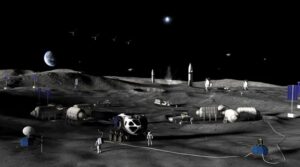
Just days ago, NASA announced a $20-billion, three-phase plan to build a permanent, human-occupied moon base near the lunar south pole by 2028. This accelerated plan, spurred by competition with China, prioritizes surface infrastructure over the previously planned lunar orbital station, utilizing robotic landers, nuclear power, and international partnerships.
“NASA is committed to achieving the near‑impossible once again, to return to the Moon before the end of President Trump’s term, build a Moon base, establish an enduring presence, and do the other things needed to ensure American leadership in space. This is why it is essential we leave an event like Ignition with complete alignment on the national imperative that is our collective mission. The clock is running in this great‑power competition, and success or failure will be measured in months, not years,” said NASA Administrator Jared Isaacman. “If we concentrate NASA’s extraordinary resources on the objectives of the National Space Policy, clear away needless obstacles that impede progress, and unleash the workforce and industrial might of our nation and partners, then returning to the Moon and building a base will seem pale in comparison to what we will be capable of accomplishing in the years ahead.”
