
USGS has issued a Volcano Watch for the Kilauea Volcano on the Big Island of Hawaii in Hawaii in the central Pacific; it is likely to be upgraded to a Volcano Warning soon. According to USGS scientists at the Hawaii Volcano Observatory (HVO), precursory low-level activity for the next eruption started at around 1:38 am local time with lava overflowing from the north vent in the summit caldera.
Due to this activity, HVO raised the Alert Level for Kīlauea from ADVISORY to WATCH and the Aviation Color Code from YELLOW to ORANGE.
“This low-level precursory activity can continue for hours to days before the lava fountaining episode beings,” says USGS. The forecast for the start of a lava fountaining event is officially predicted to begin between today and May 7.
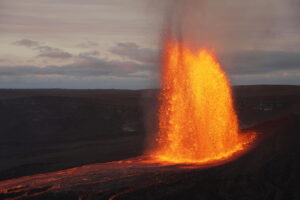
Kilauea has been erupting episodically since December 23, 2024, from two vents in Halema‘uma‘u. Lava fountaining episodes, which generally last for less than 12 hours, are separated by pauses that can be longer than three weeks. This next eruption which could happen at any time will be the 46th eruptive event of this cycle.
In the U.S., the USGS and volcano observatory units are responsible for issuing Aviation Codes and Volcanic Activity Alert Levels. Aviation Codes are green, yellow, orange, or red. When ground-based instrumentation is insufficient to establish that a volcano is at a typical background level of activity, it is simply “unassigned.” While green means typical activity associated with a non-eruptive state, yellow means a volcano is exhibiting signs of elevated unrest above known background levels. When a volcano exhibits heightened or escalating unrest with the increased potential of eruption, it jumps to orange. Finally, when an eruption is imminent with significant emission of volcanic ash expected in the atmosphere or an eruption is underway with significant emission of volcanic ash into the atmosphere, the code becomes red. Volcanic Activity Alert levels are normal, advisory, watch, or warning. As with aviation codes, if data is insufficient, it is simply labeled as “unassigned.” When the volcano is at typical background activity in a non-eruptive state, it is considered normal. If the volcano exhibits signs of elevated unrest above background level, an advisory is issued. If a volcano exhibits heightened or escalating unrest, a watch is issued while a warning is issued when a hazardous eruption is imminent.
