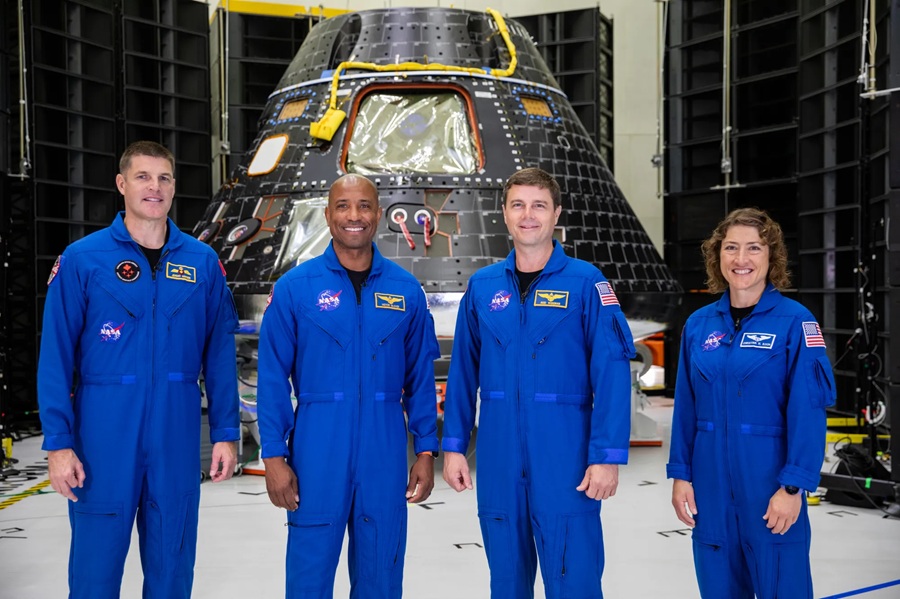
NASA astronauts are preparing to be launched from the Kennedy Space Center in Florida next week on their historic voyage to the Moon. Known as the Artemis II mission, this 10-day long space adventure will bring NASA astronauts Jeremy Hansen, Victor Glover, Reid Wiseman, and Christina Hammock Koch farther into space than any human before them. They’ll be traveling in the Orion capsule, named Integrity, which will be launched into space from Launch Complex 39B atop NASA’s mega Moon rocket, the Space Launch System. Launch is currently scheduled to occur at 6:24 pm Eastern Time on Wednesday, April 1. The launch has been delayed several times due to technical issues, with earlier launches set on February 5,6, and 8 and March 6 delayed to next week.

Over the course of about two days, the astronauts on-board Integrity will check out Orion’s systems and perform a targeting demonstration test relatively close to Earth before then beginning the trek toward the Moon. Next, Integrity will break free from Earth orbit set course for the Moon. This trans-lunar injection burn will send the astronauts on an outbound trip of about four days, taking them around the far side of the Moon, where they will ultimately create a figure eight extending more than 230,000 miles from Earth. At their maximum distance, the crew will fly 4,600 miles beyond the Moon. During the approximate four-day return trip, the astronauts will continue to evaluate the spacecraft’s systems. Finally, after 10 days, the crew will endure a high-speed, high-temperature re-entry through the Earth’s atmosphere, eventually splashing-down in the Pacific Ocean off the coast of San Diego. There, a recovery team of NASA and Department of Defense personnel will bring them back to shore. Before the journey ends, two records should be broken: this flight will take the crew farther from Earth than any previous human mission and will be re-entering the Earth’s atmosphere at a record speed of approximately 25,000 mph.
Artemis is the follow-up series of missions involving the Moon from the Apollo missions in the 1960s and 1970s. According to Greek mythology, Artemis was the daughter of Leto and Zeus, and the twin of Apollo. She is the goddess of the wilderness, the hunt and wild animals, and fertility; Artemis is also considered as one of the helpers of midwives as a goddess of birth. The original Moon landing project was known as the “Apollo Mission.”
In December of 2017, President Trump issued a directive to the National Aeronautics and Space Administration (NASA) to send American astronauts back to the moon and eventually to Mars, shifting the agency’s mission from the study of Earth and a longer-range plan to explore Mars. This marked a significant shift in space policy from the Obama administration, who had cut investment into human space flight to fund more climate change related work.
“Imagine the possibility waiting in those big beautiful stars if we dare to dream big. That’s what our country is doing again, we’re dreaming big,” the President said. “This is a giant step toward that inspiring future and toward reclaiming America’s proud destiny in space and space has so much to do with so many other applications including a military application.”
If this Artemis II mission is successful, NASA will work on Artemis III which is expected to launch during the middle of 2027. Artemis III will focus on testing human landing capabilities in low Earth orbit to prepare for future lunar surface operations. Then in early 2028, Artemis IV will be the first crewed landing of the Artemis program, with astronauts visiting the lunar South Pole.
Just days ago, NASA announced a $20-billion, three-phase plan to build a permanent, human-occupied moon base near the lunar south pole by 2028. This accelerated plan, spurred by competition with China, prioritizes surface infrastructure over the previously planned lunar orbital station, utilizing robotic landers, nuclear power, and international partnerships.
“NASA is committed to achieving the near‑impossible once again, to return to the Moon before the end of President Trump’s term, build a Moon base, establish an enduring presence, and do the other things needed to ensure American leadership in space. This is why it is essential we leave an event like Ignition with complete alignment on the national imperative that is our collective mission. The clock is running in this great‑power competition, and success or failure will be measured in months, not years,” said NASA Administrator Jared Isaacman. “If we concentrate NASA’s extraordinary resources on the objectives of the National Space Policy, clear away needless obstacles that impede progress, and unleash the workforce and industrial might of our nation and partners, then returning to the Moon and building a base will seem pale in comparison to what we will be capable of accomplishing in the years ahead.”
NASA Associate Administrator Amit Kshatriya said, “Today we are aligning NASA around the mission. On the Moon, we are shifting to a focused, phased architecture that builds capability landing by landing, incrementally, and in alignment with our industrial and international partners. In low Earth orbit (LEO), we are recognizing where the market is and where it isn’t, recognizing the incredible value of the International Space Station, and building a transition that builds a competitive commercial ecosystem rather than forcing a single outcome the market cannot support. In our science missions, we are opening the lunar surface to researchers and students nationwide, and with Space Reactor‑1 Freedom, we are finally putting nuclear propulsion on a trajectory out of the laboratory and into deep space. And this is all possible by investing in our people, bringing critical skills back into the agency, putting our teams where the machines are being built, and creating real pathways for the next generation of NASA leaders. Our workforce is the jewel of NASA, and from their leaders, they need clear mission goals, the tools to execute, and to get out of their way. This is what Ignition is about.”
