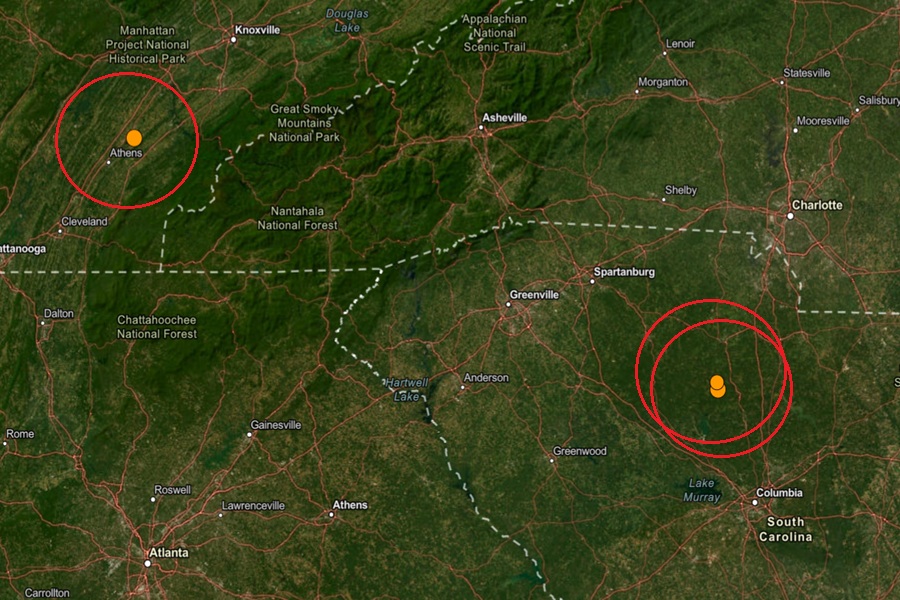
According to USGS, three earthquakes struck South Carolina and Tennessee over the last 24 hours. The first struck last night near Sweetwater, Tennessee while the next two struck just miles apart north and west of Columbia, South Carolina, during the early morning hours today. While the two South Carolina earthquakes are likely related to each other, the earthquake in Tennessee is too far away to be related to the South Carolina shaking.
The Tennessee earthquake rattled eastern Tennessee near the town of Sweetwater which is half way between Chattanooga and Knoxville.
Rated as a magnitude 2.1 seismic event, it was too weak to create any damages or injuries.
The earthquake struck at 10:43 pm from a depth of 23.4 km.
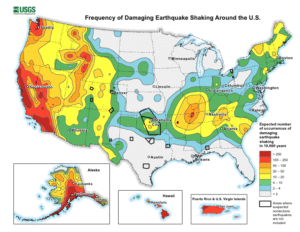
Earthquakes like the one that hit overnight in the eastern part of Tennessee are unlikely associated with the New Madrid Seismic Zone, an area of ongoing seismic activity located near the Mississippi River. However, while USGS says western Tennessee has a higher frequency of damaging earthquake shaking, the risk isn’t that low in eastern Tennessee. In the area of this most recent quake, USGS says its likely this area would see 50-100 damaging earthquakes over 10,000 years. While this number is low, it is much higher than it is elsewhere in the eastern half of the United States, where it’s likely to have 10 or less earthquakes over the same period.
The two earthquakes which struck South Carolina today were stronger than the one that hit Tennessee earlier. The first struck from a depth of 5.5 km at 5:18 am; it was rated a magnitude 2.3 earthquake; it was followed by an earthquake just a few miles away at 6:24 am; it was rated a magnitude 1.7 seismic event. The second earthquake’s epicenter was shallow at 1.8 km.
According to USGS, quakes with a magnitude of 2.0 or less are rarely felt or heard by people, but once they exceed 2.0 , more and more people can feel them. While damage is possible with magnitude 3.0 events or greater, significant damage and casualties usually don’t occur until the magnitude of a seismic event rises to a 5.5 or greater rated event.
According to the South Carolina Emergency Management Division (SCEMD), approximately 10 to 15 earthquakes are recorded annually in South Carolina with 3 to 5 of them felt or noticed by people. About 70 percent of South Carolina earthquakes are located in the Middleton Place-Summerville Seismic Zone. The two most significant historical earthquakes to occur in South Carolina were the 1886 Charleston/Summerville earthquake and the 1913 Union County earthquake. The 1886 earthquake in Charleston was the most damaging earthquake to ever occur in the eastern United States. In terms of lives lost, human suffering and devastation, this was the most destructive United States earthquake in the 19th century.
SCEMD says, “Earthquakes in South Carolina have the potential to cause great and sudden loss because devastation can occur in minutes. While there have not been any large-scale earthquakes in South Carolina in recent years, a 2001 study (Comprehensive Seismic Risk and Vulnerability Study for the State of South Carolina) confirmed the state is extremely vulnerable to earthquake activity.” That study probed the potential impacts of earthquakes on the current population and on contemporary structures and systems, including roadways, bridges, homes, commercial and government buildings, schools, hospitals and water and sewer facilities.
