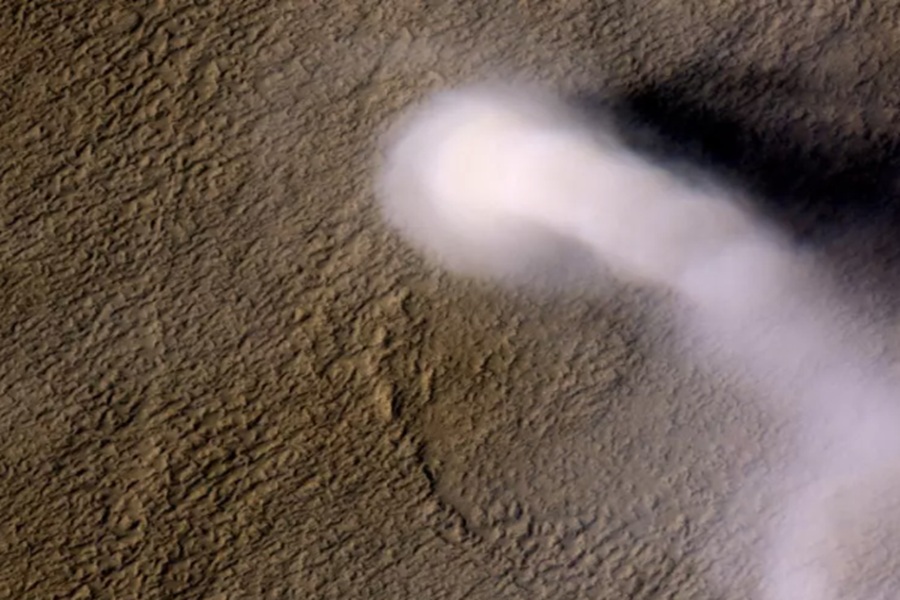
Leveraging the sophisticated equipment on-board NASA’s Perseverance’s rover on the surface of Mars, scientists believe they’ve identified a freak thunderstorm phenomena on the red planet. They’ve published their findings in the latest issue of Nature in an article entitled, ” Detection of triboelectric discharges during dust events on Mars.”
Unlike a traditional Earth thunderstorm that develops in the water-rich atmosphere here, small bolts of lightning are discharged in whirling dust devils found on the dry, dusty surface of Mars.
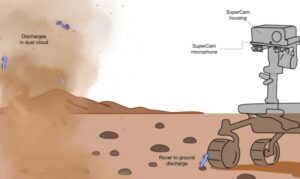
The microphone on Perseverance picked up signs of electrical arcs followed by audible shockwaves. And unlike the dramatic bolts of lightning on Earth that can extend 2-3 miles or more, these lightning flashes on Mars are tiny, extending just a few centimeters long.
A triboelectric discharge is the sudden and rapid flow of static electricity that occurs when two objects, charged by the triboelectric effect, come into contact. This discharge is the same phenomenon as the static shock you feel after walking across a carpet and touching a metal doorknob. It happens because friction or contact between two different materials causes an imbalance of electrons, leading to a buildup of a large static electric charge that then releases suddenly.
Scientists heard the snap and crackle of such electric discharges after listening to the feed from the “SuperCam” microphone on the rover.
In addition to hearing the lightning, the Rover also measured other meteorological conditions that happened with each mini-strike. In almost all instances, there were moderate to strong winds with a dust storm or dust devil nearby.
A team of scientists led by planetary scientist Baptiste Chide from the University of Toulouse in France, analyzed the microphone data to develop their findings. They went through 28 hours worth of microphone recordings to identify the thunder generated by these tiny bolts of lightning, identifying 55 events which occurred over a 2 year period. Of the 55 events, 7 captured the full acoustic signature including a tiny sonic boom which produced an equally tiny clap of thunder. Based on six of the seven recorded thunderclaps, most discharges were tiny, just 0.1 to 150 nanojoules; on Earth, typical bolts contain about 5 billion joules which is roughly 499,999,999,999,999,900 nanojoules, which underscores just how tiny these little bolts are.
