
The Kilauea Volcano experienced a significant eruption in the middle of a Major Winter Storm, prompting the National Weather Service and USGS to issue a variety of advisories and warnings for the Big Island of Hawaii. The eruption, the 44th of an ongoing series that started on December 23, 2024. Flooding rains and heavy snow fell from the winter storm while volcanic ash and tephra fell from the volcanic eruption.
According to USGS, lava fountaining stopped at 7:41 pm on April 9, 2026, after 8 hours and 31 minutes of continuous lava fountaining from the north vent at Kilauea’s summit caldera. The highest peak or instantaneous effusion rate of just over 500 cubic yards per second occurred around 12:30 pm with an overall average effusion rate of 260 cubic yards per second, with an estimated 7.5 million cubic yards of lava erupted and covering about 50% of the Halemaʻumaʻu crater floor.
The single lava fountain during this eruption episode produced significant heat and ash, feeding a plume that reached a maximum height of about 15,000 feet above sea level by 1:30 pm. Southerly winds directed the plume and tephra fall to the north of Halemaʻumaʻu.

When an ashfall incident is imminent due to some type of explosion at the volcano, the National Weather Service office in Honolulu will issue one of three types of products. The first is a Special Weather Statement. A Special Weather Statement is issued when there is the potential for trace amounts of accumulating ash. When there’s a chance of a more significant ashfall, from over a trace to up to 1/4″, the National Weather Service will then issue an Ashfall Advisory. And if a heavy ashfall is expected with accumulations greater than 1/4″, an Ashfall Warning is issued.
When any of these products are issued, the National Weather Service encourages people to avoid ash. “Avoid excessive exposure to ash which is an eye and respiratory irritant,” the Special Weather Statement text reads. “Those with respiratory sensitivities should take extra precaution to minimize exposure.”
At the start of the eruption, the National Weather Service issued a Special Weather Statement but as the eruption progressed, it was upgraded to an Ashfall Warning.
While lava from the eruption has remained inside Kilauea’s caldera crater, fallout of volcanic debris can travel far away due to the creation of Pele’s hair and other volcanic fragments from erupting lava fountains. “Pele’s hair” describes the strands of volcanic glass often produced by lava fountaining activity that can be carried well over 10 miles from the vent. Other hot glassy volcanic fragments (tephra) including volcanic ash, pumice, scoria, and reticulite can fall on the ground within 1–3 miles of the eruptive vent, with the highest concentrations immediately downwind of the vent. Various volcanic fragments have fallen on Highway 11 west of Hawai’i Volcanoes National Park at times, depending on wind and eruption conditions. Strong winds may waft light particles, including Pele’s hair, to greater distances downwind. Once on the ground, Pele’s hair can sometimes cluster and tangle together, giving it the appearance of a tumbleweed. The extent of Pele’s hair deposition is dependent on lava fountaining activity and wind conditions.
While the threat of volcanic fall out has passed due to the end of the 44th eruptive episode, other meteorological hazards remain in Hawaii.
Beyond the Big Island of Hawaii where Kilauea Volcano is, the island of Kauai in Kauai County, the island of Niihau in Kauai County, Oahu, Maui, Molokai, Lanai, and Kahoolawe are all under a Flash Flood Watch through this afternoon.
The National Weather Service warns, “Significant flooding may occur due to excessive rainfall and overflow of streams and drainages. Roads in several areas may be closed, along with property damage in urban or low lying spots due to runoff. Landslides may also occur in areas with steep terrain.”
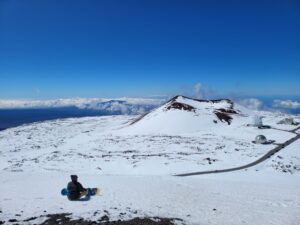
As heavy rains soak lower elevations, snow and freezing rain falls at the colder, higher volcanic peaks of Mauna Loa and Mauna Kea on the Big Island. While most people don’t associate the tropical paradise Hawaii is known for with snow, they’re surprised to learn that it does snow in the winter due to the elevation of its volcanic peaks. Mauna Kea is the highest of the bunch at 13,803 feet. Maui’s Haleakala is much lower at 10,023 feet. Because of that difference, Hawaii Island will see snow more frequently than the lower peak of Maui Island. Just one storm in January 2020 dropped 2-3 feet of snow on Hawaii Island and created snow drifts that were far deeper. Another storm in 2021 brought snowboarders and skiers out to the mountain by the dozens.
With the threat of winter weather, the National Weather Service has issued a Winter Weather Advisory for the highest elevations of the Big Island. Snow and freezing rain is likely there, with additional snow accumulations up to 4″ and ice accumulation up to a quarter inch possible. It will also be very windy in these colder areas, with winds gusting up to 60 mph at times.
The National Weather Service says the main axis of showers will slide east today with conditions improving from west to east through Saturday. However, they caution that another active period appears possible from Sunday through early next week.
