
NASA hosted a special press conference today to unveil images and to answer questions around the mysterious interstellar 3I/Atlas object that’s caught the attention of the public and the imagination of some scientists that believe this may be an alien spacecraft. But for those looking for concrete answers on what the object is, they left disappointed with NASA only sharing very blurry or very pixelated images of the distant object …and offering no conclusive evidence of what the object is, other than it is probably a comet.
Ahead of the press conference, NASA had said, “Assets within NASA’s science missions give the United States the unique capability to observe 3I/ATLAS almost the entire time it passes through our celestial neighborhood, and study – with complementary scientific instruments and from different directions – how the comet behaves. These assets include both spacecraft across the solar system, as well as ground-based observatories.”
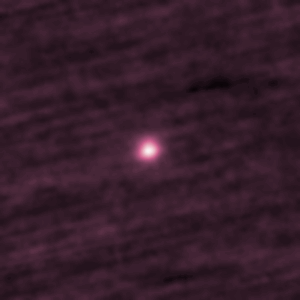
This mysterious object was discovered on July 1, 2025 by the NASA-funded ATLAS survey telescope at Río Hurtado, Chile. This newly discovered object was entering the inner Solar System at a speed of 140,000 mph relative to the Sun and was located 325 million miles from Earth. It was initially moving in the sky along the border of the constellations Serpens Cauda and Sagittarius, near the galactic plane. These initial observations initially suggested that the object could be on a highly eccentric path that might come close to Earth’s orbit, which led the International Astronomical Union Minor Planet Center to list the object on the Near-Earth Object Confirmation Page until the orbit could be confirmed. Because it is the third confirmed interstellar object passing through the Solar System, it was given the prefix “3 I” after 2I, known as Borisov, and 1I known as ‘Oumaumua.
However, the interstellar object is not behaving like a typical comet. The object had an unexplained increase in speed after passing close to the Sun. And unlike normal comets, 3I/ATLAS shows no visible gas or dust emissions that could explain its acceleration. If anything, it is exhibiting unusual jets both towards and away from the Sun which also defies expectations of a comet.
One scientists that has been very vocal about this interstellar object is Avi Loeb; he believes it may be an alien spacecraft. Avi Loeb is the head of the Galileo Project, founding director of Harvard University’s Black Hole Initiative, director of the Institute for Theory and Computation at the Harvard-Smithsonian Center for Astrophysics, and the former chair of the astronomy department at Harvard University (2011–2020). He is a former member of the President’s Council of Advisors on Science and Technology and a former chair of the Board on Physics and Astronomy of the National Academies. He is the bestselling author of “Extraterrestrial: The First Sign of Intelligent Life Beyond Earth” and a co-author of the textbook “Life in the Cosmos”, both published in 2021. The paperback edition of his new book, titled “Interstellar”, was published in August 2024.
The famous astrophysicist continues to publish on his blog on Medium his thoughts on this new object, including things that suggest it’s more of a manufactured object than a natural comet. His posts on Medium can be found here: https://avi-loeb.medium.com/
There is a lot of debate on social media on not only the quality of imagery released by NASA today on 3I/Atlas, but the level of detail, or lack thereof, in today’s press conference. https://t.co/m0uYvwVq9V
— the Weatherboy (@theWeatherboy) November 20, 2025
“Given the large-scale jets reported recently, the fact that 3I/ATLAS remains a single body is surprising for a natural comet. In particular, the large-scale image of 3I/ATLAS reported here on November 9, 2025 shows jets reaching out to ~1 million kilometers towards the Sun and ~3 million kilometers in the opposite direction, as discussed here. For a natural comet, the outflow velocity of the jets is expected to be 0.4 kilometers per second, of order the sound speed of gas at the distance of 3I/ATLAS from the Sun. At that speed, the jets must have persisted over a timescale of 1–3 months,” writes Loeb. He also adds later in his entry, “Technological thrusters which point their exhaust towards the Sun would accelerate away from the Sun. This post-perihelion maneuver might be employed by a spacecraft that aims to gain speed rather than slow down through the gravitational assist from the Sun,” writes Loeb.
NASA hasn’t been forthcoming with imagery or analysis of this interstellar object in recent weeks. With a lack of answers and pictures, Representative Anna Paulina Luna sent a request on Congressional letterhead on October 31 asking the Acting NASA Director for the agency to release its photographs and knowledge of the mystery object. Sources at NASA said they were unable to respond and were unable to review and process images due to the government shut-down.
There is more pressure for the science community to share images and insights around the mysterious 3I/Atlas object, including from Congress: https://t.co/pP5GDLYUGD
— the Weatherboy (@theWeatherboy) November 6, 2025
NASA’s representatives should have emphasized what we do not understand about 3I/ATLAS rather than insist that it is a familiar comet from a new birth environment. They stated that 3I/ATLAS does what comets do, namely shed gas and dust and responds to gravity. But a spacecraft that collected dust and CO2, CO & H2O ices on its surface by traveling through the cold interstellar medium could have also developed an outer layer of dust mixed with ices that sublimate when illuminated by sunlight. We should not “judge a book by its cover,” because we all know about the Trojan Horse which appeared unthreatening to the guardians of the City of Troy. When monitoring an interstellar visitor, we should not fall prey to traditional thinking but scrutinize new interpretations. The public resonates with science as a learning experience, where the collection of evidence leads the way to new knowledge rather than reinforces variants on past knowledge.”
Loeb folded in a Sherlock Holmes to conclude his thought: “Sherlock Holmes noted: “There is nothing more deceptive than an obvious fact.” He also observed: “It is a capital mistake to theorize before one has data. Insensibly one begins to twist facts to suit theories, instead of theories to suit facts.” I wish NASA’s representatives shared this wisdom.”
Loeb concluded, “Life is worth living if we allow for the unexpected to surprise us. Bureaucrats or unimaginative scientists want us to believe in the expected. But the rest of us know that the best is yet to come.”
In the coming weeks, 3I/Atlas will continue to move closer to Earth, reaching its closest point on December 19. As the object approaches, a variety of space and ground based equipment will be able to take more high-resolution imagery of the interstellar object. Scientists like Loeb hope the more detailed imagery coming out in the days and weeks ahead will finally confirm what this object really is.
