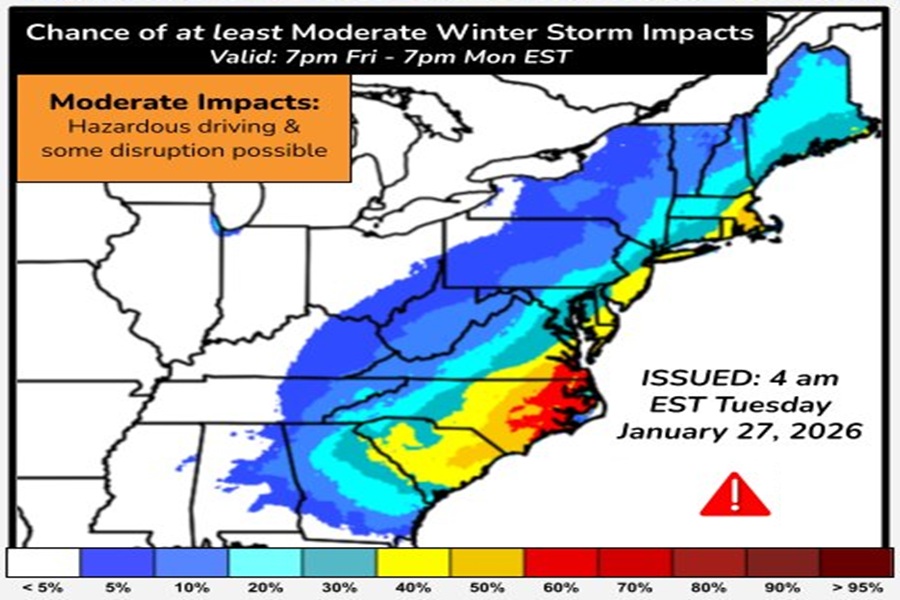
While the forecast isn’t yet crystal clear, the National Weather Service and it’s Weather Prediction Center unit want people to know about the possibility of a weekend east coast snowstorm threat that could bring blizzard conditions to some areas.
According to meteorologists at the Weather Prediction Center (WPC), recent model guidance remains generally agreeable overall across the lower 48 and specifically with regards to impactful coastal storm development along the East Coast this weekend. The notable recent trend across multiple leading global computer forecast models is towards a stronger upper-low and a much deeper coastal low, with the increasing potential of wintry precipitation and wind/wave impacts for the East Coast.
“However, despite the notable agreement on the intensifying system, subtle differences in the track off the coast not surprisingly lead to a lot more uncertainty with respect to the potential impacts,” writes the WPC in their latest Forecast Discussion. “For now, the greatest consensus amongst the guidance is for coastal areas and possibly further inland across the Carolinas and southern New England, with more uncertainty through the Mid-Atlantic.”
National Weather Service local offices are keeping a watchful eye on the prospects of a weekend snowstorm too.
In Mount Holly, New Jersey, the National Weather Service office there said in this morning’s forecast discussion, “We are monitoring the potential for a coastal storm next weekend. While forecast confidence regarding specific impacts remains low, there are concerns the storm may track close enough to the region to bring at least some impacts to portions of our forecast area.”
In New York City’s local office, the National Weather Service says, “…Deterministic guidance suggests a very near miss for most of our area, with perhaps eastern portions of the area getting brushed with some snow and wind. However, there remain enough ensemble members…that remain on the western half of the forecast envelope that it would be too soon to write this off and to say with any confidence what any impacts may be.”
The meteorologists at the Boston office of the National Weather Service are also waiting for additional data on the storm. In this morning’s forecast discussion, they write, “…there are otherwise still too many uncertainties at this Day-6 timeframe that need to be ironed out. It thus remains way too early to lock into any potential outcome at this time – ranging from a significant slow-moving winter storm to a dry pass offshore.”
In Wakefield, Virginia, where the National Weather Service office handles forecasts and advisories for eastern Virginia and Maryland, meteorologists say there odds are increasing for accumulating snow over the weekend. “Probabilities for accumulating snow have slightly increased for the weekend system (overall). Confidence in the storm developing is higher than before but the precise track and impacts of this storm remains low at this range,” they write in their latest forecast discussion.
“Couldn’t ask for a better synoptic setup,” writes the National Weather Service office for Washington DC and Baltimore, which details a very favorable storm patten in terms of analogs for big snows in the Mid-Atlantic this weekend. They say a 50/50 low, negative NAO, a ridge of high pressure in Idaho, blocking over Hudson Bay, and a trough moving into the eastern Pacific are factors that create a great set-up for a major east coast snowstorm. However, they add this is a highly sensitive pattern and more analysis needs to be performed to see if the ingredients will come together in time to create a blockbuster east coast storm.
The WPC boils things down to 3 key things they do know and 3 things they don’t.
For “What We Know,” the WPC knows there will be 1) continued very cold temperatures in the eastern U.S. into next week, 2) a strong surface low-pressure system is expected to rapidly develop off the southeast coast on Saturday and move off the Mid Atlantic Sunday, prompting widespread gusty winds, and 3) this surface low interacting with the very cold air mass will result in widespread heavy precipitation.
For “What We Don’t Know”, the WPC says they don’t know 1) the exact track and strength of the surface low, which will determine the precipitation type (rain/snow/mix) and where/how much precipitation occurs, 2) the impacts to travel and infrastructure due to the combinations of snow and wind, and 3) the impacts to coastal regions due to strong winds, rough surf, and timing coincident with astronomical high tide.
