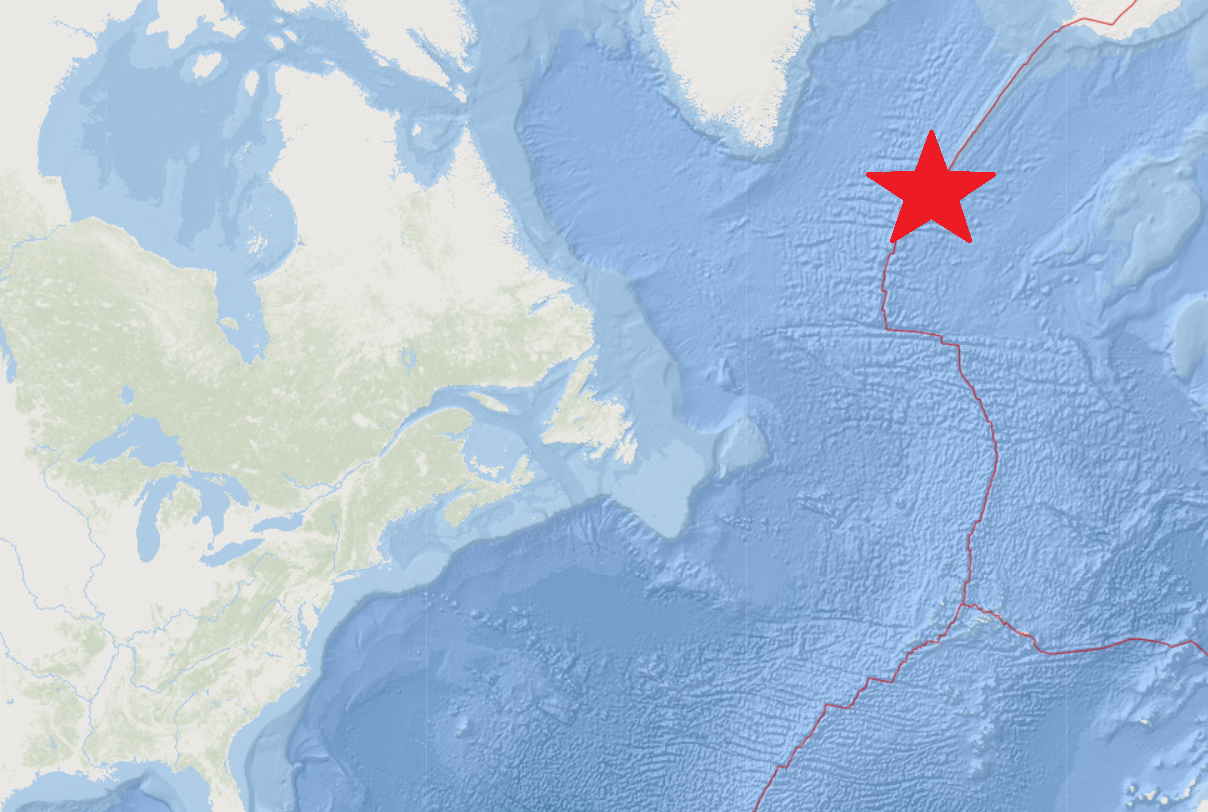
USGS reports that a moderate earthquake has struck under the North Atlantic Ocean; fortunately, there is no threat of tsunami at this time from this earthquake along the U.S. East Coast or Europe. The 4.9 earthquake struck along the Reykjanes Ridge southeast of Greenland and southwest of Iceland in the North Atlantic.
Today’s earthquake, which struck at 9:31 pm ET, was located at 58.305 North 32.124 West at a depth of 10 km.
The earthquake was not strong enough to generate a tsunami.
This earthquake struck along the northern portion of the Mid Atlantic Ridge in the central Atlantic between the North American plate and the Eurasian Plate; the African Plate is south of today’s earthquake’s epicenter.
These plates are based on the scientific theory of Plate Tectonics, which describes the large-scale motion of plates making up the Earth’s lithosphere. Scientists believe tectonic processes began on Earth between 3.3 and 3.5 billion years, building upon the concept of continental drift, a scientific concept developed in the early part of the 20th century. Continental drift is the gradual movement of the continents across the Earth’s surface through geological times.

Tsunamis are giant waves caused by earthquakes or volcanic eruptions under the sea. Out in the depths of the ocean, tsunami waves do not dramatically increase in height. But as the waves travel inland, they build up to higher and higher heights as the depth of the ocean decreases. According to the National Ocean Service, the speed of tsunami waves depends on ocean depth rather than the distance from the source of the wave. Tsunami waves may travel as fast as jet planes over deep waters, only slowing down when reaching shallow waters. While tsunamis are often referred to as tidal waves, this name is discouraged by oceanographers because tides have little to do with these giant waves.
These earthquakes are in addition to an active period in the United States over the previous Memorial Day holiday weekend. Through Sunday night, more than 130 earthquakes rocked the Continental United States. Also over the weekend, a strong 6.1 earthquake rocked south central Alaska. And seismic activity continues on Hawaii’s Big Island due to volcanic unrest there.
