According to USGS, there are three volcanoes around the United States that are erupting or may soon erupt, prompting them to issue bulletins alerting people of the heightened unrest being exhibited by the volcanoes. One of the volcanoes is expected to erupt within the next 72 hours and perhaps as soon as today.
USGS is responsible for monitoring volcanoes and earthquakes around the United States and its territories. Today, of the volcanoes it is monitoring, it has one at an alert level of WATCH and a color code of ORANGE while it has two others at an alert level of ADVISORY and a color code of YELLOW. The 3 volcanoes around the U.S. with the heightened alert level are Great Sitkin in Alaska (WATCH/ORANGE), Shilshaldin Volcano in Alaska (ADVISORY/YELLOW), and the Kilauea in Hawaii (ADVISORY/YELLOW). All of the other volcanoes USGS is monitoring today are either at GREEN or unrated conditions.
Within the United States, the USGS tracks dozens of potentially active volcanoes, most of which are in Alaska. In Alaska alone, there are more than 130 volcanoes and volcanic fields which have been active within the geologically young last 2 million years. 50 have been active since the mid 1700s and the Alaska Volcano Observatory (AVO) studies those too.
The U.S. is only home to a fraction of the world’s volcanoes: according to USGS, there are normally around 2 dozen erupting volcanoes around the world at any given time. The USGS says there are about 1,500 potentially active volcanoes worldwide, with about 500 of the 1,500 erupting in modern historical times.
The Hawaii volcanoes are monitored by the Hawaii Volcano Observatory (HVO) while the Alaska volcanoes are monitored by the Alaska Volcano Observatory (AVO.) In addition to the AVO and HVO, there are also the California Volcano Observatory , Cascades Volcano Observatory, the Yellowstone Volcano Observatory, and the Northern Mariana Islands Volcano Observatory. Each of those additional volcano observatories within the USGS are monitoring volcanoes in their respective regions. At this time, none of those other observatories on the U.S. mainland are reporting unusual activity or signs of anything more than background noise for now.
In the U.S., the USGS and volcano observatory units are responsible for issuing Aviation Codes and Volcanic Activity Alert Levels. Aviation Codes are green, yellow, orange, or red. When ground-based instrumentation is insufficient to establish that a volcano is at a typical background level of activity, it is simply “unassigned.” While green means typical activity associated with a non-eruptive state, yellow means a volcano is exhibiting signs of elevated unrest above known background levels. When a volcano exhibits heightened or escalating unrest with the increased potential of eruption, it jumps to orange. Finally, when an eruption is imminent with significant emission of volcanic ash expected in the atmosphere or an eruption is underway with significant emission of volcanic ash into the atmosphere, the code becomes red. Volcanic Activity Alert levels are normal, advisory, watch, or warning. As with aviation codes, if data is insufficient, it is simply labeled as “unassigned.” When the volcano is at typical background activity in a non-eruptive state, it is considered normal. If the volcano exhibits signs of elevated unrest above background level, an advisory is issued. If a volcano exhibits heightened or escalating unrest, a watch is issued while a warning is issued when a hazardous eruption is imminent.
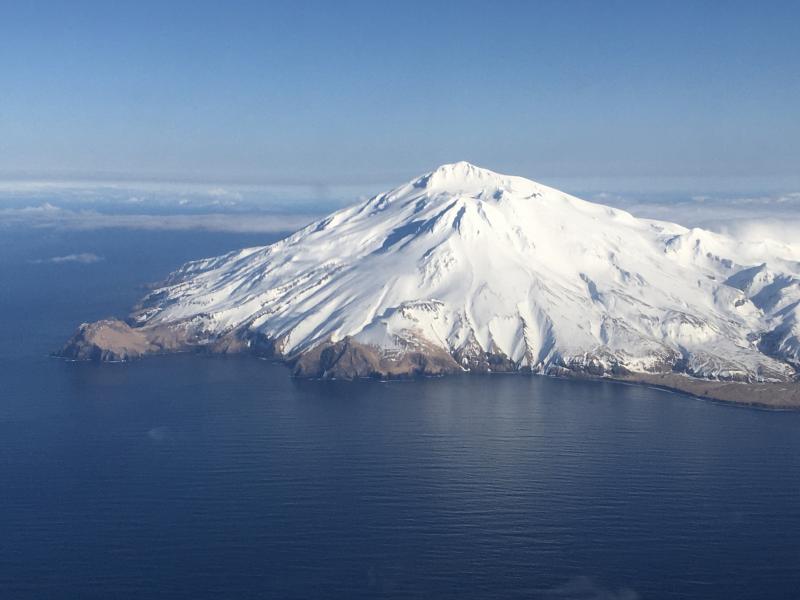
The Great Sitkin Volcano is a basaltic andesite volcano that occupies most of the northern half of Great Sitkin Island, a member of the Andreanof Islands group in the central Aleutian Islands. It’s located roughly 26 miles east of Adak, which is 1,192 miles southwest of Anchorage. According to the AVO, the volcano has a composite structure consisting of an older dissected volcano and a younger parasitic cone with a 1.8 mile diameter summit crater. A steep-sided lava dome, emplaced during an eruption in 1974, occupies the center of the crater. Within the past 280 years, a large explosive eruption here produced pyroclastic flows that partially filled the Glacier Creek valley on the southwest flank.
According to AVO, slow lava effusion continues within the Great Sitkin summit crater. Over the past day, seismic data recorded rockfalls from the growing lava dome there. Minor lava flow growth to the east was observed in satellite radar imagery; otherwise, clouds obscured satellite and webcam views of the volcano.
The current eruption of Great Sitkin Volcano began with a single explosive event in May 2021. The ongoing eruption of lava at the summit began shortly afterward, in July 2021. This volcano, currently at WATCH/ORANGE, is monitored using local seismic and infrasound sensors, satellite data and web cameras, and regional infrasound and lightning networks.
The Shishaldin Volcano is also showing unrest. According to AVO, there has been ongoing seismic and infrasound signals coming from the volcano while sulfur dioxide emissions and steaming observed. USGS says local seismic and infrasound sensors, web cameras, and a geodetic network are used to monitor Shishaldin Volcano. In addition to the local monitoring network, AVO uses nearby geophysical networks, regional infrasound and lightning data, and satellite images to detect eruptions.
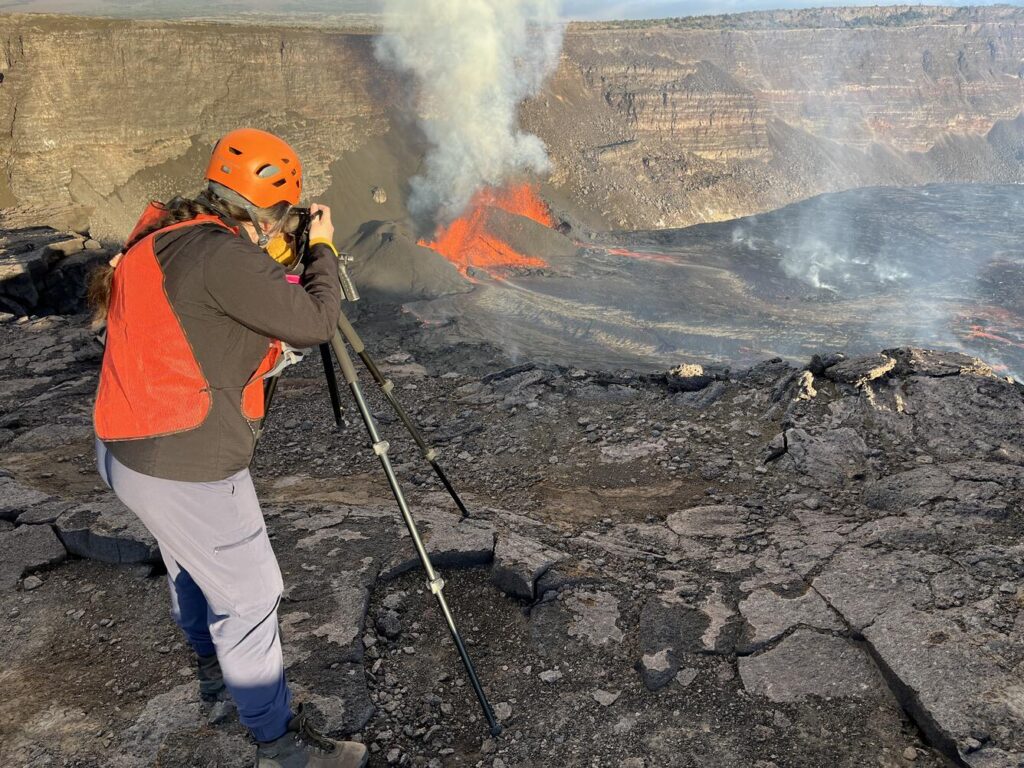
On the Big Island of Hawaii, the Kilauea Volcano has erupted many times since re-starting after a dormant period of December 23. The volcano just completed it’s 46th eruption within this series and HVO scientists believe another eruption event is likely within the next 72 hours. Each episode characterized by lava fountaining separated by pauses in activity. All recent eruptive activity has occurred in Hawaii Volcanoes National Park. No significant changes have been noted along Kīlauea’s East Rift Zone or Southwest Rift Zone which are closer to populated areas on the island. With another eruption expected in the days ahead here, HVO has Kilauea at YELLOW/ADVISORY status for now but will raise it to ORANGE/WATCH once the start of the next eruption is detected.
