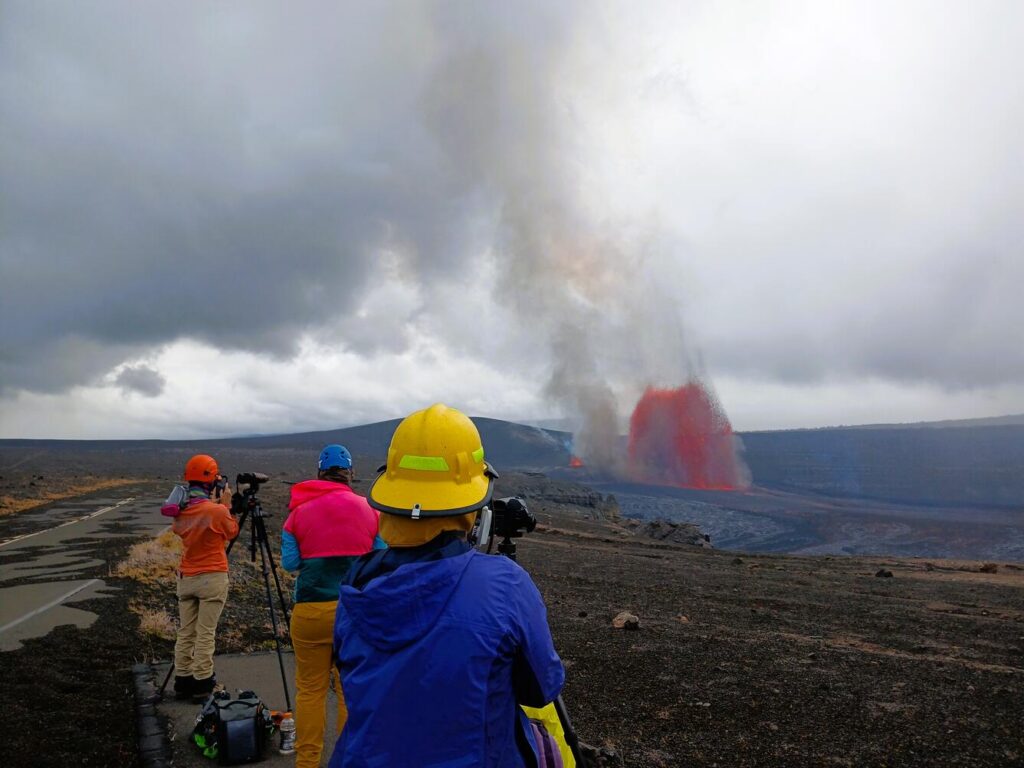
While episode 47 of the Kilauea summit eruption in Hawaii Volcanoes National Park stopped at 12:27 am local time on May 15 after 9 hours of lava fountaining, USGS believes the volcano will erupt back to life soon, forecasting an eruption between May 22-25. USGS has accurately forecast the timing of most eruptions at Kilauea this year.
Before Kilauea erupts again, scientists are busy analyzing what just happened with the most recent eruption. Lava flowed from the south vent about 75 times in the 12 hours before episode 47, but only the north vent produced a lava fountain up to 650 feet during the episode. The south vent continued to overflow for a couple of hours, diminishing over time to spattering and then only flames. USGS says an estimated 6.2 million cubic yards of lava spilled across Halemaʻumaʻu, covering nearly half of the crater floor with new lava at the volcano on the Big Island of Hawaii.
The eruptive plume rose to about 20,000 ft above sea level; weak winds as the episode peaked allowed the plume to rise vertically, causing tephra to fall around Kaluapele , the Kīlauea caldera. Most tephra fell within the closed area of Hawaii Volcanoes National Park, but sparse reticulite up to 3 inches in size fell at both the Uēkahuna and Keanakākoʻi overlooks. Fine ash and Peleʻs hair also fell in communities to the northeast.
The USGS kept the Kīlauea alert level/aviation color code at WATCH/ORANGE throughout the episode because fallout was not extensive and did not last very long. After the episode ended, USGS lowered Kīlauea to ADVISORY/YELLOW reflecting that volcanic activity had decreased significantly but continues to be closely monitored for renewed activity.
For now, both eruptive vents continue to glow, and incandescence remains visible on the crater floor as episode 47 lava flows cool and solidify. Summit reinflation of magma is underway at this time according to USGS, increasing their forecast confidence that episode 48 will occur sometime between Friday, May 22 and Monday, May 25.
The building excitement in Hawaii is in anticipation of the 48th eruptive event from Kilauea Volcano since it re-activated on December 23, 2024. Eruptions occur primarily from two vents (north and south) in Halema‘uma‘u inside the summit caldera. Eruptive episodes, which can last up to 12 hours, are separated by pauses that can be as long as two weeks.

The USGS Hawaiian Volcano Observatory (HVO) is responsible for issuing Aviation Codes and Volcanic Activity Alert Levels. Aviation Codes are green, yellow, orange, or red. When ground-based instrumentation is insufficient to establish that a volcano is at a typical background level of activity, it is simply “unassigned.” While green means typical activity associated with a non-eruptive state, yellow means a volcano is exhibiting signs of elevated unrest above known background levels. When a volcano exhibits heightened or escalating unrest with the increased potential of eruption, it jumps to orange. Finally, when an eruption is imminent with significant emission of volcanic ash expected in the atmosphere or an eruption is underway with significant emission of volcanic ash into the atmosphere, the code becomes red. Volcanic Activity Alert levels are normal, advisory, watch, or warning. As with aviation codes, if data is insufficient, it is simply labeled as “unassigned.” When the volcano is at typical background activity in a non-eruptive state, it is considered normal. If the volcano exhibits signs of elevated unrest above background level, an advisory is issued. If a volcano exhibits heightened or escalating unrest, a watch is issued while a warning is issued when a hazardous eruption is imminent.
Currently, the Kilauea Alert Level is ADVISORY and the Aviation Color Code is YELLOW.
While lava from this next eruption is expected to be contained to the summit caldera, other volcanic debris could travel far from the eruption site. A major volcanic hazard is fallout of Pele’s hair and other volcanic fragments from lava fountains. Pele’s hair is strands of volcanic glass often produced by lava fountaining activity that can be carried well over 10 miles from the vent. Other hot glassy volcanic fragments (tephra) including volcanic ash, pumice, scoria, and reticulite can fall on the ground within 1–3 miles of the eruptive vent(s), with the highest concentrations immediately downwind of the vent(s). Various volcanic fragments have fallen on Highway 11 west of Hawai’i Volcanoes National Park at times, depending on wind and eruption conditions. Strong winds may waft light particles, including Pele’s hair, to greater distances downwind. Once on the ground, Pele’s hair can sometimes cluster and tangle together, giving it the appearance of a tumbleweed. The extent of Pele’s hair deposition is dependent on lava fountaining activity and wind conditions.
USGS urges caution, saying, “Residents and visitors should minimize exposure to Pele’s hair and other glassy volcanic fragments, which can cause skin and eye irritation and can also contaminate catchment water supplies.”
When the eruption occurs, the National Weather Service may issue ash fall related advisories. For now, they urge people to exercise caution: ““If an eruption occurs, varying levels of ash, Pele`s hair, and other lightweight tephra may fall downwind of the eruption. Smaller particles can travel farther from the eruption site and may affect communities at greater distances.” They also add, “If you live downwind of the Kilauea summit, or plan to visit the summit area, stay informed about current volcanic activity and weather conditions. Be prepared to take precautions if needed, such as disconnecting water catchment systems. Follow all guidance from the National Park Service and the County of Hawaii. Be aware that road or park closures may occur.”
