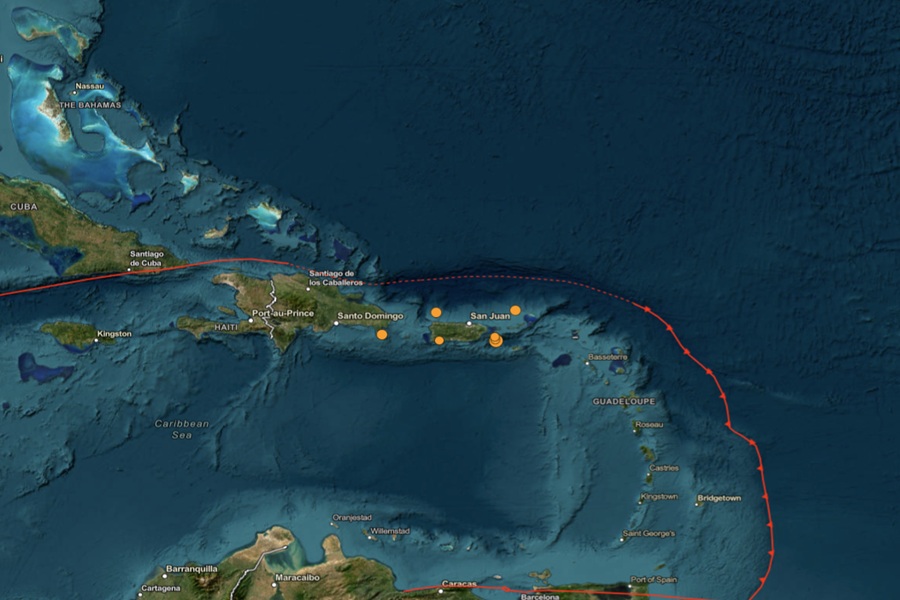
Seven earthquakes, some moderate, struck the Caribbean around the Puerto Rico, the Dominican Republic, and the U.S. Virgin Islands over the last 24 hours. Despite the surge in seismic activity, there doesn’t appear to be any tsunami threat to the Caribbean, the Bahamas, or the U.S. East Coast at this time.
The first earthquake struck near Fuig, Puerto Rico at 7:46 pm last night. Striking at a depth of 7.4 km, the earthquake was rated a 2.3 magnitude event.
The second earthquake struck near Isabela, Puerto Rico at 9:00 pm. Striking from a depth of 9.5 km, this was a stronger magnitude 3.4 earthquake.
The third earthquake was the strongest of the bunch; striking near Esperanza, Puerto Rico, this earthquake struck from a depth of 25 km and was rated a magnitude 4.1 event. It struck at 5:44 in the morning today.
The fourth earthquake struck near Boca de Yuma in the Dominican Republic; this magnitude 3.9 event, the second strongest earthquake of the set. It struck at 5:51 am today from a depth of 83 km, the deepest of the bunch.
The fifth earthquake struck near Esperanza, Puerto Rico again at 7:20 am from a depth of 29.7 km; it was rated a magnitude 2.4 event.
The sixth earthquake near Cruz Bay in the U.S. Virgin Islands from a depth of 14.1 km at 9:34 am today. It was rated a magnitude 3.3 earthquake.
The seventh and final earthquake so far today struck again near Esperanza, Puerto Rico at 11:19 am from a depth of 33.8 km. It was rated a magnitude 2.5 event.
According to USGS, earthquakes with a magnitude of 2.0 or less are rarely felt or heard by people, but once they exceed 2.0 , more and more people can feel them. While damage is possible with magnitude 3.0 events or greater, significant damage and casualties usually don’t occur until the magnitude of a seismic event rises to a 5.5 or greater rated event. None of these earthquakes were strong enough to trigger the release of a bulletin by the National Weather Service’s Tsunami Warning Center.
These earthquakes are occurring near the northern edge of the Caribbean Plate, a mostly oceanic tectonic plate underlying Central America and the Caribbean Sea off of the north coast of South America. The Caribbean Plate borders the North American Plate, the South American Plate, the Nazca Plate, and the Cocos Plate. The borders of these plates are home to ongoing seismic activity, including frequent earthquakes, occasional tsunamis, and sometimes even volcanic eruptions.
USGS continues to monitor earthquake activity in and around Puerto Rico while the National Weather Service Tsunami Warning Center is keeping an eye on any tsunami threats.
Tsunamis are giant waves caused by earthquakes or volcanic eruptions under the sea. Out in the depths of the ocean, tsunami waves do not dramatically increase in height. But as the waves travel towards the coast, especially within shallow coastal waters, they build up to higher and higher heights as the depth of the ocean decreases. The speed of tsunami waves depends on ocean depth rather than the distance from the source of the wave. Tsunami waves may travel as fast as jet planes over deep waters, only slowing down when reaching shallow waters. While tsunamis are often referred to as tidal waves, this name is discouraged by oceanographers because tides have little to do with these giant waves.
An earthquake causes a tsunami when it abruptly shifts the seafloor vertically during a major underwater or coastal earthquake. This sudden motion pushes a massive column of water upward or drops it downward. Gravity then forces the displaced water to regain its balance, sending powerful waves racing outward in all directions.
While the Pacific is better known for tsunamis, tsunami can and does occur in the Atlantic basin too. As with the Pacific basin, earthquakes can trigger a tsunami threat for the U.S. East and Gulf coasts. According to USGS, submarine landslides can be one result of an Atlantic-based quake. An offshore earthquake with a magnitude 4.5 or greater can destabilize the continental shelf, causing massive underwater avalanches. These landslides displace large volumes of water and can generate significant, localized tsunamis. This was the case during the 1929 Grand Banks earthquake near Canada, which caused a destructive localized tsunami. Distant tectonic earthquakes can also create problems; massive earthquakes along faults further away in the Atlantic, such as the Azores-Gibraltar Transform Fault near Portugal or the Puerto Rico Trench in the Caribbean, are capable of generating tsunami waves that travel across the ocean. While the infamous 1755 Lisbon earthquake created a trans-Atlantic tsunami that was recorded on the East Coast, the height of the waves reaching the US mainland was relatively small but different earthquake intensities and locations can trigger very different results.
