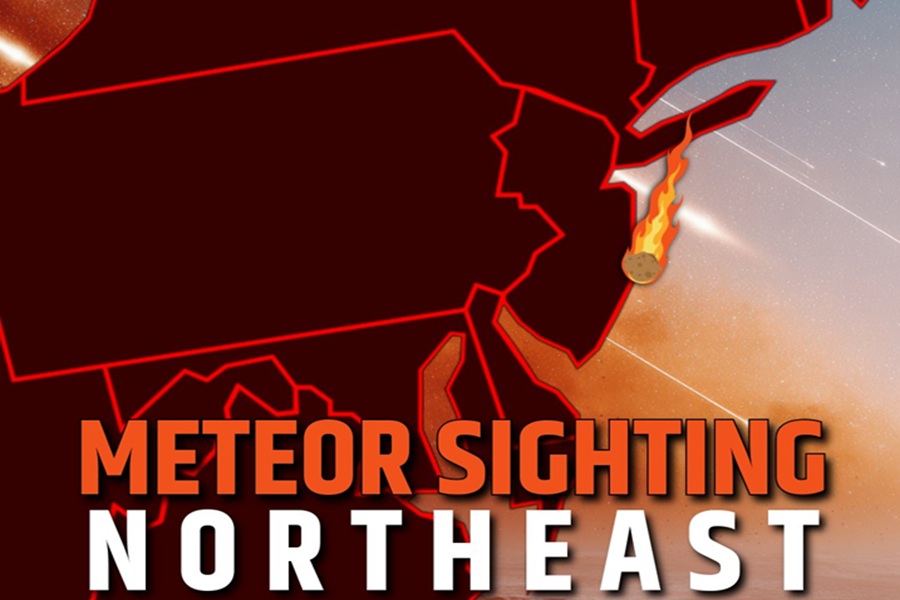
According to NASA, a meteor exploded over New Jersey yesterday afternoon. This meteor event is among a recent uptick in activity reported on in social media in recent week.
NASA says the uptick isn’t that unexpected. “While it may seem like meteor reports and sightings have been more frequent recently, it is not out of the ordinary,” NASA said in a recent update. “In the northern hemisphere, we’re in peak “fireball season.” From February through April, the appearance rate of these very bright meteors can increase by as much as 10% to 30%, especially around the weeks of the March equinox. Exactly why is not known. Some astronomers think the Earth passes through more large debris at this time of year, causing an uptick in fireball sightings. ”
Based on reports logged by the American Meteor Society, eyewitnesses in Connecticut, Delaware, New Jersey, New York, and Pennsylvania reported a daytime fireball on Tuesday, April 7, at 2:34 pm. The first visibility of the meteor was at 48 miles above the Atlantic Ocean, off the shore of Mastic Beach on Long Island. Moving to the southwest at 30,000 mph, the fireball traveled 117 miles through the upper atmosphere before disintegrating 27 miles above the town of Galloway, north of Atlantic City.
Many people reported they saw a bright flash in the sky between 2:35 and 2:40 pm, with some reporting seeing several green-colored fragments streaking across the sky for several seconds. At the time of the explosion, people reported hearing a rumble and/or a loud boom.
A meteor, often referred to as a “shooting star”, is a steak of light produced when a space rock, such as a meteoroid, enters the Earth’s atmosphere at high speeds and burns up as it does so. According to NASA, these small fragments from comets or asteroids burn up about 50 miles above the Earth’s surface, typically appearing as flashes of light caused by intense atmospheric heat. Meteoroid, meteor, and meteorite all refer to a the same rock but in different places: a meteoroid is in space, a meteor burns up in the atmosphere, and a meteorite is a remnant, if any, that actually hits the ground.
