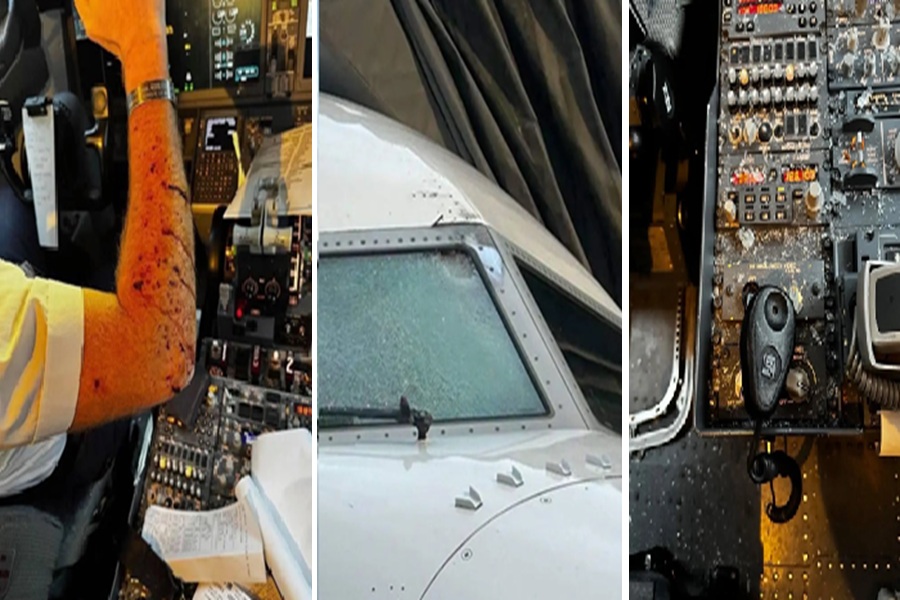
A Boeing 737 MAX 8 flight traveling from Denver to Los Angeles as United flight 1093 with 140 souls on board was forced to divert to Salt Lake City after a cracked windshield was discovered midair. The incident occurred on Thursday, October 16, 2025 at an altitude of 36,000 feet. No definitive cause has been declared for the incident, although a meteorite strike is the leading theory. A pilot was injured in the incident.
If a meteor strike is to blame, it would be an aviation first. There’s been no record of any space debris strike on a commercial aircraft anywhere in the world. A 2023 FAA report found there to be an annual 0.1% chance that falling space debris would cause a single global aviation casualty, which yields a risk to a passenger of about 1 trillion to one.
The flight landed in Salt Lake City and all passengers were re-accommodated on later flights to their destination. As of Saturday evening, the aircraft remains on the ground in Salt Lake City.
Photographs shared by a United employee show damage inside and outside of the aircraft, along with a bloodied pilot’s arm, apparently injured by shattered glass that entered the cockpit and also littered the center console.
A 737 cockpit windshield is made of a multi-layered “sandwich” of materials, typically consisting of an outer glass layer for weather resistance, a middle layer of stretched acrylic or a heating element for de-icing, and an inner glass layer that acts as the primary load-bearer. These layers are bonded together with other materials like vinyl or urethane to ensure strength, durability, and safety, and have specialized coatings.
There was an initial theory that the heating element layer of the windshield failed, shattered the laminated layers. However, the photo shared by the United employee shows an impact area not only on the glass, but on the cockpit frame around the glass.
There is also a theory that a large hail stone impacted the cockpit window. Hail can severely damage a cockpit window, causing cracks, shattering, and even shattering it completely. This was demonstrated in recent incidents where hailstorms caused extensive damage to cockpit windows and the aircraft’s nose cone. While modern aircraft have strong, multi-layered windshields designed to withstand impacts, they are not immune to large or powerful hail. In July 2023, a Delta Airlines cockpit window was shattered by a hail strike. In June 2024, Austrian Airlines lost its nose cone and cockpit windshields to a severe hail impacts.
Hail can reach altitudes as high as 36,000 feet, especially in the strong updrafts of severe thunderstorms. Although it is less common at cruising altitudes, aircraft can be struck by hail that is ejected far from a storm’s core, sometimes even in clear air. This is one reason why pilots avoid flying through thunderstorms to avoid such damage.
However, in the case of United flight 1093, the aircraft flew through an area free of convective weather which could produce hail.
Another active theory is that the aircraft was struck by a small meteorite or some kind of space debris.
A meteorite is a natural, solid piece of rock from space that survives its journey through Earth’s atmosphere and lands on the surface. It was once a meteoroid in space, which created a bright streak of light as it burned up in the atmosphere as a meteor. It then becomes a meteorite once it hits the ground or an object above it.
On social media, some have reported seeing a meteor at around the time of this aircraft impact, but no officials have confirmed any link to that and this aircraft incident.
It’s also possible that artificial space debris entered the Earth’s atmosphere and impacted the plane. That too would be an aviation first, but like the meteorite theory, has not been confirmed.
We’ve requested additional details from United but have not received a comment as of press time.
