• Skip to primary navigation
  • Skip to main content
  • Skip to primary sidebar

Weatherboy

Weatherboy Weather News, Maps, RADAR, Satellite, and Forecasts.

  • Local
  • Earth Science News
  • RADAR
  • Current Warnings
  • Satellite
  • Current Maps
  • Forecast Maps
  • Video

Strong 5.0 Earthquake Rocks Southern Mid Atlantic Ridge; No Tsunami Threat

by Weatherboy Team Meteorologist - August 8, 2021

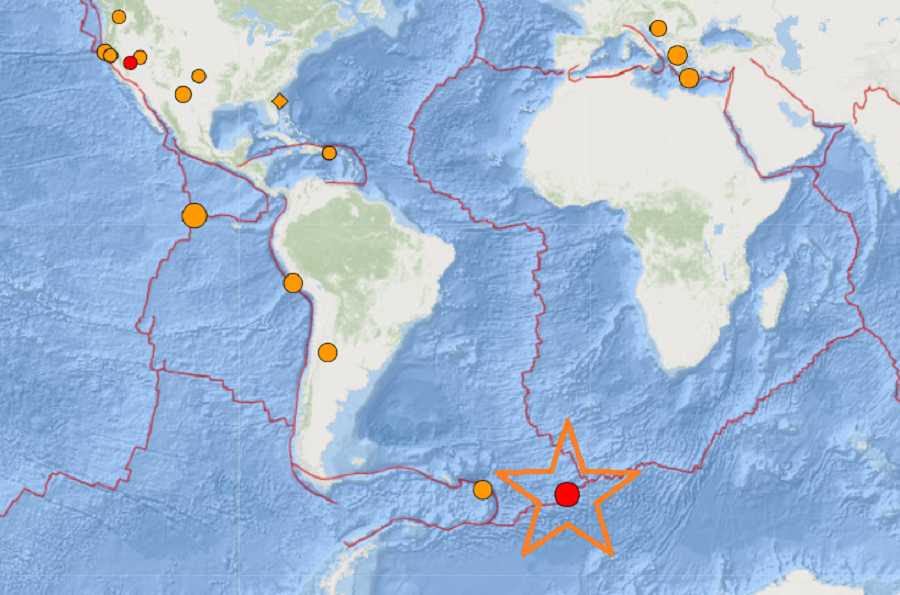
The 5.0 earthquake struck along the Mid Atlantic Ridge a short time ago. The strong earthquake is marked by a star; other orange and red dots indicate other recent seismic activity recorded by USGS. Image: USGS


A strong 5.0 earthquake rocked the southern Mid Atlantic ridge this evening; fortunately, it was not strong enough to create a tsunami in the Atlantic Ocean.

According to USGS, the earthquake struck at 7:03 pm ET tonight at a depth of 10 km; the earthquake was centered in a seismically active portion of the Mid Atlantic ridge near 56.703°S 6.028°W.

The southern Mid Atlantic Ridge  separates the South American Plate from the African Plate and the Antarctic Plate. As the plates move away and into each other, they can trigger earthquakes as they split above the ridge.

These plates are based on the scientific theory of Plate Tectonics, which describes the large-scale motion of plates making up the Earth’s lithosphere. Scientists believe tectonic processes began on Earth between 3.3 and 3.5 billion years, building upon the concept of continental drift, a scientific concept developed in the early part of the 20th century. Continental drift is the gradual movement of the continents across the Earth’s surface through geological times.


Tsunamis are giant waves caused by earthquakes or volcanic eruptions under the sea. Out in the depths of the ocean, tsunami waves do not dramatically increase in height. But as the waves travel inland, they build up to higher and higher heights as the depth of the ocean decreases. According to the National Ocean Service, the speed of tsunami waves depends on ocean depth rather than the distance from the source of the wave. Tsunami waves may travel as fast as jet planes over deep waters, only slowing down when reaching shallow waters. While tsunamis are often referred to as tidal waves, this name is discouraged by oceanographers because tides have little to do with these giant waves.

There is no link between this strong earthquake and a large explosion triggered by the U.S. military off the coast of Florida earlier today. That experimental explosion generated a 3.9 magnitude event. 

Primary Sidebar

Sponsored Ad

Search

Latest News

  • Geomagnetic Storm Watch In Effect for Friday Starting Thursday Night
  • Dozens Report Shaking from Ohio Earthquake
  • Second Earthquake in Two Days Rattles Eastern Tennessee
  • Tennessee Latest State in the East to Experience an Earthquake Today
  • “Kona Low” Brings Heavy Snow to Hawaii Prompting Winter Storm Warnings
  • Weak Early Morning Earthquake Rattles North Carolina
  • Early Morning Earthquake Rattles New Hampshire; Hundred+ Report Shaking
  • Cape Canaveral Prepares for Tsunami with TsunamiReady Certification
About | Careers | Contact | Contests
Terms | Privacy | Ad Choices
Weatherboy is a (R) Registered Trademark of isarithm LLC, All Rights Reserved.
All content herein is Copyright by Isarithm LLC 1997-2022

Insert/edit link

Enter the destination URL

Or link to existing content

    No search term specified. Showing recent items. Search or use up and down arrow keys to select an item.