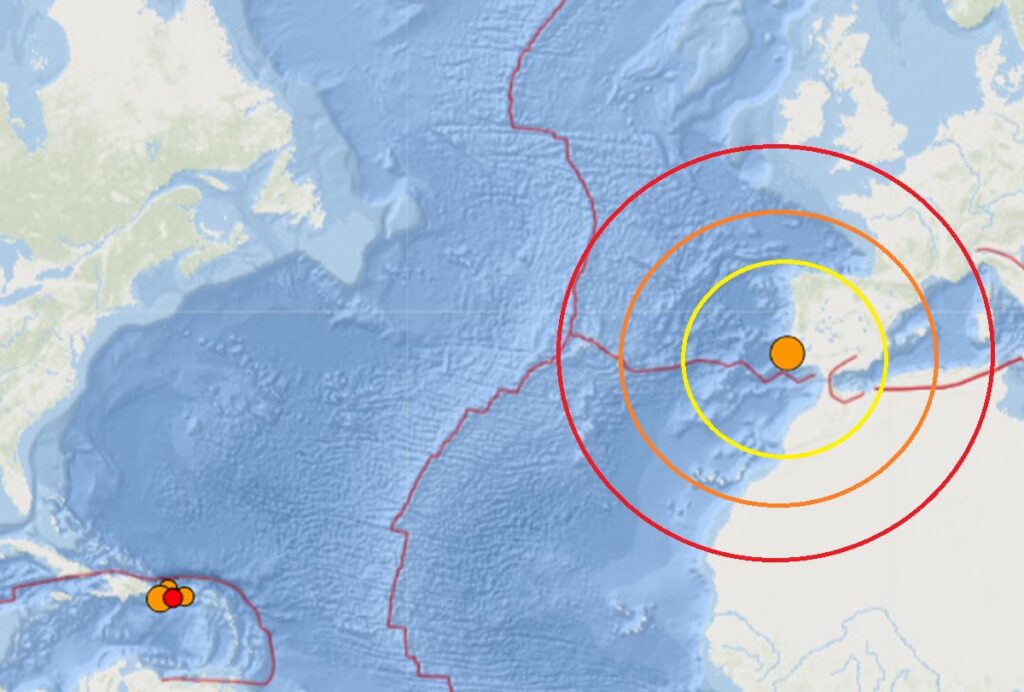
Thousands of people have reported to USGS they felt a strong earthquake which struck the off-shore waters of Portugal today. At 2:11 am ET, a magnitude 5.4 earthquake struck about 30 miles west of Sines, Portugal from a depth of 17.5 km. Fortunately, the earthquake wasn’t strong enough to generate a tsunami and there is no threat of tsunami to the U.S. East Coast or the Atlantic coast of Europe.
More than 2,200 used the “Did you feel it?” tool on the USGS website to report they felt today’s strong quake. Today’s quake, located well south and west of Lisbon, hit in an area with limited recent seismic activity; there’s been no report of any earthquakes located within 250 miles of today’s epicenter over the last 30 days according to USGS.
While there hasn’t been recent seismic activity, the earthquake struck not far from a plate boundary between the Eurasian Plate and the African Plate. These plates are based on the scientific theory of Plate Tectonics, which describes the large-scale motion of plates making up the Earth’s lithosphere. Scientists believe tectonic processes began on Earth between 3.3 and 3.5 billion years, building upon the concept of continental drift, a scientific concept developed in the early part of the 20th century. Continental drift is the gradual movement of the continents across the Earth’s surface through geological times.
Tsunamis are giant waves caused by earthquakes or volcanic eruptions under the sea. Out in the depths of the ocean, tsunami waves do not dramatically increase in height. But as the waves travel inland, they build up to higher and higher heights as the depth of the ocean decreases. According to the National Ocean Service, the speed of tsunami waves depends on ocean depth rather than the distance from the source of the wave. Tsunami waves may travel as fast as jet planes over deep waters, only slowing down when reaching shallow waters. While tsunamis are often referred to as tidal waves, this name is discouraged by oceanographers because tides have little to do with these giant waves.
