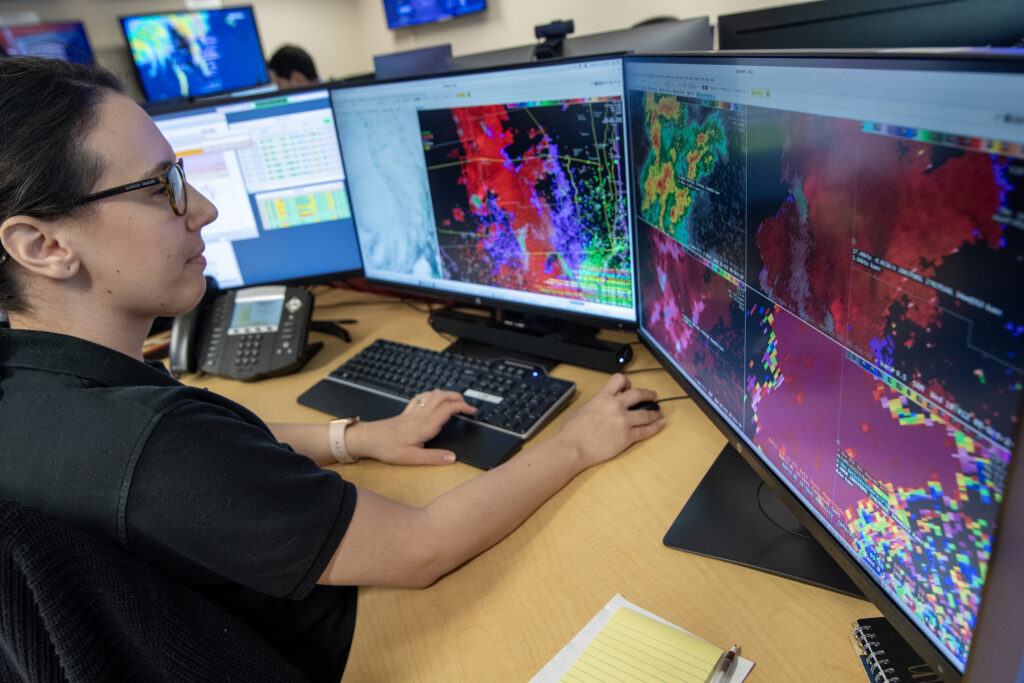
Through ongoing modernization efforts through NOAA’s National Weather Service (NWS), meteorologists will soon be doing more work not just with clouds, but in the cloud. The National Weather Service has awarded two contracts for the NWS’s new cloud-based data and applications services, launching a new era of modernization for the nation’s weather agency. These tools will effectively transfer the capabilities of AWIPS, the information technology system used by NWS to integrate meteorological, hydrological, satellite and radar data to the cloud, allowing forecasters to create, visualize and distribute weather forecasts, warnings and advisories without being tethered to a specific location.
“For far too long American weather forecasters have relied on decades-old, hardwired technology to provide critical data to the American public,” said Secretary of Commerce Howard Lutnick. “Under President Trump’s leadership, we are modernizing the National Weather Service’s operations using the cloud and our American tech stack.”
“This transition to cloud-based technology is a monumental improvement from the current structure, which was first implemented in the 1990s,” said Neil Jacobs, Ph.D, NOAA administrator. “This upgrade will greatly improve the NWS mission by eliminating time spent downloading data to desktop workstations, while increasing flexibility through remote laptop accessibility.”
This initial effort will focus on the development and launch of new cloud-based data and application environments. Cloud computing architecture will allow for scalability and mobility for employees across NWS’s 122 local Weather Forecast Offices, 13 River Forecast Centers, 21 Center Weather Service Units at major airport hubs, 9 National Centers, and other NWS field offices. It accelerates the addition of new technologies, such as those based on Artificial Intelligence, and the integration of new data sources in both the public sector and private industry.
The contracts will kickstart the development of two proprietary new tools exclusive to NWS. NWS HIVE (Hydrometeorological Interactive Virtual Environment) will be built to serve as the central application environment for NWS forecasters to analyze data, create weather forecasts, and issue warnings, replacing the legacy AWIPS system developed in the 1990s. NWS HIVE will support all current operational capabilities and establish the foundation for future enhancements.
NWS CIRRUS (Centralized Integrated Real-Time Repository for Unified Services) will serve as a centralized, cloud-based repository for both NWS-owned and partner data. Moving away from the current fragmented storage and distribution process across legacy systems, NWS CIRRUS will provide the high-quality foundation necessary to power future capabilities across NWS, transforming its data management infrastructure. NWS CIRRUS will also allow partners to access more data faster, adding value to a multi-billion dollar private weather enterprise.
The development of NWS HIVE and NWS CIRRUS will occur in two phases. Phase 1, targeted for completion by early 2027, will establish the capability for storage and viewing of weather and water data, as well as the creation and issuance of key public-facing products. Phase 2 is scheduled for completion by early 2028. This phase will deliver the comprehensive capabilities required to fully decommission the legacy AWIPS system.
