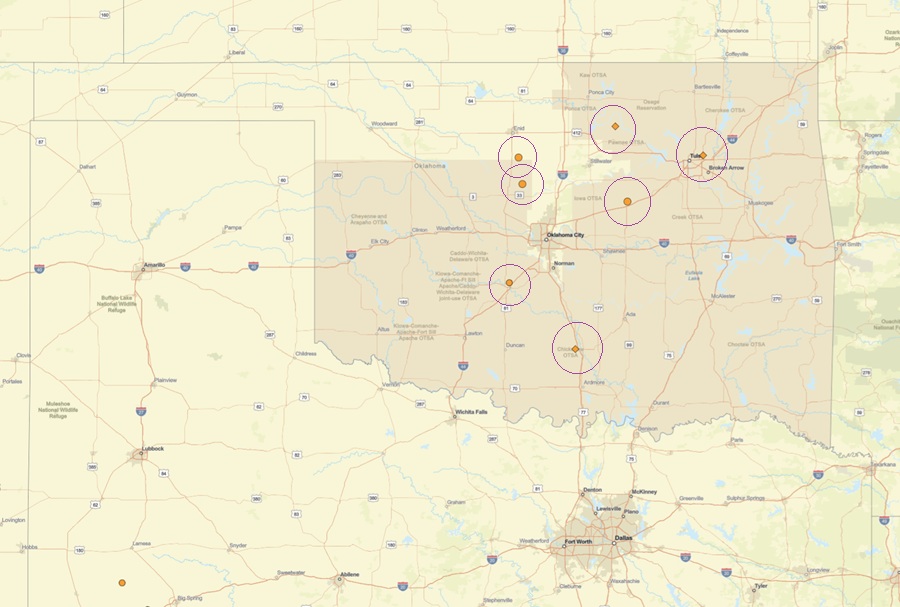
USGS is reporting that 7 earthquakes and explosions rocked Oklahoma today, adding to the overall logged seismic activity being tracked in the Sooner State this month. Of the 7 seismic events recorded by the agency, 4 were earthquakes and 3 were explosions.
USGS recorded three explosions, labeling them at quarry blasts. They occurred at 11:55 am near Ralston, 1:19 pm near Owasso, and 3:37 near Davis.
In addition to naturally occurring earthquakes, human activities such as mining and construction blasts can sometimes produce seismic waves large enough to be detected on the USGS national seismic network. These artificially-generated events have a different seismic ‘fingerprint’ from tectonic earthquakes, so they can be discerned by a seismologist when reviewed.
Specifically, small quarry blasts tend to have a shorter surface wave ‘echo’ than natural earthquakes. Seismologists with USGS also note if the blast was in an area not known for earthquakes and if it was located within 1-2 miles of an active quarrying operation. The USGS no longer does a systematic review of mining seismicity, but these events can sometimes be identified using certain criteria.
The four earthquakes were all very weak, with none over a magnitude 2.0 event. The first was a magnitude 1.1 event near Stroud, the next was a magnitude 1.5 event near Dover at 9:34 am, the following was a magnitude 1.4 event at 11:24 am near Bison, the last was a magnitude 0.5 near Chickasha at 2:04 pm.
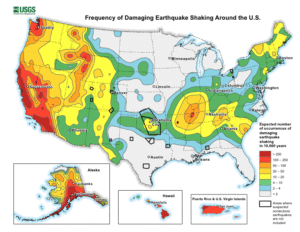
USGS says that earthquakes with a magnitude of 2.0 or less are rarely felt or heard by people, but once they exceed 2.0 , more and more people can feel them. While damage is possible with magnitude 3.0 events or greater, significant damage and casualties usually don’t occur until the magnitude of a seismic event rises to a 5.5 or greater rated event.
Beginning in 2009, Oklahoma experienced a surge in seismicity. This surge was so large that its rate of magnitude 3 and larger earthquakes exceeded California’s from 2014 through 2017.
While these earthquakes have been induced by oil and gas related process, few of these earthquakes were induced by fracking. The largest earthquake known to be induced by hydraulic fracturing in Oklahoma was a M3.6 earthquakes in 2019. The largest known fracking induced earthquake in the United States was a M4.0 earthquake that occurred in Texas in 2018. The majority of earthquakes in Oklahoma are caused by the industrial practice known as “wastewater disposal”. Wastewater disposal is a separate process in which fluid waste from oil and gas production is injected deep underground far below ground water or drinking water aquifers. In Oklahoma over 90% of the wastewater that is injected is a byproduct of oil extraction process and not waste frack fluid.
