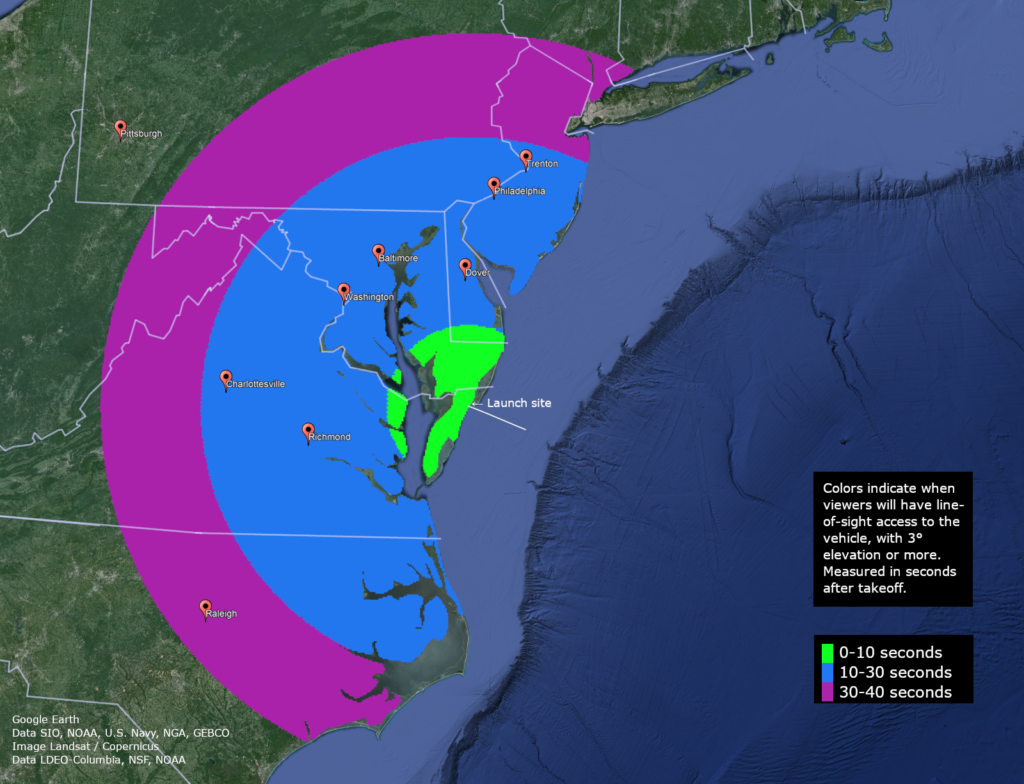
NASA is planning to launch three rockets from the Mid Atlantic this evening as part of the TOMEX+ experiment and the rockets and experiments could be visible across a broad area of the Mid Atlantic from New Jersey to North Carolina. Beyond the streak of a lifting rocket, some may also be able to observe colors high in the atmosphere as part of this mission.
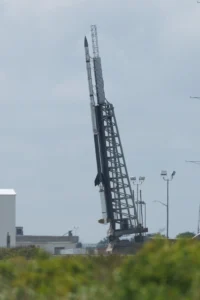
The three-rocket TOMEX+ mission, which had previous launches canceled due to weather, is scheduled for sometime tonight: the launch window is open between 10 pm and 3am and a launch could occur at anytime within that window. The rockets will be lifting off from the NASA Wallops spaceport on the Virginia coast. While the visitor center will be closed for the late night launch, things should be visible in cloud-free skies with the naked eye throughout the region.
TOMEX+ is short for The Turbulent Oxygen Mixing Experiment Plus. This NASA sounding rocket mission will investigate one of Earth’s most turbulent atmospheric regions — the mesopause. Led by principal investigator Jim Clemmons, a professor of physics and astronomy at the University of New Hampshire, the study hopes to better understand the coldest layer of the Earth’s atmosphere.
The mesopause is a region of the upper atmosphere stretching from about 53 to 65 miles in altitude, at the boundary between Earth’s mesosphere and thermosphere. As the coldest layer of the atmosphere, the mesopause is a mixing ground where weather patterns from the lower atmosphere transfer energy upward into space, fueling turbulence that can increase drag on satellites.
The TOMEX+ mission will focus on a layer of atomic sodium in the atmosphere that peaks at about 56 miles altitude. This sodium layer forms from the constant influx of dust grain-sized meteors that burn up in the sky. A specialized laser aboard the TOMEX+ rocket, tuned to a wavelength that excites sodium atoms, will cause the sodium layer to fluoresce. This glowing band then becomes a natural tracer for atmospheric motions, allowing scientists to track its bends, ripples, and swirls as energy moves through the upper atmosphere.
The mission builds on the design of the original TOMEX sounding rocket launched in 2000. This time, the mission will use three rockets instead of one, and one of the rockets will carry a light detection and ranging (LIDAR) instrument previously used only on the ground.
The first two rockets, launched within one minute of each other, will release vapor tracers which should produce colorful clouds which scientists will photograph from the ground to map upper-atmospheric wind patterns. The vapor tracers are made from compounds similar to those used in fireworks to give them their color.
The third rocket, launched about five minutes later, will carry the LIDAR instrument, sending out short pulses of visible light at a wavelength absorbed and re-emitted by atomic sodium. By analyzing the returned light, scientists can measure atmospheric density and motion over time.
NASA hopes that all together, the TOMEX+ payloads will provide the clearest 3D view yet of turbulence at the edge of space, improving their understanding of high-altitude cloud formation, satellite drag, and even atmospheric processes on other planets.
