
USGS is reporting a large number of earthquakes on the Big Island of Hawaii, where Kilauea Volcano has been erupting on and off since last December. Over the last 30 days, USGS reports there have been 366 earthquakes with a magnitude of 1.5 or greater; the largest was a magnitude 4.6 earthquake which struck Fern Forest on November 23.
Kilauea started to erupt at its summit last year on December 23; since then, it has had 38 eruptions with lava and volcanic debris shooting high into the sky with most.
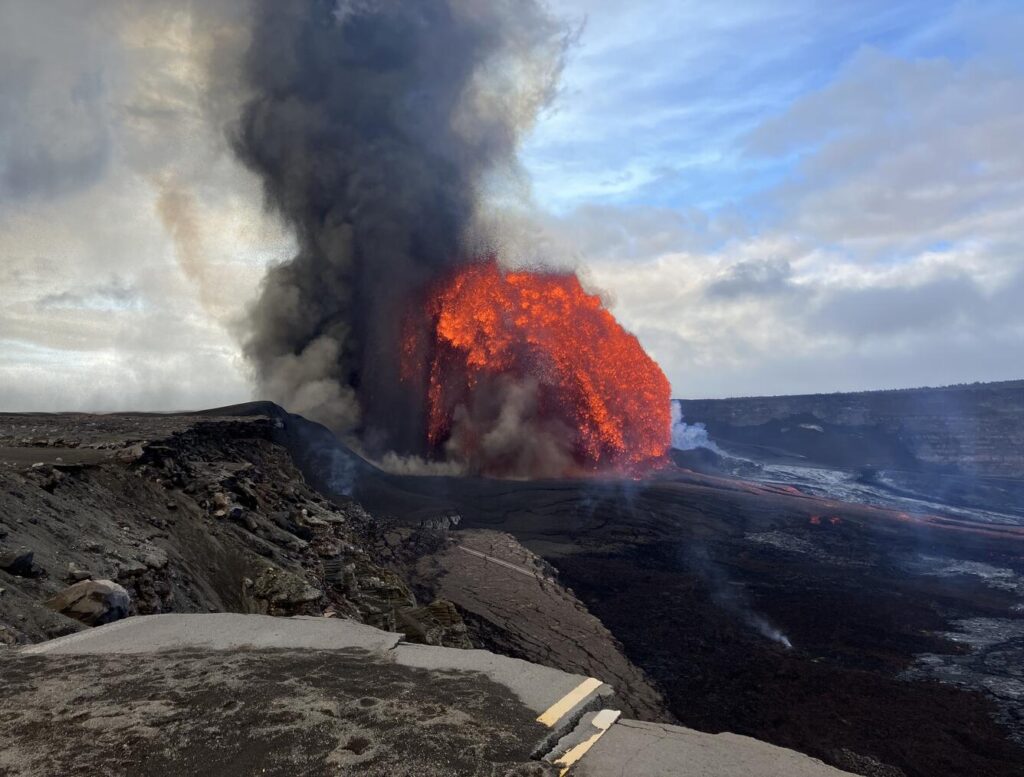
One of the most significant events hit just days ago on December 6, with 12.1 hours of sustained lava fountaining. The south vent fountain began at 8:49 AM local time and within 10-20 minutes all three fountains were about 500 feet high creating a rare triple fountain. By 9:40 am, the south vent fountain grew to about twice as high as the north vent fountains. According to USGS, the highest peak or instantaneous effusion rate of 1,300 cubic yards per second occurred just before 10 AM when the south vent exploded. The enlarged south vent produced an inclined fountain over 1,000 feet tall that sprayed the south wall of Halemaʻumaʻu crater.
Hot pumice and molten spatter from this fountain destroyed the HVO “V3” streaming camera site.
The south fountain gradually dropped in height throughout the afternoon to about 500 feet high along with declining effusion rates. Episode 38 ended with an average effusion rate of 250 cubic yards per second about 12 hours after it started. An estimated 16.5 million cubic yards or 12.6 million cubic meters of lava erupted and covered about 50-60% of the floor of Halemaʻumaʻu crater. The Uēkahuna tiltmeter recorded about 33.1 microradians of deflationary tilt during episode 38.
But it looks like episode 39 may be about to start before the end of the month. While not currently erupting, Kīlauea is showing moderate glow in the flow field and from cracks near the north vent.
“It is too early to make an accurate forecast, but the onset of the next episode of fountaining is likely 2-3 weeks away,” wrote USGS in an update they released today.
Since the end of episode 38, Kilauea has inflated 8.5 microradians as recorded on the UWD tiltmeter this morning with an increase of 2.0 microradians over yesterday.
Volcanic gas emissions have greatly decreased with the end of the eruption and are back in the normal range of 1200 to 1500 tonnes per day of SO2. Emissions will likely increase again during the next eruptive period.
