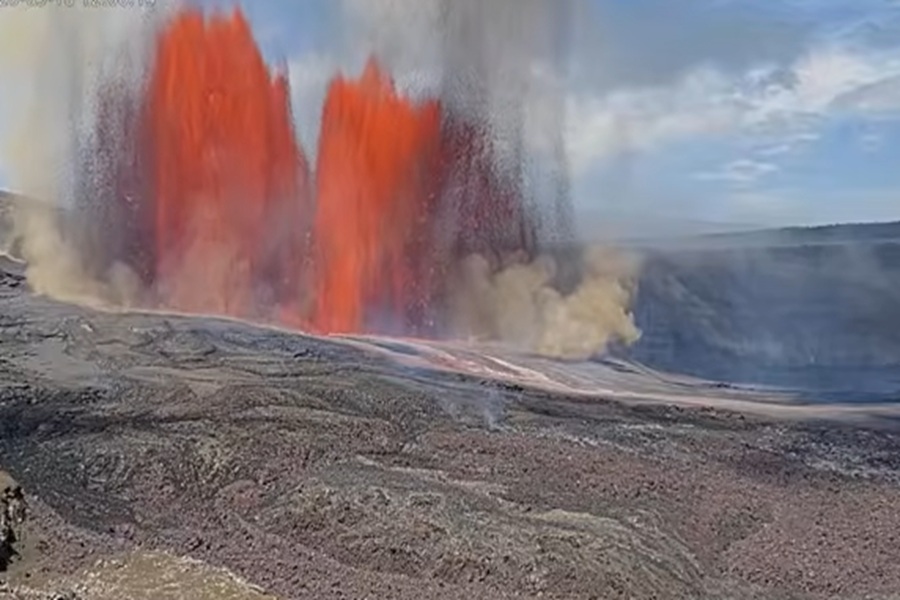
USGS has issued a Volcano Warning due to the start of a significant eruption of the Kilauea Volcano on the Big Island of Hawaii. A USGS Volcano Warning is the highest alert level indicating that a hazardous, major volcanic eruption is imminent, underway, or suspected. It signals significant hazards to both ground-based communities and aviation, often accompanied by orange or red aviation color codes.
“Due to Kilaue’s Volcano Warning, please be advised (that) the Volcano National Park is closed, Highway 11 is closed between the 23 and 40 mile markers due to dangerous conditions of falling tephra,” warned Hawaii County Civil Defense in an emergency broadcast airing on stations in Hawaii. They add, “If in the area, seek shelter indoors.”
The Robert N. Herkes Gym in the Kau’u District south of the volcano has opened as an evacuation shelter.
Tephra is the general term for any airborne fragmental material ejected from a volcano, ranging from fine ash to large boulders during an explosive eruption. It consists of magma droplets (glass), crystals, and broken rock.
USGS says tephra up to 5″ wide is impacting communities near the volcano, with a plume of gas, ash, and volcanic debris extending upwards of 25,000 feet into the air.

The National Weather Service has also issued an Ashfall Warning through 5pm local time today.
The National Weather Service on Oahu in Honolulu says, “A significant eruption is occurring at Kilauea with more than quarter inch of ashfall accumulation for Hawaii Volcanoes National Park and areas to the northeast including Mountain View, Volcano, Glenwood, and extending to the southeast and southwest.”
“Disruption of services and utilities (water, sewer, electric) possible. Ash removal efforts significant,” says the National Weather Service.
“Seal windows and doors. Protect electronics and cover air intakes and open water sources. Avoid driving. Remain indoors unless absolutely necessary. Use extreme caution clearing rooftops of ash,” adds the National Weather Service in their urgent bulletin.
Ashfall is one of many hazards of a volcano like Kilauea. But unlike the ashes from a cook-out or cigarette or cigar, the ashes that fall from a volcano are nothing more than ground up rock. “It’s really minute particles of rock, ” Hawaii Volcanoes National Park spokesperson Jessica Ferracane told us at the crater rim inside the park during a previous interview. “This rock is getting pulverized by the gases in it, when it hits the magma, its a chemical reaction that happens, and big chunks of rock can come out, but so can small pulverized particles that come out as volcanic ash.” Each time there’s some instability at the top of the volcano and rock falls into it, the stage is set for a possible ash event.
A 2018 eruption of Kilauea prompted the National Weather Service to create volcanic related advisories for Hawaii. With the threat of falling ash, the National Weather Service in Honolulu created special products to keep the public informed of the risks posed by the ash.
NOAA meteorologist John Bravender, who works at the Honolulu office of the National Weather Service, told us how they’ve developed the advisories. “As the weather forecast office, we’ve had responsibility for issuing SIGMET and aviation warnings but given the past history from our volcanoes, haven’t really been really concerned about ashfall. ” Recent explosive eruptions that have ejected a significant amount of debris have changed that.
Bravender said the team there has had a “crash course” of sorts to develop a program in 2018, relying on experts from other groups such as Hawaiian Volcano Observatory (HVO) and the Alaska Aviation Weather Unit. But unlike severe weather watches that are issued ahead of other severe weather events, you won’t see an Ashfall Watch posted. “There’s no watches; these are very reactive products, ” Bravender told us.
When an ashfall incident is imminent due to some type of explosion at the volcano, the National Weather Service office in Honolulu will issue one of three types of products. The first is a Special Weather Statement. A Special Weather Statement is issued when there is the potential for trace amounts of accumulating ash. When there’s a chance of a more significant ashfall, from over a trace to up to 1/4″, the National Weather Service will then issue an Ashfall Advisory. And if a heavy ashfall is expected with accumulations greater than 1/4″, an Ashfall Warning is issued.
When any of these products are issued, the National Weather Service encourages people to avoid ash. “Avoid excessive exposure to ash which is an eye and respiratory irritant,” the Special Weather Statement text reads. “Those with respiratory sensitivities should take extra precaution to minimize exposure.”
The International Volcanic Health Hazard Network (IVHHN), the Cities and Volcanoes Commission, GNS Science, and the USGS developed guidelines on preparedness before, during, and after an ashfall.
The International Volcanic Health Hazard Network (IVHHN), the Cities and Volcanoes Commission, GNS Science, and the USGS developed guidelines on preparedness before, during, and after an ashfall:
BEFORE
Stock essential items; a sustained ashfall may keep people housebound for hours or even days. Based on the guidelines you should:
- have dust masks and eye protection
- have enough drinking water for at least 72 hours (1 gallon water per person per day)
- have enough non-perishable food for at least 72 hours for family and pets
- get plastic wrap to keep ash out of electronics
- get a battery-operated radio and extra batteries
- have lanterns or flashlights and extra batteries for both
- keep extra stocks of medicine for people and pets
- have a first aid kit
- prepare cleaning supplies, such as a broom, vacuum cleaner with spare bags and filters, and a shovel
- get a small amount of cash; sources such as ATMs and banks may not be open
- consider that you could be stuck in your vehicle, so store emergency supplies in your vehicle too
AFTER
When a Special Weather Statement, Ashfall Advisory, or Ashfall Warning are issued for your area, take immediate action to protect life and property.
- close all doors and windows
- place damp towels at door thresholds and other draft sources, like window cracks
- protect sensitive electronics and do not uncover until the environment is totally ash free
- disconnect drainpipes and downspouts from gutters to stop drains from clogging, but allowing ash and water to empty from gutters onto the ground
- if you use a water catchment system, disconnect the tank prior to the ashfall
- if you have respiratory illness, such as chronic bronchitis, emphysema, or asthma, stay inside and avoid unnecessary exposure to the ash
- ensure livestock and pets have clean food and water
DURING
If volcanic ash is falling, stay safe!
- don’t panic; stay calm
- stay indoors
- if outside, seek shelter such as a car or in a building
- use a mask or cloth over your nose and mouth
- if a warning is given before ashfall starts, go home from work; if at work when ashdall starts, stay indoors until the ash has settled
- do not tie up phone lines with non-emergency calls
- listen to your local radio for information on the eruption and clean-up plans
- do not wear contact lenses as these will result in corneal abrasion
- if there is ash in your water, let it settle and then use the clear water. If there is a lot of ash in the water supply, do not use your dishwasher or washing machine. Water contaminated by ash will usually make drinking water unpalatable before it presents a health risk
- you can eat vegetables/fruit from outside, but wash ash off first
Volcanic ash, even in small quantities, can do harm on the surface. A light coating on car or home windows can scratch them; great care should be used when removing ash. Ash entering water catchment systems can contaminate their contents, clog filters, and/or do harm to pumps. More substantial eruptions can also impact cars and jet aircraft.
The National Weather Service says in the event Kilauea creates a large ash loud, NOAA’s Volcanic Ash Advisory Centers (VAAC) will issue critical guidance to help aircraft steer away from destructive ash particles. NOAA’s VAAC has been providing guidance on remote volcanoes erupting in/around Alaska that could pose an aviation threat too.
The Big Island is also expected to be impacted by a severe Kona Low storm starting tomorrow. The Kona low is expected to bring flooding rains, severe thunderstorms with damaging winds and the possibility of hail, and very heavy snow to the higher terrain of Hawaii. Additional advisories are being issued for that weather situation in addition to the Ashfall Warning.
