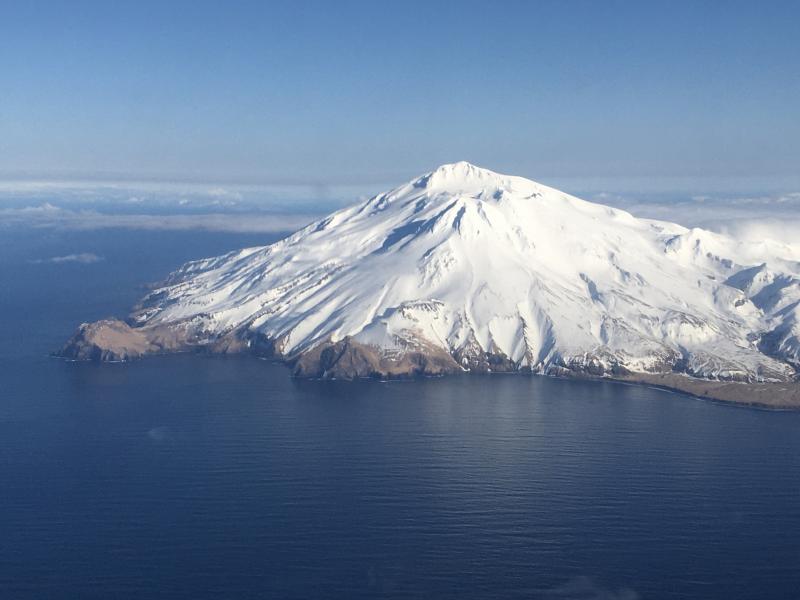
Lava is still oozing slowly into the summit crater of Great Sitkin Volcano in Alaska’s central Aleutian Islands, the Alaska Volcano Observatory said, keeping the remote volcano as the only one in the United States at the second-highest alert status.
In its most recent daily update, issued at 9:50 a.m. AKST Saturday, the observatory said, “Lava likely continues to erupt slowly within the summit crater of Great Sitkin Volcano. A few small earthquakes were detected at the volcano over the last day. Clouds obscured other satellite and webcam views of the volcano.”
The volcano remained at Volcano Alert Level WATCH and Aviation Color Code ORANGE. As of early Sunday, AVO had not issued a newer update, and the observatory reported no major change in activity since Saturday.
The U.S. Geological Survey’s list of elevated volcanoes early Sunday showed Great Sitkin as the only U.S. volcano at ORANGE. Kilauea in Hawaii and Ahyi Seamount in the Northern Mariana Islands were listed at ADVISORY and YELLOW.
A Dome That Keeps Growing
AVO’s weekly update, released at 12:10 p.m. AKST Friday, offered a little more detail. “Minor growth of the active lava dome within the summit crater was observed in satellite imagery over the past week,” the observatory said. “The south flank of the dome is moving slowly southward.”
The same update said clouds obscured all visible images of the volcano over the week. Seismic activity remained low, with occasional small volcanic earthquakes and signals from minor rockfalls caused by the growing lava flow, AVO said.
The observatory said the current eruption began in July 2021. “Since then, lava flows have filled most of the summit crater and advanced into valleys below,” it said. There have been no explosions at Great Sitkin since an event in May 2021.
How the Volcano is Watched
Great Sitkin sits in a remote stretch of the central Aleutians, so most monitoring is done from afar. AVO said it watches the volcano using local seismic and infrasound sensors, satellite data and webcams, along with regional infrasound and lightning networks. Its weekly update also listed geodetic sensors, which measure ground movement.
That network matters most when the weather does not cooperate. The Aleutians are often cloudy, and AVO has repeatedly reported in recent updates that clouds blocked views of the summit. In those stretches, seismic and infrasound sensors become the main way to detect any sudden change, such as an explosion.
According to AVO’s volcano page, Great Sitkin’s summit rises to 5,709 feet. The community of Adak is about 26 miles west-southwest of the volcano, and Atka is about 81 miles east.
From Unrest to Explosion to Lava
The eruption followed years of restlessness. In an eruption summary posted by AVO, citing a 2024 report by Orr and others, the observatory said volcanic unrest began at Great Sitkin in July 2016, with elevated seismicity, unusual steam emissions from the summit crater and a few small explosive events.
Activity faded in 2020, and AVO lowered the alert to NORMAL and GREEN on Oct. 21, 2020. But surface temperatures in the summit crater rose slightly in January 2021, and earthquakes increased that spring, according to the summary. AVO raised the alert to ADVISORY and YELLOW on May 12, 2021.
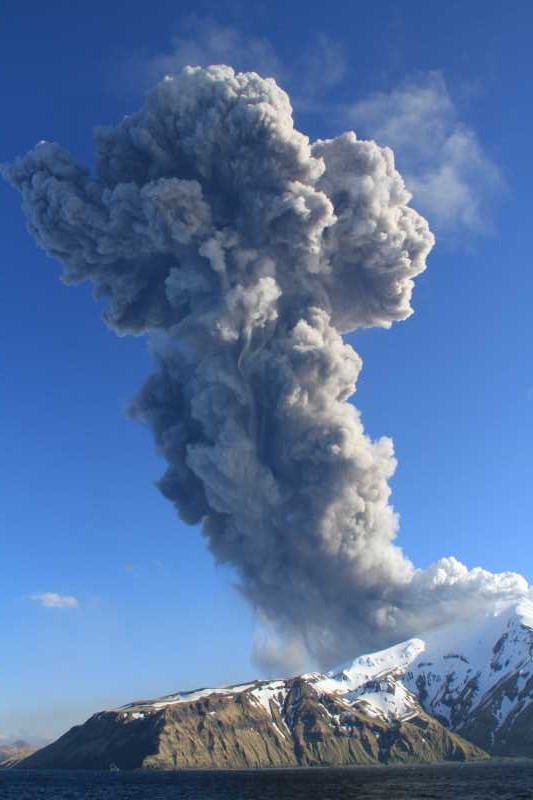
An earthquake swarm began May 24, 2021, and AVO raised the alert to WATCH and ORANGE on May 25. One hour and 39 minutes later, at 8:04 p.m. HADT, the volcano produced an explosion that sent an ash and gas plume northeast to about 15,000 feet above sea level, the summary said. The roughly two-minute blast was detected by seismic, infrasound and satellite data and by local observers. AVO called it an event “successfully forecasted by AVO in the hours prior.”
The explosion widened an older crater in the 1974 lava dome and hurled large blocks of old rock across an area about 1 mile in diameter, the summary said. It also left a trace ash deposit extending about 3 miles east-southeast and a lahar, or volcanic mudflow, that ran about 1.2 miles downslope to the south. AVO raised the alert to WARNING and RED that night, then lowered it to WATCH and ORANGE the next morning after seismic activity declined and ash emissions stopped.
The slow phase began weeks later. Satellite radar images showed a small new lava dome in the explosion crater on July 23, 2021, and no lava in images from July 14, meaning lava started erupting sometime in that window, according to AVO’s summary. AVO raised the alert to WATCH and ORANGE on July 23, 2021, the level it remains at today.
By early August 2021, lava had overflowed the explosion crater. In September it began spilling over the summit crater rim, eventually forming three lobes down the volcano’s steep flanks. By the end of 2021, the lava covered about 0.5 square mile, the summary said.
The pace of that first year was uneven. Lava erupted at an estimated 100 to 250 cubic feet per second in August 2021, then slowed to about 70 cubic feet per second in September and below 35 cubic feet per second by November, according to the summary. AVO located 966 earthquakes near the volcano during 2021, most of them within about 6 miles of the surface. Slow lava effusion continued into 2022 and, according to AVO’s current updates, has not stopped since.
A Pattern Seen Before
Great Sitkin is a basaltic andesite volcano that occupies most of the northern half of Great Sitkin Island in the Andreanof Islands, AVO said. It has a summit crater about 1 mile wide.
The current eruption echoes the past. A steep-sided lava dome built during a 1974 eruption has been mostly buried by the ongoing eruption, AVO said. That 1974 eruption produced at least one ash cloud that likely rose higher than 25,000 feet above sea level. A poorly documented eruption in 1945 also produced a lava dome.
AVO’s summary noted that the 2021 eruption “followed the pattern of the 1974 eruption: an explosive event followed by lava effusion in the summit crater.” Within the past 280 years, a larger explosive eruption sent pyroclastic flows into the Glacier Creek valley on the volcano’s southwest flank, AVO said.
What ORANGE Means for Aviation
AVO issues an aviation color code alongside each volcano’s ground-based alert level. Under the USGS system, as described by AVO, ORANGE means a volcano “is exhibiting heightened or escalating unrest with increased potential of eruption, timeframe uncertain, OR eruption is underway with no or minor volcanic-ash emissions.”
At Great Sitkin, that second definition applies: lava is erupting, but ash is not being thrown into the sky. The alert level WATCH is defined as an eruption “underway but poses limited hazards.”
AVO runs ash-dispersion models for restless volcanoes based on a hypothetical eruption. Its Great Sitkin page notes that the National Weather Service in Anchorage would issue any official ashfall warnings if an ash-producing eruption occurred.
Elsewhere in Alaska
Great Sitkin is the only Alaska volcano currently above NORMAL. AVO lowered Shishaldin Volcano on Unimak Island to NORMAL and GREEN on Nov. 2, 2026, following more than a year of elevated activity, saying unrest is slowly declining and an eruption is not expected at this time.
AVO’s daily updates on Great Sitkin are posted on the observatory’s website and through the USGS Volcano Notification Service.
