
Volcanoes have become active around the world, with a total of 40 eruptions underway today. The most recent eruption began and ended yesterday on the Big Island of Hawaii where the Kilauea Volcano erupted for the 50th time since the current eruption sequence began in December 2024. But Kilauea wasn’t the only volcano in the U.S. to blow its lid; the Great Sitkin Volcano in Alaska is also erupting, keeping volcanologists around the country and the world busy with the recent eruptive activity.
Lava fountaining episode 50 in Halemaʻumaʻu at the summit of Kilauea began at 10:10 am local time on June 27 and stopped abruptly at 5:10 pm after 7 hours of continuous fountaining from its north vent; unlike past eruptions, the south vent never fountained during this episode. The instantaneous effusion rate peaked at about 430 cubic yards per second between 10:30 and 11:00 am with an average effusion rate of 280 cubic yards per second for the entire fountaining episode. An estimated 6.4 million cubic yards of lava erupted and covered about 50% of the Halemaʻumaʻu crater floor. Lava erupted up to 1,000 feet into the air at the peak of yesterday’s eruption.
The Great Sitkin Volcano is located along the “Ring of Fire”, which is a region around the rim of the Pacific Ocean where many volcanic eruptions and earthquakes occur. Caused by plate tectonics, lithospheric plates under and around the Pacific Ocean move, collide, and/or are destroyed, creating the seismic activity the Ring of Fire is famous for.
Volcanoes in this portion of the Ring of Fire are monitored by the Alaska Volcano Observatory (AVO), which is a joint program of the U.S. Geological Survey (USGS), the Geophysical Institute of the University of Alaska Fairbanks (UAFGI), and the State of Alaska Division of Geological and Geophysical Surveys (ADGGS). The AVO is similar to the Hawaii Volcano Observatory (HVO) which monitors Hawaii’s three active volcanoes: Kilauea, Mauna Loa, and Hualalai. In the case of AVO, they monitor Cleveland, Semisopochnoi, and Veniaminof too.
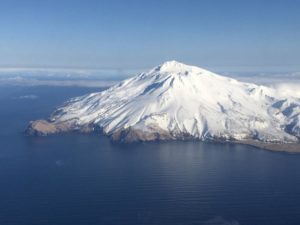
The Great Sitkin Volcano is a basaltic andesite volcano that occupies most of the northern half of Great Sitkin Island, a member of the Andreanof Islands group in the central Aleutian Islands. It’s located roughly 26 miles east of Adak, which is 1,192 miles southwest of Anchorage. According to the Alaska Volcano Observatory (AVO), the volcano has a composite structure consisting of an older dissected volcano and a younger parasitic cone with a 1.8 mile diameter summit crater. A steep-sided lava dome, emplaced during an eruption in 1974, occupies the center of the crater. Within the past 280 years, a large explosive eruption here produced pyroclastic flows that partially filled the Glacier Creek valley on the southwest flank.
According to AVO, minor seismicity and small rockfalls were detected over the past day. Clouds obscured views of the active lava dome in satellite and web camera imagery. The current eruption began in July 2021 and, since then, lava flows have filled most of the summit crater and advanced into valleys below. There have been no explosions at Great Sitkin Volcano since an event in May 2021. The volcano is monitored using local seismic and infrasound sensors, satellite data, webcams, and regional infrasound and lightning networks.
Alaska is home to many volcanoes, though; there are more than 130 volcanoes and volcanic fields which have been active within the geologically young last 2 million years. 50 have been active since the mid 1700s and AVO studies those too.
AVO is responsible for issuing Aviation Codes and Volcanic Activity Alert Levels. Aviation Codes are green, yellow, orange, or red. When ground-based instrumentation is insufficient to establish that a volcano is at a typical background level of activity, it is simply “unassigned.” While green means typical activity associated with a non-eruptive state, yellow means a volcano is exhibiting signs of elevated unrest above known background levels. When a volcano exhibits heightened or escalating unrest with the increased potential of eruption, it jumps to orange. Finally, when an eruption is imminent with significant emission of volcanic ash expected in the atmosphere or an eruption is underway with significant emission of volcanic ash into the atmosphere, the code becomes red. Volcanic Activity Alert levels are normal, advisory, watch, or warning. As with aviation codes, if data is insufficient, it is simply labeled as “unassigned.” When the volcano is at typical background activity in a non-eruptive state, it is considered normal. If the volcano exhibits signs of elevated unrest above background level, an advisory is issued. If a volcano exhibits heightened or escalating unrest, a watch is issued while a warning is issued when a hazardous eruption is imminent.
Kilauea is currently at a Yellow / Advisory level while Great Sitkin is at an Orange / Watch level.
Other volcanoes erupting around the world include Lewotobi, Lewotolok, Marapi, Merapi, Semeru, Ibu, and Dukono in Indonesia, Mayon, Taal, and Kanlaon in the Philippines, Home Reef and Tofua in Tonga, Ambae and Yasur in Vanuatu, Purace and Nevado del Ruiz in Columbia, Sabancaya in Peru, Krasheninnikov, Sheveluch, Poas in Costa Rica, Sangay in Ecuador, Manam, Langila, and Bagana in Papua New Guinea, Nyamulagira and Nyiragongo in DR Congo, Ol Doinyo Lengai in Tanzania, Aira and Suwanosejima in Japan, Saunders in the United Kingdom, Heard in Australia, Reventador in Ecuador, Popocatepetl in Mexico, Fuego and Santa Maria in Guatemala, Stromboli in Italy, and Erebus in Antarctica.
