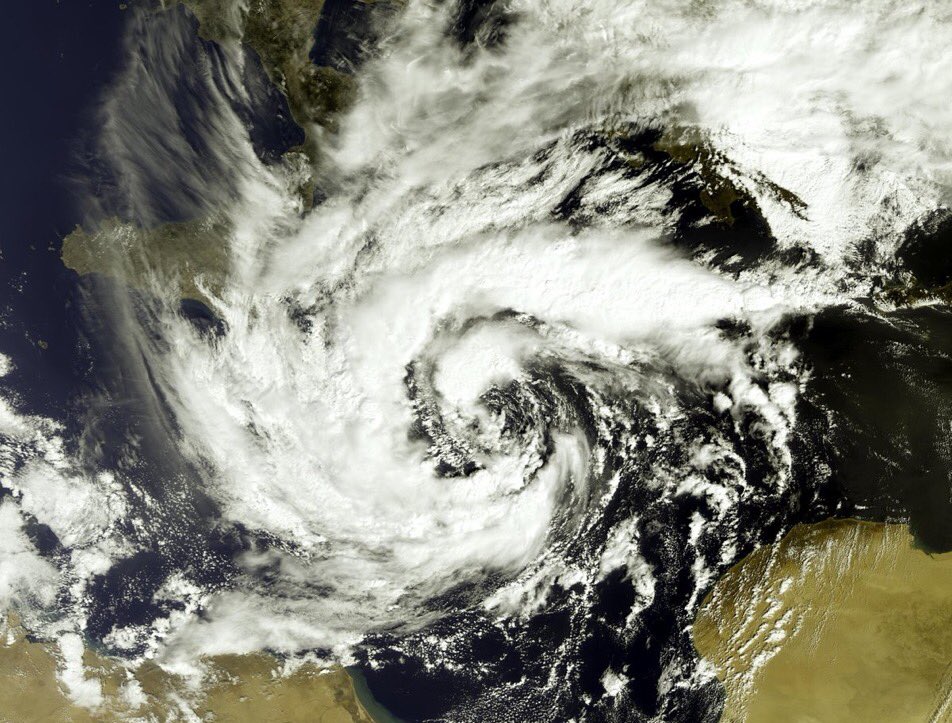
An unusual albeit not completely rare storm has formed in the Mediterranean Sea; because it resembles a hurricane, this type of system is being referred to as a “Medicane.” Tropical-like systems were first identified in the Mediterranean basin in the 1980’s when widespread satellite coverage showing tropical-looking low pressures which formed an eye in the centre were identified. Because the region around the Medieterranean is usally arid or dry, tropical cyclones rarely form here; between 1947 and 2011, only 100 tropical-like systems were recorded here.
Local media on the Greek Island Peloponnese reported winds over 73mph early Saturday as the storm came ashore and headed towards Bulgaria and Turkey. The storm is already blamed for 5 deaths in Tunisia due to storm related floods there.
Julian Heming, a tropical cyclone expert at the British Met Office weather service, said the storm was formed by a clash of cold air pushing south over the Balkans and warm air moving north from Africa. Hemings said, “However, as it has strengthened over the warm waters of the Mediterranean Sea it is starting to acquire some characteristics of a tropical cyclone.” She added in a statement, “Bands of thunderstorms are starting to wrap around the low pressure centre, although are not yet concentrated close to the centre as you might see in a fully ‘tropical’ cyclone.”
While these systems look dramatic on satellite, most storms don’t have the same punch as their oceanic siblings. In most cases, these storms have an intensity at or less than a tropical storm, although some have been recorded to get as strong as a category 1 hurricane. Because these storms are rare, there is no one body within the European Union that monitors their development or issues advisories for storm dangers like the National Hurricane Center does for waters around the continental United States.
Several notable and damaging Medicanes are known to have occurred. In September 1969, a North African Mediterranean tropical cyclone produced flooding that killed nearly 600 individuals, left 250,000 homeless, and crippled local economies. A Medicane in September 1996 that developed in the Balearic Islands region spawned six tornadoes, and inundated parts of the islands.
