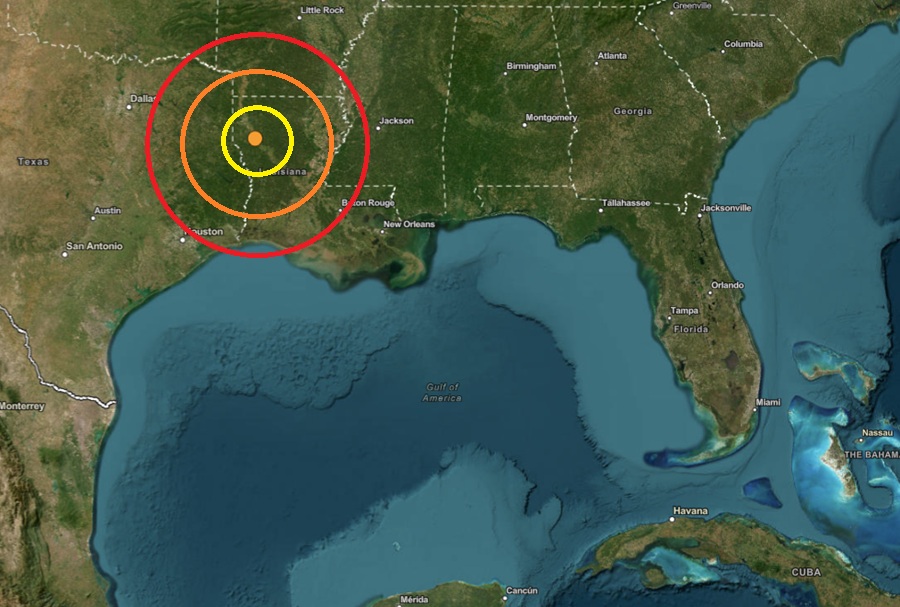
According to USGS, a relatively strong earthquake struck Louisiana this morning, rattling people out of their beds and homes from what would be rated the second strongest quake to ever hit the state. At 5:30 am today, a magnitude 4.9 earthquake struck Red River Parish in the northwest corner of Louisiana from a depth of 5.0 km. The epicenter is south of Shreveport, Louisiana, and east of Tyler, Longview, and Nacogdoches, Texas. The strongest earthquake on record in Louisiana remains a magnitude 5.3 event that struck Grand Isle on February 6, 2006. Today’s earthquake was also the strongest to strike North America over the prior 24 hours.
The area involved in today’s strong earthquake has been shaking quite a bit since December, with 8 earthquakes rated over 2.4 impacting he area.
USGS reports that more than 1,190 people used the “Did you feel it?” reporting tool on their website to report they felt today’s earthquake. According to USGS, earthquakes with a magnitude of 2.0 or less are rarely felt or heard by people, but once they exceed 2.0 , more and more people can feel them. While damage is possible with magnitude 3.0 events or greater, significant damage and casualties usually don’t occur until the magnitude of a seismic event rises to a 5.5 or greater rated event.
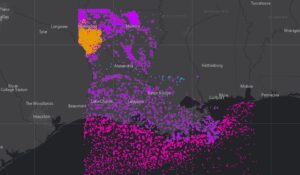
The Coushatta earthquakes are likely manmade. Louisiana does not regularly experience natural quakes due to its geology, but like in east Texas and Oklahoma it is believed an increase in shaking over recent years is due to the disposal of waste water generated from oil and gas extraction through injection into the ground.
Beginning in 2009, Oklahoma experienced a surge in seismicity according to USGS. “This surge was so large that its rate of magnitude 3 and larger earthquakes exceeded California’s from 2014 through 2017,” writes USGS in a report analyzing the increase in seismicity here. “While these earthquakes have been induced by oil and gas related process, few of these earthquakes were induced by fracking. The largest earthquake known to be induced by hydraulic fracturing in Oklahoma was a M3.6 earthquakes in 2019. The largest known fracking induced earthquake in the United States was a M4.0 earthquake that occurred in Texas in 2018. The majority of earthquakes in Oklahoma are caused by the industrial practice known as “wastewater disposal”. Wastewater disposal is a separate process in which fluid waste from oil and gas production is injected deep underground far below ground water or drinking water aquifers. In Oklahoma over 90% of the wastewater that is injected is a byproduct of oil extraction process and not waste frack fluid.”
According to USGS, this is not a seismically active part of the country. According to the Fractracker Alliance, though, the area of today’s activity is in an area rich of fracking and oil and gas production.
Due to the strength of today’s earthquake, USGS says there could be more. They’ve released an aftershock forecast, computing the odds of at least one aftershock within the next week. Right now USGS forecasts a less than 1% chance of a magnitude 6.0 or greater earthquake, a 1% chance of a magnitude 5.0 or greater earthquake, an 11% chance of a magnitude 4.0 or greater earthquake, and a 41% chance of a magnitude 3.0 or greater earthquake. USGS also says there’s a 65% chance that a magnitude 3.0 or greater earthquake will strike here within the next year.
