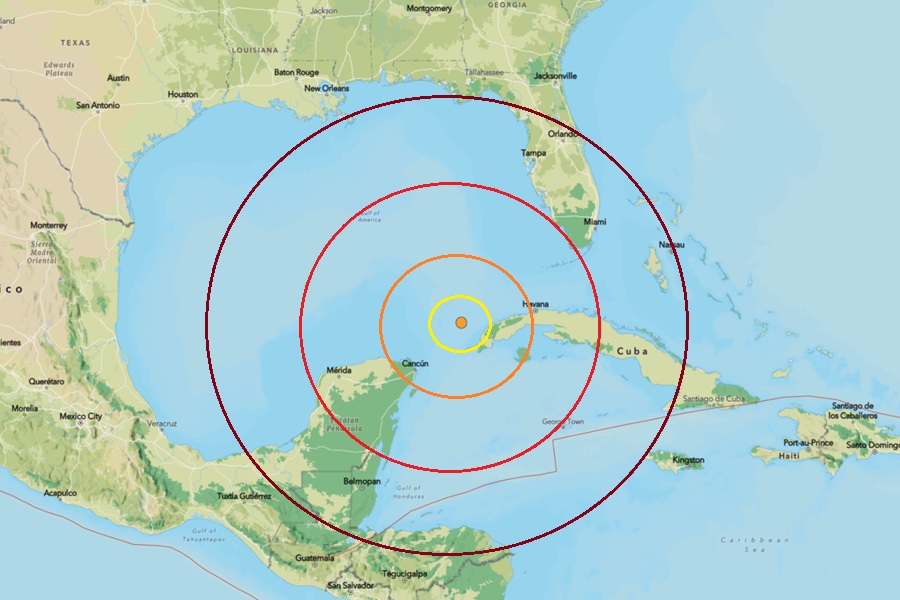
For the third time in 7 days, a strong earthquake by Gulf of America standards struck the body of water just west of Cuba, not far from where the previous earthquakes struck. According to USGS, the magnitude 4.9 earthquake struck at 1:37 pm this afternoon from a depth of 19.8 km about 98 km west-northwest of Mantua, Cuba. The first earthquake which struck last Monday was the strongest at 6.1; the second earthquake, which struck last Tuesday was the weaker of the three as a magnitude 4.3 event. The intensity and volume of earthquakes is very unusual for this area.
While the stronger quake earlier last week triggered tsunami bulletins, this latest earthquake didn’t.
USGS says that earthquakes with a magnitude of 2.0 or less are rarely felt or heard by people, but once they exceed 2.0 , more and more people can feel them. While damage is possible with magnitude 3.0 events or greater, significant damage and casualties usually don’t occur until the magnitude of a seismic event rises to a 5.5 or greater rated event.
The National Weather Service’s Pacific Tsunami Warning Center (PTWC), which is also responsible for issuing Tsunami Advisories and Warnings to the Gulf of America and U.S. East Coasts, issued a bulletin shortly after the earthquake last Monday. “Based on all available data, there is no significant tsunami threat from this earthquake,” the PTWC said. They added, “However, there is a very small possibility of tsunami waves along coasts located nearest the epicenter.”
“There is no tsunami danger for the U.S. east coast, the Gulf of America states, or the eastern coast of Canada,” wrote PTWC in an additional bulletin to address other areas exposed to tsunami threats.
More than 3,600 people across much of Florida used the “Did you feel it?” online reporting tool at the USGS website to report feeling the earthquake last Monday. The same didn’t happen with this latest earthquake, which was much weaker and a bit more west than the first. However, this earthquake was stronger than the second one to strike the Gulf.
Tsunamis are giant waves caused by earthquakes or volcanic eruptions under the sea. Out in the depths of the ocean, tsunami waves do not dramatically increase in height. But as the waves travel towards land, they build up to higher and higher heights as the depth of the ocean decreases. The speed of tsunami waves depends on ocean depth rather than the distance from the source of the wave. Tsunami waves may travel as fast as jet planes over deep waters, only slowing down when reaching shallow waters. While tsunamis are often referred to as tidal waves, this name is discouraged by oceanographers because tides have little to do with these giant waves.
A tsunami is a series of waves not simply a single event. The time between wave crests can vary from 5 minutes to an hour. The hazard may persist for many hours or longer after the initial wave. Impacts can vary significantly from one section of coast to the next due to local bathymetry and the shape and elevation of the shoreline. Impacts can also vary depending upon the state of the tide at the time of the maximum tsunami waves.
While the Pacific is better known for tsunamis, tsunami can and does occur in the Atlantic basin too. As with the Pacific basin, earthquakes can trigger a tsunami threat for the U.S. East and Gulf coasts. According to USGS, submarine landslides can be one result of an Atlantic-based quake. An offshore earthquake with a magnitude 4.5 or greater can destabilize the continental shelf, causing massive underwater avalanches. These landslides displace large volumes of water and can generate significant, localized tsunamis. This was the case during the 1929 Grand Banks earthquake near Canada, which caused a destructive localized tsunami. Distant tectonic earthquakes can also create problems; massive earthquakes along faults further away in the Atlantic, such as the Azores-Gibraltar Transform Fault near Portugal or the Puerto Rico Trench in the Caribbean, are capable of generating tsunami waves that travel across the ocean. While the infamous 1755 Lisbon earthquake created a trans-Atlantic tsunami that was recorded on the East Coast, the height of the waves reaching the US mainland was relatively small but different earthquake intensities and locations can trigger very different results.
It is very unusual for earthquakes to hit the Gulf of America. Last Monday’s earthquake was the strongest on record. The next strongest earthquake hit on September 10, 2006 when a magnitude 5.9 earthquake struck the central Gulf of Mexico. The next strongest earthquake on record hit on February 10, 2006 near Grand Isle, Louisiana; it was a magnitude 5.3 quake.
