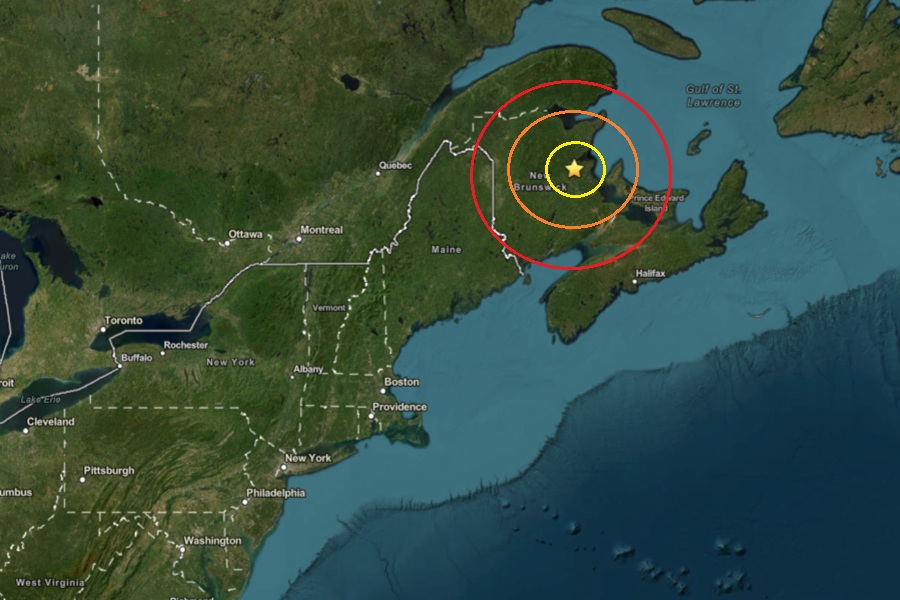
An afternoon earthquake rattled New Brunswick, Canada this afternoon. While felt within New Brunswick area, it is unlikely it would have been felt in the northeastern U.S. According to USGS, the magnitude 3.1 earthquake struck at 2:55 pm this afternoon from a depth of 10 km near the town of Miramichi in New Brunswick. The earthquake was also confirmed by the Canadian equivalent of USGS, Earthquakes Canada. Earthquakes Canada confirmed the earthquake, saying it was the 106th earthquake to strike the region in the last 30 days. Of the 106 earthquakes to strike the area, most were rated under a magnitude 2.0 event and were located around the St. Lawrence River; 29 of the 106 earthquakes were rated as strong or stronger than today’s.
According to Earthquakes Canada, earthquakes in New Brunswick occur with a continuing low level of seismic activity as part of the Northern Appalachians Seismic Zone. While minor events and felt tremors happen occasionally, moderate-to-large damaging earthquakes are rare and sporadic.
The most notable earthquake to strike the region struck near today’s in 1982. During that event, central New Brunswick experienced a magnitude 5.7 and 5.8 earthquake followed by extensive aftershocks.
According to USGS, earthquakes with a magnitude of 2.0 or less are rarely felt or heard by people, but once they exceed 2.0 more and more people can feel them. While damage is possible with magnitude 3.0 events or greater, significant damage and casualties usually don’t occur until the magnitude of a seismic event rises to a 5.5 or greater rated event.
According to the Maine Geological Survey with the Department of Conservation, seismic activity in Maine is typical of the Appalachian region of northeastern North America. “There is a low but steady rate of earthquake occurrence,” they report, adding that “The earthquakes are presumably caused by modern stress being released occasionally along zones of weakness in the earth’s crust, but a more specific cause for the earthquake activity is not known.”
