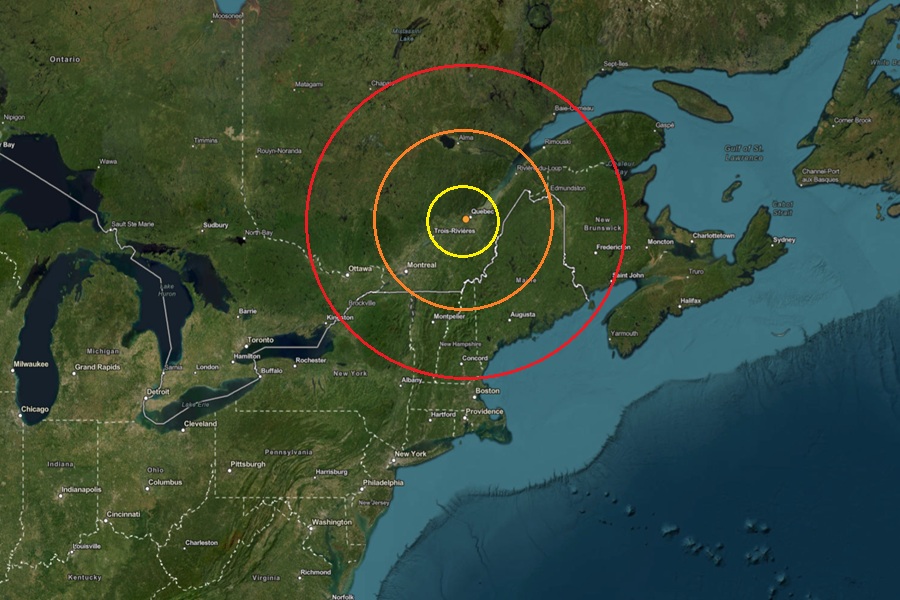
An evening earthquake rattled Quebec on Sunday, adding to the overall number of earthquakes that have impacted southeastern Canada and the northeastern United States in recent weeks. According to USGS, a relatively weak magnitude 2.7 earthquake struck from a depth of 10.5 km near L’Ancienne-Lorette, just outside of Quebec. While the earthquake struck Canada, more than a dozen people used the USGS website in the U.S. to report they felt the earthquake. The earthquake hit at 8:33 pm last night.
In Canada, though, more than 2,100 people reported shaking from the earthquake to the Canadian equivalent of USGS, Earthquakes Canada. People felt varrying degrees of shaking, with the most abrupt movement closest to the city of Quebec. This latest earthquake comes just after another jolt struck New Brunswick in recent days.
According to Earthquakes Canada, seismic activity in Quebec is fairly common, with hundreds occurring across eastern Canada each year, though most are small and unfelt. There are three primary seismic zones around Quebec: Charlevoix-Kamouraska, Western Quebec, and Bas-Saint-Laurent and Côte-Nord. The Charlevoix-Kamouraska area is the most active zone in the province, producing over 200 earthquakes annually. Western Quebec, which covers the Ottawa Valley, Montreal, and the Laurentians has smaller events felt regularly. Lastly, Bas-Saint-Laurent and Côte-Nord, located along the St. Lawrence estuary, experiences regular low-magnitude activity.
According to USGS, earthquakes with a magnitude of 2.0 or less are rarely felt or heard by people, but once they exceed 2.0 more and more people can feel them. While damage is possible with magnitude 3.0 events or greater, significant damage and casualties usually don’t occur until the magnitude of a seismic event rises to a 5.5 or greater rated event.
According to Earthquakes Canada, eastern Canada will see about 450 earthquakes each year, with 25-50 of them strong enough to be felt by residents like this latest quake in Quebec. On average there are 4 earthquakes with a magnitude 4.0 or greater each year, with larger damaging quakes possible but uncommon. Western Canada is far more active; with more than 4,500 earthquakes measured every year there.
