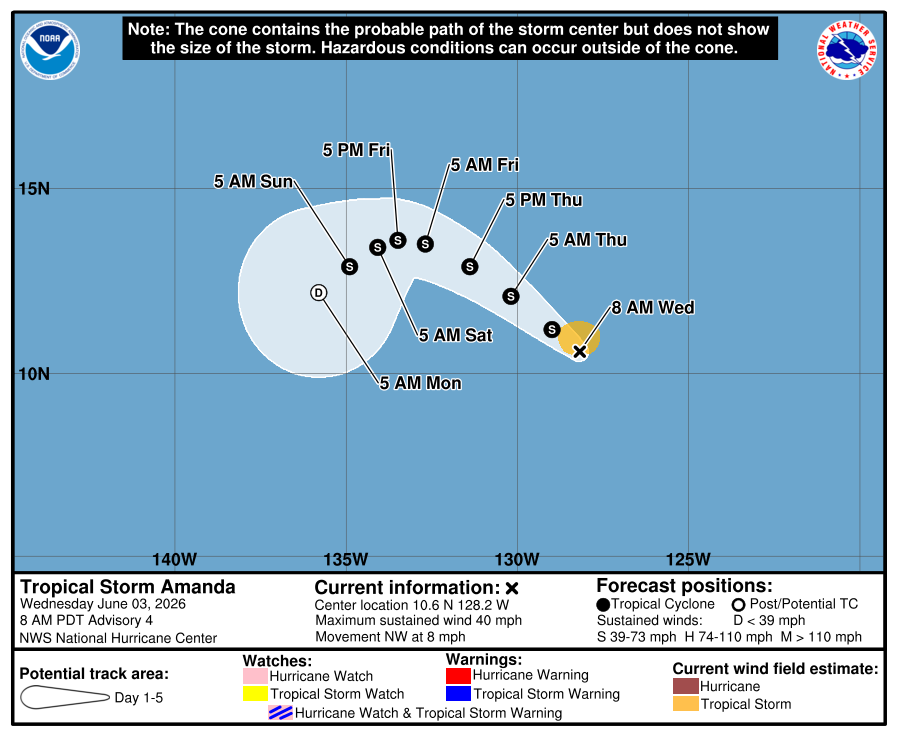
The first named tropical storm of the 2026 Hurricane Season has formed and the National Hurricane Center has named it Amanda. Located well east of Hawaii in the Eastern Pacific hurricane basin, the storm is of no threat to land at this time nor is it expected to be over the next week. Beyond then, though, it is too soon to say with great certainty whether the storm or what’s left of it will impact Hawaii. Elsewhere in the Central Pacific and Atlantic Hurricane Basins, there are no other named tropical systems.
Right now, Tropical Storm Amanda was located near latitude 10.6 North, longitude 128.2 West which is 1,475 miles west-southwest of the southern tip of Baja California. Amanda is moving toward the northwest near 8 mph and the National Hurricane Center (NHC) expects this motion to continue through Friday. A turn toward the west and west-southwest at a slower forward motion is forecast this weekend.
Maximum sustained winds have increased to near 40 mph with higher gusts. Additional strengthening is forecast during the next couple of days. However, as the storm moves west over colder waters, a weakening trend is forecast later this weekend. Tropical-storm-force winds extend about 60 miles from the center of the storm.
Both the American GFS and European ECMWF global computer forecast models keep the system well south and east of Hawaii for the next week or two. With high pressure in place over the islands, the storm should avoid Hawaii for now but interests in Hawaii should continue to keep an eye on this system and any other disturbance that could form in the basin that surrounds it.

In recent weeks, NOAA has unveiled their outlooks for the Atlantic and Central Pacific Hurricane basins, saying the role of the El Nino weather pattern is expected to have a significant impact on setting the stage for an above-normal season around Hawaii and a below-normal season around the U.S. East and Gulf coasts. Regardless of the number of storms that materialize in each basin, forecasters still say it just takes one storm to create a catastrophe somewhere.
Forecasters with NOAA’s National Weather Service are predicting a below-normal hurricane season for the Atlantic basin this year. NOAA’s outlook for the 2026 Atlantic hurricane season predicts a 35% chance of a near-normal season, a 10% chance of an above-normal season, and a 55% chance of a below-normal season. NOAA scientists expect the opposite for the Central Pacific basin, saying that there’s a high probability of 5 to 13 tropical cyclones of at least tropical depression strength in the Central Pacific basin, which is far above the average of 4 to 5 tropical cyclones.
While a below-normal season is expected in the Atlantic, a good number of storms are still expected to form. NOAA is forecasting a total of 8-14 named storms with winds of 39 mph or higher. Of those, 3-6 are forecast to become hurricanes with winds of 74 mph or higher, including 1-3 major hurricanes. A major hurricane is a category 3, 4 or 5 storm on the Saffir-Simpson wind scale with winds of 111 mph or higher. In the Atlantic, an average season has 14 named storms with seven hurricanes, including three major hurricanes.
The Atlantic season is expected to be below-normal due to competing factors. El Niño is expected to develop and intensify during the hurricane season, while ocean temperatures in the Atlantic are expected to be slightly warmer than normal and trade winds are likely weaker than average. El Niño conditions tend to support less tropical storms and hurricanes in the Atlantic, while warmer ocean temperatures and low winds support a more active year.
In Hawaii, El Nino is expected to have the opposite impact, providing an abundance of oceanic heat to fuel storms there.
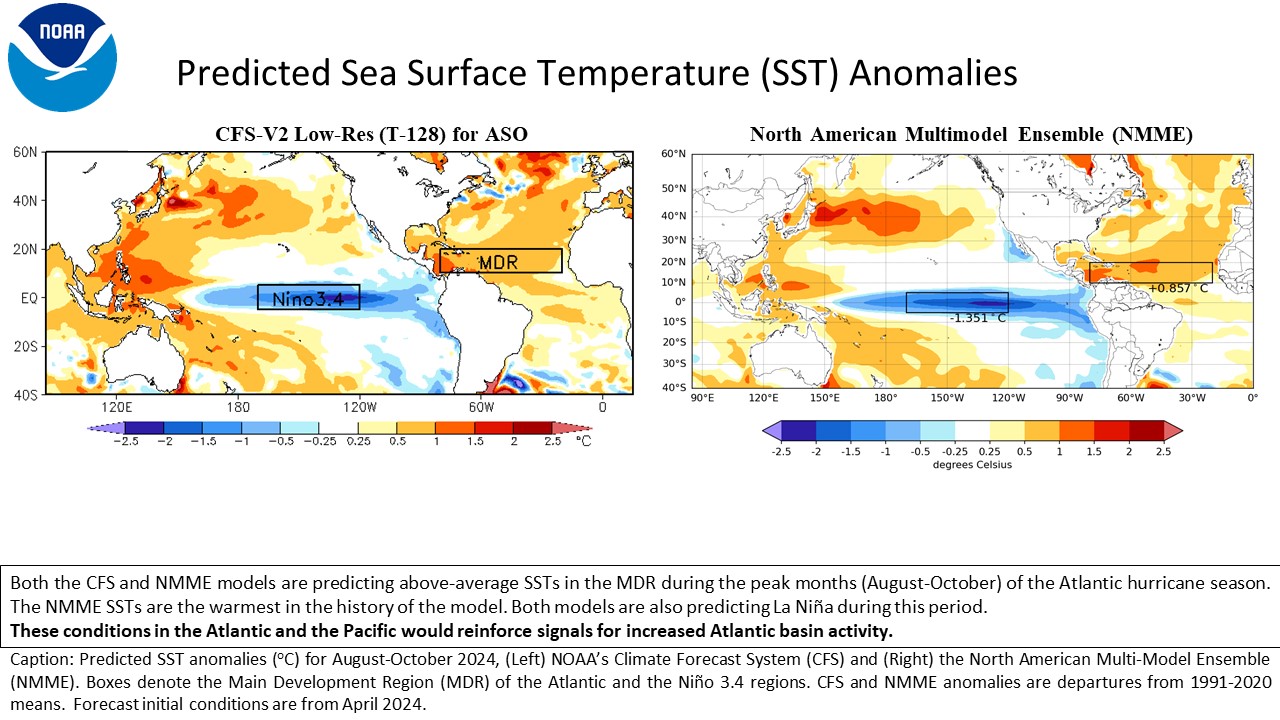
The most recent forecast from the NOAA Climate Prediction Center indicates El Niño conditions are expected throughout the hurricane season. The ENSO influence on eastern and central Pacific hurricane activity is highly dependent upon the background sea surface temperature (SST) patterns across the eastern tropical Pacific and the Atlantic hurricane Main Development Region (MDR). For 2026, the tropical Pacific is most likely to experience a moderate or stronger El Niño. The El Niño conditions and lack of strong forcings (SSTs near normal) in the Atlantic are likely to support higher levels of activity in the East Pacific. Strong El Niño conditions are typically associated with dramatically elevated levels of activity in the central Pacific.
NOAA also says the latest monthly SST anomalies reflect ENSO-neutral conditions, a negative Pacific Decadal Oscillation (PDO) structure, and North Atlantic SSTs just slightly above-normal for much of the basin. The transition to El Niño will likely shift the projection onto the PDO toward zero or even into positive PDO territory. Historically, this combination has resulted in more tropical cyclone activity for the eastern and central Pacific.
At the National Tropical Weather Conference on South Padre Island, Texas in April, hurricane experts gathered to discuss the upcoming hurricane season. While the focus was on the Atlantic Hurricane Basin, where there was a collective sigh of relief that the Atlantic may see a below-normal hurricane season, there were concerns that the inverse may be true in the Pacific where Hawaii could be a sitting duck for an active season.
“We anticipate that the 2026 Atlantic basin hurricane season will have somewhat below normal activity,” the official CSU outlook states. “Current weak La Niña conditions are likely to transition to El Niño in the next few months, with the potential for a moderate/strong El Niño for the peak of hurricane season,” they add.
Dr. Phil Klotzbach said NOAA forecasters say there is a 90% chance of an El Nino event during the peak of hurricane season.
ENSO, short for El Nino Southern Oscillation, is a recurring climate pattern involving changes in the temperature of waters in the central and eastern tropical Pacific Ocean. On periods ranging from about three to seven years, the surface waters across a large swath of the tropical Pacific Ocean warm or cool by anywhere from 1°C to 3°C, compared to normal. This oscillating warming and cooling pattern, referred to as the ENSO cycle, directly affects rainfall distribution in the tropics and can have a strong influence on weather across the United States and other parts of the world. El Niño and La Niña are the extreme phases of the ENSO cycle; between these two phases is a third phase called ENSO-neutral. While this phenomena impacts the entire United States, Hawaii may find itself particularly vulnerable this year to bad weather conditions.
Dr. Phil Klotzbach said Hawaii is a relatively small chain of islands in a very large ocean at their seasonal outlook unveiling. He added that even with an active season, because the basin is so large and the islands are relatively small, it’s possible even an active season in the Central Pacific could lead to no or a low number of landfalls.
Deputy Director of the National Hurricane Center, Jaime Rhome, urged caution for Hawaii. “Usually when the Atlantic is quiet, the Pacific perks up.”
The CSU forecasters say, “As with all hurricane seasons, coastal residents are reminded that it only takes one hurricane making landfall to make it an active season. Thorough preparations should be made every season, regardless of predicted activity.”
“Although El Niño’s impact in the Atlantic Basin can often suppress hurricane development, there is still uncertainty in how each season will unfold,” said NOAA’s National Weather Service Director Ken Graham. “That is why it’s essential to review your hurricane preparedness plan now. It only takes one storm to make for a very bad season.”
“Our geography makes preparedness even more important because we are the most isolated populated landmass on the planet here,” said Hawaii Governor Josh Green. “If we ever had a severe hurricane come and take out our harbor, we would be on our own for a while, and so that’s why you have to be prepared.”
“Preparing now for hurricane season — and not waiting for a storm to threaten — is essential for staying ahead of any storm. Visit weather.gov/safety and Ready.gov for important preparedness information,” added Graham.