
The United Nations (UN) says they are preparing for an “observing exercise” as mysterious interstellar object 3I/Atlas approaches Earth. Harvard astrophysicist Avi Loeb says more needs to happen and is urging the UN to flush out a policy to deal with alien encounters.
This mysterious object was discovered on July 1, 2025 by the NASA-funded ATLAS survey telescope at Río Hurtado, Chile. This newly discovered object was entering the inner Solar System at a speed of 140,000 mph relative to the Sun and was located 325 million miles from Earth. It was initially moving in the sky along the border of the constellations Serpens Cauda and Sagittarius, near the galactic plane. These initial observations initially suggested that the object could be on a highly eccentric path that might come close to Earth’s orbit, which led the International Astronomical Union Minor Planet Center to list the object on the Near-Earth Object Confirmation Page until the orbit could be confirmed. Because it is the third confirmed interstellar object passing through the Solar System, it was given the prefix “3 I” after 2I, known as Borisov, and 1I known as ‘Oumaumua.
However, the interstellar object is not behaving like a typical comet. The object had an unexplained increase in speed after passing close to the Sun. And unlike normal comets, 3I/ATLAS shows no visible gas or dust emissions that could explain its acceleration. If anything, it is exhibiting unusual jets both towards and away from the Sun which also defies expectations of a comet.
One scientists that has been very vocal about this interstellar object is Avi Loeb; he believes it may be an alien spacecraft. Avi Loeb is the head of the Galileo Project, founding director of Harvard University’s Black Hole Initiative, director of the Institute for Theory and Computation at the Harvard-Smithsonian Center for Astrophysics, and the former chair of the astronomy department at Harvard University (2011–2020). He is a former member of the President’s Council of Advisors on Science and Technology and a former chair of the Board on Physics and Astronomy of the National Academies. He is the bestselling author of “Extraterrestrial: The First Sign of Intelligent Life Beyond Earth” and a co-author of the textbook “Life in the Cosmos”, both published in 2021. The paperback edition of his new book, titled “Interstellar”, was published in August 2024.
The famous astrophysicist continues to publish on his blog on Medium his thoughts on this new object, including things that suggest it’s more of a manufactured object than a natural comet. His posts on Medium can be found here: https://avi-loeb.medium.com/
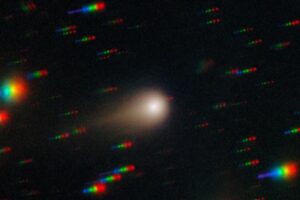
“Given the large-scale jets reported recently, the fact that 3I/ATLAS remains a single body is surprising for a natural comet. In particular, the large-scale image of 3I/ATLAS reported here on November 9, 2025 shows jets reaching out to ~1 million kilometers towards the Sun and ~3 million kilometers in the opposite direction, as discussed here. For a natural comet, the outflow velocity of the jets is expected to be 0.4 kilometers per second, of order the sound speed of gas at the distance of 3I/ATLAS from the Sun. At that speed, the jets must have persisted over a timescale of 1–3 months,” writes Loeb. He also adds later in his entry, “Technological thrusters which point their exhaust towards the Sun would accelerate away from the Sun. This post-perihelion maneuver might be employed by a spacecraft that aims to gain speed rather than slow down through the gravitational assist from the Sun,” writes Loeb.
Scientists, including Loeb, are awaiting new imagery and data to learn more about this interstellar object and determine what exactly it is.
Time if of the essence: the object is approaching Earth and will be at its closest point to the planet in just a few weeks on December 19, 2025.
The United Nations is tracking the interstellar object too. Through their Office for Outer Space Affairs (UNOOSA) , they said, “Interstellar comet 3I/ATLAS offers a fantastic opportunity for the International Asteroid Warning Network (IAWN) community to conduct an observing exercise. Its prolonged observability and scientific interest make it an ideal target!” Coordinated by NASA’s Planetary Defense Coordination Office (PDCO), IAWN is a global network of observatories established in 2013 by the UN Committee on the Peaceful Uses of Outer Space, alongside the Space Mission Planning Advisory Group (SMPAG). UNOOSA works with both IAWN and SMPAG in coordinating global efforts to share information and plans on how to respond to any potential hazardous asteroids and comets.
“The 3I/ATLAS campaign marks the 8th IAWN observing campaign. The exercise is designed for IAWN astronomers to refine techniques for determining comet positions — a complex task, as comets appear as diffuse, extended objects rather than the point-like asteroids typically observed in telescope images,” the UNOOSA office said.

But while UN plans to observe, Loeb wants much more done. Loeb argues that the absence of a coordinated response plan is a “policy blind spot of existential proportion.” In remarks shared with several scientific outlets, Loeb urged the United Nations Office for Outer Space Affairs (UNOOSA) to create “clear diplomatic, scientific, and ethical frameworks” for contact scenarios—whether through radio signals, recovered artifacts, or direct engagement.
In a letter to the UN, Loeb wrote, “The operation of the Vera C. Rubin Observatory’s Legacy Survey of Space and Time (LSST) marks a transformative moment in humanity’s capacity to detect and characterize interstellar objects (ISOs). With projections indicating an increase from a few detections per decade to potentially one every few months, humanity stands at the threshold of unprecedented scientific opportunity offering revolutionary insights into the nature of rocky materials, building blocks of life and technological products from other star systems.”
In his detailed policy recommendations, Loeb says, “The choice is clear: proceed with fragmented national efforts that risk missing critical observations for assessing unprecedented global threats from interstellar space, or unite our capabilities to ensure that no interstellar object passes through our solar system without yielding its scientific information content. The latter path offers not just superior science, but a model for addressing other global challenges through coordinated international action.”
With 3I/Atlas approaching Earth, some point to the 1977 science fiction motion picture, “Close Encounters of the Third Kind” as a framework of positive interaction with extraterrestrial life. Written and directed by Steven Spielberg, the movie follows an Indiana man, Roy Neary, whose life is turned upside down after a close encounter with a UFO. The film follows his obsessive quest for answers, which leads him to a group of scientists and another individual who has had similar experiences The film also follows a team of international scientists, led by the French researcher Claude Lacombe, who are investigating a series of global UFO sightings and trying to understand the messages being sent by the extraterrestrials. The various plotlines converge at Devil’s Tower, a National Monument in Wyoming, where the aliens have orchestrated a massive, peaceful first contact with humanity, returning people they had taken and preparing for a final, awe-inspiring exchange. Unlike many other motion pictures featuring interactions with space aliens, this movie presents the extraterrestrials as peaceful beings, focusing on themes of wonder, human curiosity, and a search for something greater.
Whether 3I/Atlas is a comet or an alien spacecraft, as Loeb suggests, Loeb wants to make sure a global framework is in place for what he sees as an inevitable interaction with humans and non-humans from space.
