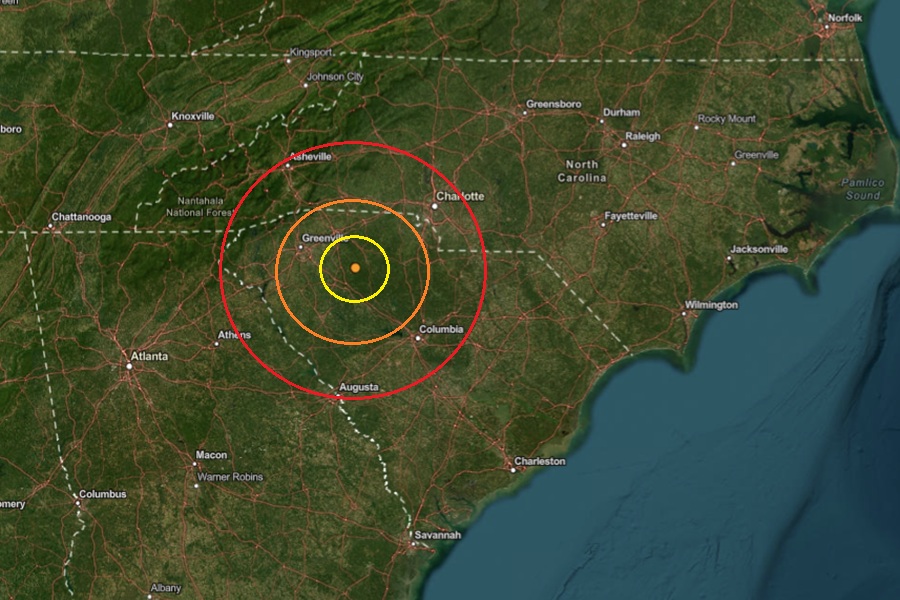
Something unusual is happening in South Carolina and there are more questions than answers being shared about recent earthquakes and explosions in the Palmetto State. The latest event involved a pair of weak earthquakes which struck on Friday between Columbia and Greenville and also between Columbia and Spartanburg, not far from where an unexplained explosion and sonic boom occurred. Over a year, South Carolina typically will see 10-15 earthquakes; that number is now up to 79 for just the last 12 months.
The first of two earthquakes to strike yesterday near Cross Anchor, South Carolina arrived at 6:05 pm. USGS measured that seismic event as a magnitude 1.8 event, with the epicenter pegged at 6.8 km deep.
The second earthquake struck 1 mile east of the first 17 minutes later at 6:22 pm. Unlike the first, the epicenter of this second earthquake was very shallow, measured by USGS at only 1.6 km. The second earthquake was a bit stronger and was rated a magnitude 1.9 event.
This pair of earthquakes was unusual in that there was no other seismic activity recorded within 25 miles over the last 3 weeks.
According to USGS, earthquakes with a magnitude of 2.0 or less are rarely felt or heard by people, but once they exceed 2.0 , more and more people can feel them. While damage is possible with magnitude 3.0 events or greater, significant damage and casualties usually don’t occur until the magnitude of a seismic event rises to a 5.5 or greater rated event.
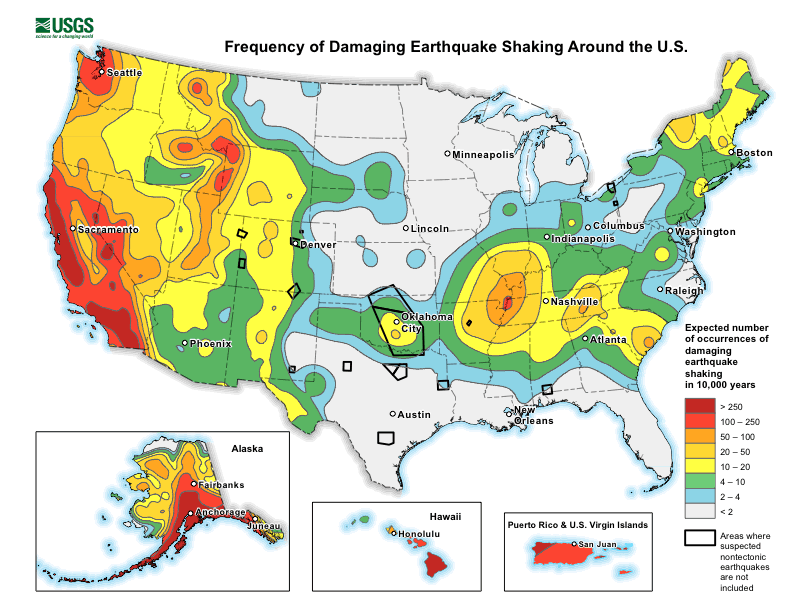
According to the South Carolina Emergency Management Division (SCEMD), approximately 10 to 15 earthquakes are recorded annually in South Carolina with 3 to 5 of them felt or noticed by people. About 70 percent of South Carolina earthquakes are located in the Middleton Place-Summerville Seismic Zone.
The two most significant historical earthquakes to occur in South Carolina were the 1886 Charleston/Summerville earthquake and the 1913 Union County earthquake. The 1886 earthquake in Charleston was the most damaging earthquake to ever occur in the eastern United States. In terms of lives lost, human suffering and devastation, this was the most destructive United States earthquake in the 19th century.
SCEMD says, “Earthquakes in South Carolina have the potential to cause great and sudden loss because devastation can occur in minutes. While there have not been any large-scale earthquakes in South Carolina in recent years, a 2001 study (Comprehensive Seismic Risk and Vulnerability Study for the State of South Carolina) confirmed the state is extremely vulnerable to earthquake activity.” That study probed the potential impacts of earthquakes on the current population and on contemporary structures and systems, including roadways, bridges, homes, commercial and government buildings, schools, hospitals and water and sewer facilities.

This latest pair of quakes isn’t too far from an area impacted by some kind of explosion and sonic boom on Thursday. Experts aren’t sure what the causse was; they are just certain it wasn’t an earthquake. NASA says they believe the explosion happened because of something Earth-based. “We have no eyewitness reports of a fireball and no satellite detections of a meteor over the area at the time,” said Bill Cooke, lead for NASA’s Meteoroid Environments Office. The American Meteor Society, which also tracks and reports on meteor sightings, also said they saw no evidence of a space-based event behind the boom.
At 5:24 pm on Thursday, people around the greater Columbia metro area started reporting hearing and feeling a large explosion. USGS confirmed the presence of the boom but because their equipment is calibrated to measure earthquakes and not sonic booms, they declared it a 0.0 magnitude seismic event and broadly painted it as a “sonic boom” event. The sudden explosive bang and resulting vibrations triggered widespread inquiries and reports across multiple counties, though no official cause or source has been publicly identified by authorities including those tied to the U.S. military.
A sonic boom is a massive, thunder-like noise caused by shock waves when an object travels through the air faster than the speed of sound. As an object moves through the air, it pushes air out of the way, creating continuous ripples of pressure waves that travel outward at the speed of sound. When the object reaches supersonic speeds it moves faster than its own sound, outrunning the pressure waves it is creating These pressure waves pile up and compress in front of the object, eventually merging into a single, massive, cone-shaped shock wave. As this cone trails behind the object and sweeps across the ground, observers hear it as a sudden, loud explosion or boom.
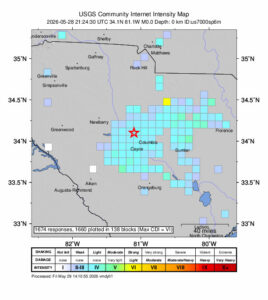
The South Carolina Emergency Management Division also confirmed the sonic boom but was unable to confirm its source.
USGS released this statement: “This event is not an earthquake. The recorded waves and eyewitness reports are consistent with a sonic boom. Because earthquake magnitude scales are calibrated for seismic waves that travel through the Earth, our standard magnitude calculation methods do not apply to sonic booms. Therefore, we manually assigned a magnitude of 0.0. Given that the source of a sonic boom is moving, the location and origin time are also approximate and are based on the arrival times of the sound waves at seismic stations, as well as the locations of eyewitness reports.”
In recent months, South Carolina has had other mysterious swarms of earthquake activity and scientists have been unable to confirm why they’ve been happening.
A swarm of earthquakes struck earlier this year on the east side of Lake Murray, a 50,000-acre reservoir held back by a dam. If the dam broke from a natural disaster like an earthquake, it would send roughly 650 billion gallons of water into nearby communities. According to Kim Stenson, the Director of the South Carolina Emergency Management Division, a breach of the dam would subject the nearby Midlands area to catastrophic flooding, with water reaching south of I-20 into the Congaree Swamp. That swarm has stopped and the dam is in no danger of failing, but questions remain behind the unusual seismic activity there.

A more puzzling earthquake swarm has been on and off again near the town of Elgin. Unusual seismicity started there in December of 2021. On Monday, December 27, 2021 at 2:18 pm in the afternoon, an unusual earthquake struck around Elgin, with dozens reported in 2022, 2023, and 2024. That first 3.3 magnitude earthquake hit 30 miles north of Columbia, South Carolina at a depth of only 3.1 km. More than 3,100 residents reported to USGS they felt it at the time, with one report of shaking coming from as far away as Rock Hill, which is at the North/South Carolina state border. While many felt the earthquake, there was no reported damage in the Palmetto State. That earthquake was followed by 10 more ranging in intensity between a magnitude 1.5 to a magnitude 2.6 event. The second earthquake struck three hours twenty minutes after the first one. The last earthquake in that series struck on the morning of January 5, bringing a temporary end to the earthquakes there. But the swarm returned many times throughout 2022, rattling locals and unnerving local officials that weren’t sure of their source or cause.
According to USGS, a swarm is a sequence of mostly small earthquakes with no identifiable mainshock. “Swarms are usually short-lived, but they can continue for days, weeks, or sometimes even months,” USGS adds. However, the South Carolina event doesn’t fit the typical definition of a swarm since the first event was substantially larger than the rest.
USGS has been unable to say with certainty why earthquakes are occurring here. In 2022, scientists tied with the University of South Carolina’s School of Earth, Ocean, and Environment teamed up with Georgia Tech to install 86 nodal seismometers in and around the area experiencing this ongoing swarm near Elgin. Scientists don’t know what’s driving this earthquake activity and the data from these devices have yet to provide crystal clear clarity to geologists in what’s happening under ground there.
