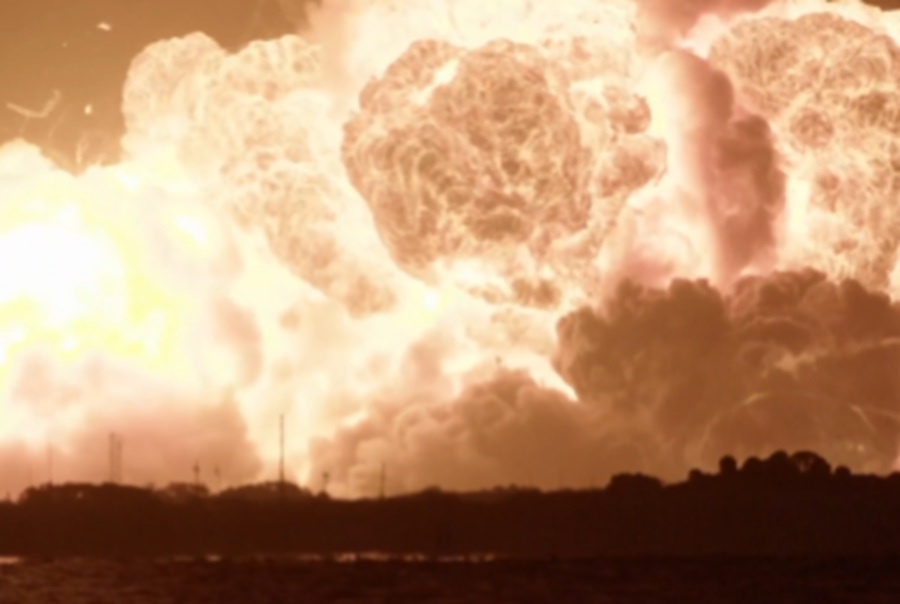
Thursday was an explosive day in the eastern United States, with explosions occurring in Upstate New York, over central South Carolina, and on the Florida Space Coast. The New York incident was captured by weather satellite while the South Carolina event was captured by USGS seismographs logging earthquake activity. The Florida event is now a record-breaking explosion, bringing a fiery end to a booming day.
At around 5am, people across western New York reported loud booms that shook their homes as a glowing object moved overhead. Scientists describe the phenomena over New York as a “bolide” incident, which is an exceptionally bright meteor capable of producing an explosion as it moves through and breaks-up in the Earth’s atmosphere. With the disintegrating meteor traveling faster than the speed of sound, a sonic boom was generated which shook trees, homes, and people.
The first explosion of the day came from space: a meteor shot across the dark sky of New York State, waking people up by its loud boom: https://t.co/8PrwZrugFg
— the Weatherboy (@theWeatherboy) May 29, 2026
A meteor, often referred to as a “shooting star”, is a steak of light produced when a space rock, such as a meteoroid, enters the Earth’s atmosphere at high speeds and burns up as it does so. According to NASA, these small fragments from comets or asteroids burn up about 50 miles above the Earth’s surface, typically appearing as flashes of light caused by intense atmospheric heat. Meteoroid, meteor, and meteorite all refer to a the same rock but in different places: a meteoroid is in space, a meteor burns up in the atmosphere, and a meteorite is a remnant, if any, that actually hits the ground.
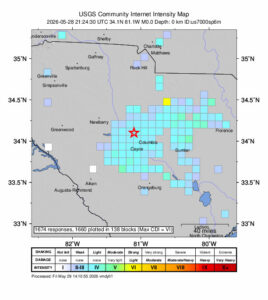
For the second major explosion of the day, which impacted South Carolina, experts aren’t sure what the causse was; they are just certain it wasn’t an earthquake. NASA says they believe the explosion happened because of something Earth-based. “We have no eyewitness reports of a fireball and no satellite detections of a meteor over the area at the time,” said Bill Cooke, lead for NASA’s Meteoroid Environments Office. The American Meteor Society, which also tracks and reports on meteor sightings, also said they saw no evidence of a space-based event behind the boom.
At 5:24 pm, people around the greater Columbia metro area started reporting hearing and feeling a large explosion. USGS confirmed the presence of the boom but because their equipment is calibrated to measure earthquakes and not sonic booms, they declared it a 0.0 magnitude seismic event and broadly painted it as a “sonic boom” event.
Scientists have yet to determine what created this widespread heard/felt explosion over South Carolina yesterday. NASA says it wasn’t a meteor. https://t.co/IH0hVUjrGg
— the Weatherboy (@theWeatherboy) May 29, 2026
The sudden explosive bang and resulting vibrations triggered widespread inquiries and reports across multiple counties, though no official cause or source has been publicly identified by authorities including those tied to the U.S. military.
A sonic boom is a massive, thunder-like noise caused by shock waves when an object travels through the air faster than the speed of sound. As an object moves through the air, it pushes air out of the way, creating continuous ripples of pressure waves that travel outward at the speed of sound. When the object reaches supersonic speeds it moves faster than its own sound, outrunning the pressure waves it is creating These pressure waves pile up and compress in front of the object, eventually merging into a single, massive, cone-shaped shock wave. As this cone trails behind the object and sweeps across the ground, observers hear it as a sudden, loud explosion or boom.
The South Carolina Emergency Management Division also confirmed the sonic boom but was unable to confirm its source.
USGS released this statement: “This event is not an earthquake. The recorded waves and eyewitness reports are consistent with a sonic boom. Because earthquake magnitude scales are calibrated for seismic waves that travel through the Earth, our standard magnitude calculation methods do not apply to sonic booms. Therefore, we manually assigned a magnitude of 0.0. Given that the source of a sonic boom is moving, the location and origin time are also approximate and are based on the arrival times of the sound waves at seismic stations, as well as the locations of eyewitness reports.”
The third and largest explosion of the day occurred on the Florida Space coast at the Cape Canaveral Space Station. A rocket built by Blue Origin, the Jeff Bezos-owned space company, blew up during a static fire test at its launch pad at about 9 pm. During a static fire test, the rocket’s 7 engines in the booster stage are lit while the rocket is held at the launchpad. But during last night’s test, something went wrong and the entire rocket exploded, destroying much of the launchpad in the process.
After the explosion, Bezos wrote on X, “All personnel are accounted for and safe. It’s too early to know the root cause but we’re already working to find it. Very rough day, but we’ll rebuild whatever needs rebuilding and get back to flying. It’s worth it.”
United States Space Force released a public advisory warning the public of debris from the explosion. “Range officials, in coordination with Blue Origin and appropriate partners, are currently evaluating available data to determine the exact cause of the anomaly. Debris from the anomaly could wash ashore along publicly accessible areas over the coming days or weeks, it is critical that this debris is reported to 911 for proper removal and mitigation. Launch vehicle debris is potentially hazardous, direct contact poses a risk to personal health and welfare.”
Incredible view of tonight’s explosion! https://t.co/tMS1I5jdd8
— the Weatherboy (@theWeatherboy) May 29, 2026
The explosion is considered the most powerful rocket explosion recorded since 1969 when a Soviet Union N1 rocket was destroyed in a launch attempt then.
Photographs taken today show the damage left behind last night’s explosion of a Blue Origin rocket. https://t.co/rV0tnqLLHq
— the Weatherboy (@theWeatherboy) May 29, 2026
NASA Administrator Jared Isaacman shared his thoughts on the explosion at the space center on X.
“Spaceflight is unforgiving, and developing new heavy-lift launch capability is extraordinarily difficult,” Isaacman wrote. “We will work with our partners to support a thorough investigation of this anomaly, assess near-term mission impacts, and get back to launching rockets. We will provide information on any impacts to the Artemis and Moon Base programs as it becomes available.”
Last night’s explosion could have a significant negative impact not only on Blue Origin’s plans of deploying a competitive internet service to SpaceX’s Starlink, but have significant impacts to the U.S. lunar mission with NASA too. NASA earlier this week awarded Blue Origin a $188 million contract to ferry rovers to the Moon’s South Pole region, as part of the agency’s upcoming Moon Base missions. The Blue Origin contract includes an option period worth $280.4 million for two task orders, which NASA can choose to extend. Blue Origin was also slated to transport NASA equipment for the Moon Base I mission by using its Mark 1 Endurance lander. NASA originally planned to launch that mission “no earlier” than this fall. NASA also selected Blue Origin to develop the Blue Moon Mark 2 lander for future Artemis missions. The Artemis III mission, which was scheduled for mid-2027, aimed to test the performance and capabilities of Blue Origin’s and SpaceX’s landers in orbit but this explosion puts that timeline into doubt.
