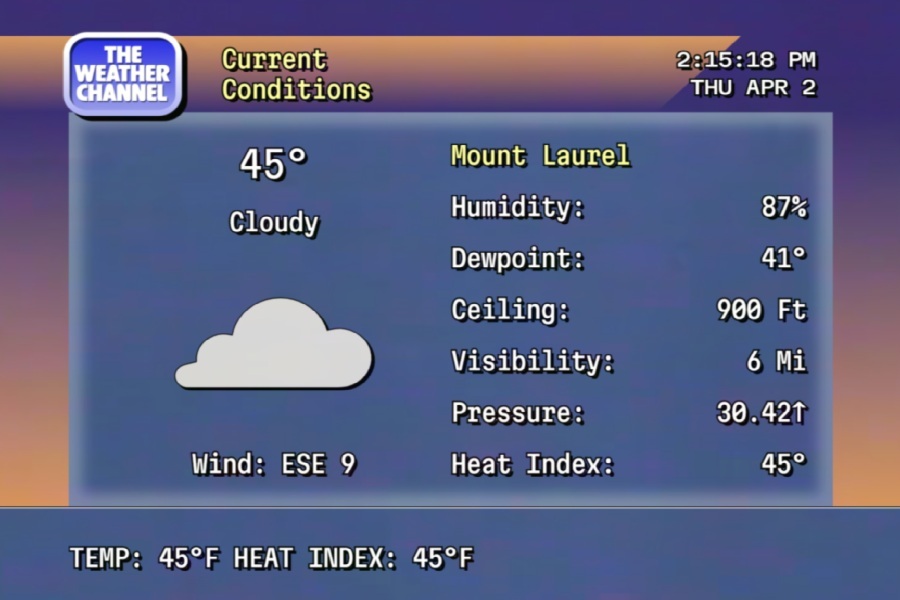
The Weather Channel today unveiled “Retrocast Now” which provides web surfers the opportunity to go back into time to the cable network’s early days and relive an era of low-resolution graphics and text local forecasts.
The Retrocast Now is available on this website by punching in your zip code or city/state:
https://weather.com/retro/
Shortly after announcing its availability on X, others rushed to the social media property to share their excitement with the tribute to the cable network’s earlier, simpler days.
“The weather channels retrocast feature is the single greatest user experience upgrade we didn’t know we needed,” wrote @PcPilanthropy. @Black_D_Gamer1 wrote, “Looking at this right now, and it’s clear that these companies need to go back to their old aesthetics. They had so much personality & charm. This is exactly how i grew up on The Weather Channel. And it is entirely accurate too.” @GrantSmithEllis wrote, “This is all we wanted for the past 25 years, rather than corporate winter storms names. Information, light music and retro vibes. Find your niche and thrive, Weather Channel. God bless and good luck!” “More feels this morning. As a kid my dad used to have TWC on all the time, and I would wake up to this before we’d go hiking or fishing. This will be the first page I load for my morning coffee. Thank you @weatherchannel, I needed this,” wrote @lorigracewx.
This old-school local forecast product on television was a key point of difference introduced in The Weather Channel’s earlier years. Based on the WeatherSTAR system, which was short for Satellite Transponder Addressable Receiver, the local forecasts were generated through a computer installed on a cable system’s headend; the computer generated and inserted local forecasts and weather warnings into the Weather Channel’s national programming feed. During severe weather events, the STAR systems were also able to display watches, advisories, and warnings issued by the National Weather Service and the Storm Prediction Center for the immediate area where the WeatherSTAR stem’s headend was based. The system would also generate a tone to alert the viewer that a special bulletin was coming in.
On the night of the network’s 1982 launch, Weather Channel founder John Coleman said, “There will be about 14 minutes of music per hour on The Weather Channel. Every one minute out of every five, when they have the Local Forecast, you’ll hear music and we are making a strong effort to see that it’s very, that its current, that its bright, that its happy, that its upbeat, and I really think that some people will stay tuned to The Weather Channel just to keep up with the music, they may began to think that our meteorologists are as part-disc jockeys.”
In the early days of the local forecast offering, various music, including random songs with vocals aired. But around 1983, the Weather Channel used primarily non-vocalized music. Before November 12, 2013, the network played mainly pop music or jazz. After that date, production music was created and used for the channel.
During 1988-1991, the Weather Channel would also feature music from its sponsors as background music for its local forecasts. Advertisers like Gatorade, United Airlines, and Liquid Clorox 2 are among the advertisers that had their own music added as background music to the local forecasts.
Over the years, advances with the WeatherSTAR system were made, allowing the addition of higher resolution icons and graphics, current weather maps, and even video clips; beyond serving as a local forecast technology, the system would also display current local conditions and forecast information over live programming.
