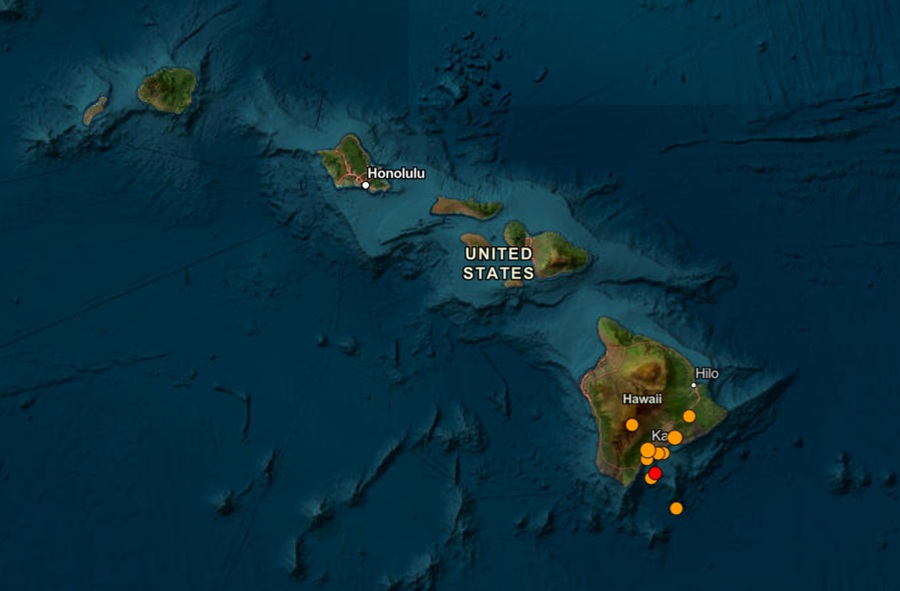
Hawaii is bracing again for another round of natural disasters, with impacts from both a new tropical storm and a volcanic eruption expected as soon as this weekend. While meteorologists with the Central Pacific Hurricane Center are tracking Tropical Storm Moke, USGS scientists with Hawaii Volcano Observatory (HVO) are tracking Kilauea Volcano on the Big Island of Hawaii. The National Weather Service in Honolulu is also monitoring conditions should tropical downpours arrive in tandem with fresh lava from an eruption and the potential of ash and other volcanic fallout hazards. Along with the persistent threat of earthquakes, residents and visitors have their hands full on Hawaii Island this weekend.
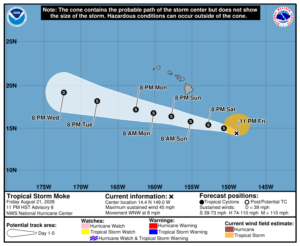
Unlike Hurricane Lala which hit the island hard just days ago, Tropical Storm Moke appears to be a smaller and weaker storm that should pass south of Hawaii. However, Moke will help drive potentially flooding rains and damaging winds across the Big Island over the next 48 hours.
According to the latest advisory from the Central Pacific Hurricane Center, Moke was located at 14.4 N 149.0 W which is about 545 miles southeast of Hilo, Hawaii. Maximum sustained winds are up to 45 mph while minimum central pressure is down to 999 mb or 29.50″.
Moke is forecast to continue moving to the west-northwest for the next day or two. On the
forecast track, the center of the storm is expected to pass south of the Big Island of Hawaii this weekend, then south of the smaller main Hawaiian Islands early next week.
Gradual strengthening is forecast during the next day or two, followed by a steady weakening trend as the storm passes well south of the smaller main Hawaiian Islands early next week.
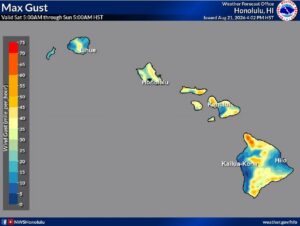
While the core of the storm will remain well south of the Hawaiian Islands, it will help drive moisture and stronger trade winds across the state. As a result, gusty winds are expected across the Hawaiian Islands this weekend, especially in areas of high terrain. This same set-up will also bring heavy rain to the Big Island, where up to 5-10″ is expected on the eastern and southern sides of the island hit hard by Lala; amounts of 15″ are possible in isolated areas. Rain under 2″ is expected over portions of western Big Island and Maui. For the remainder of the islands, 1-2″ of rain are possible. This rainfall may produce life-threatening flooding and mudslides for the windward and southeast Big Island, especially in steep terrain and over areas that were affected recently by Lala.

Swells generated by the storm are expected to affect exposed east and south facing shores of the Hawaiian Islands this weekend and into early next week. These swells may cause life-threatening surf and rip current conditions.
While Moke brings rain and wind, Kilauea will bring lava, gas, ash, and other volcanic debris. USGS and HVO believe an eruption of Kilauea on the Big Island of Hawaii could occur as early as today, although their forecast is a broader August 22-27.
According to USGS, t he summit eruption of Kīlauea in Halemaʻumaʻu is paused. Data from summit tiltmeters shows deflation began last night, following the pattern of deflationary steps observed before previous eruptive pisodes. Glow was observed on webcams from the north and west vents overnight.

USGS also warns, “NWS forecasts the possible arrival of another tropical storm system this weekend with potential torrential rains. Overlap with an eruption may create extreme conditions not suitable for viewing. Watch for closures. All of Hawaiʻi Volcanoes National Park, including USGS HVO facilities, remain without power since Hurricane Lala.”
Torrential rains and hot lava could create an abundance of steam which could create white-out conditions with zero visibility. Potentially harmful volcanic gasses and other volcanic fall-out, like ash, tephra, and Pele’s Hair could also travel along with strong winds being driven by Moke.
Kīlauea has been erupting episodically since December 23, 2024, from two vents (north and south) in Halema‘uma‘u. Lava fountaining episodes, which generally last for less than 12 hours, are separated by pauses that can be longer than three weeks. Hawaii Volcano Observatory (HVO) continues to closely monitor Kīlauea and is in contact with Hawai‘i Volcanoes National Park and the Hawai‘i County Civil Defense Agency about eruptive hazards.
Hawaii is a naturally seismically active location with active volcanoes and geologically young landmasses that are still settling. In the last 24 hours, according to USGS, 12 earthquakes hit on or near Hawaii Island. More earthquakes are likely this weekend and the days ahead.