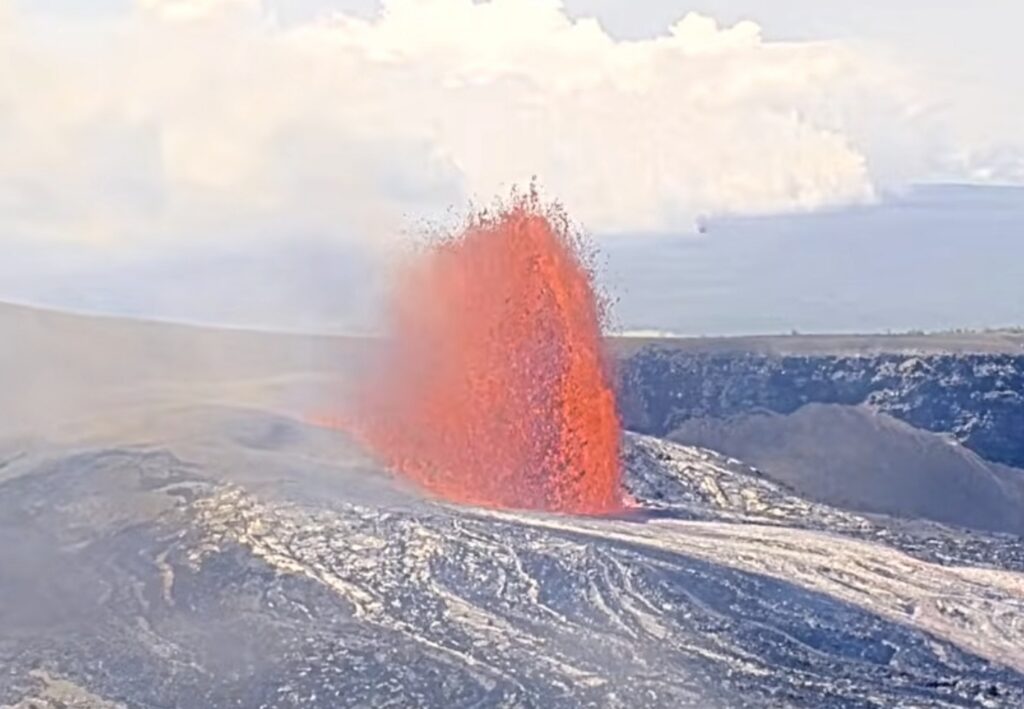
The Kilauea Volcano on the Big Island of Hawaii today erupted in spectacular fashion, shooting red hot lava high into the sky. With volcanic matter being ejected high into the air, quickly cooling, and returning to the surface as volcanic fallout, the National Weather Service on Oahu in Honolulu has issued a Special Weather Statement for the Big Island, primarily for communities hit hard by Hurricane Lala last week.
Episode 54 of the Kīlauea summit eruption in Hawai‘i Volcanoes National Park began at 10:30 am local time, today, August 25.

Based on USGS webcam views, the north vent lava fountain is reaching 500 feet above ground level, and its plume is reaching 17,000 feet above sea level. Ground-level sensors near the eruptive vents indicate that winds are blowing from the northeast direction, which suggests that volcanic gas emissions and volcanic material may be distributed to the southwest direction from Halemaʻumaʻu.
With volcanic fall-out returning to the surface, the National Weather Service issued a relatively rare ash-specific Special Weather Statement for portions of the island.
The National Weather Service office in Honolulu wrote, “Low level trade winds will push ash toward the southwest, and any ash fallout will likely occur over the Kau District and Highway 11 southwest of the town of Volcano. This includes the communities of Pahala, Wood Valley, Naalehu and Ocean View.”
These were the same communities hit hardest by Hurricane Lala last week.
“Avoid excessive exposure to ash which is an eye and respiratory irritant,” says the National Weather Service, adding “Those with respiratory sensitivities should take extra precaution to minimize exposure.
During the 2018 eruption of Kilauea, the National Weather Service in Honolulu created special products to keep the public informed of the risks posed by the possible ashfall from Hawaii’s most active volcano. . NOAA meteorologist John Bravender, who works at the Honolulu office of the National Weather Service, told us then how they’ve developed the advisories.
“The volcanic ashfall program is something we’ve been working on quite fast over the past week or two. As the weather forecast office, we’ve had responsibility for issuing SIGMET and aviation warnings but given the past history from our volcanoes, haven’t really been really concerned about ashfall. ” Bravender said the team there has had a “crash course” of sorts to develop a program, relying on experts from other groups such as Hawaiian Volcano Observatory (HVO) and the Alaska Aviation Weather Unit. But unlike severe weather watches that are issued ahead of other severe weather events, you won’t see an Ashfall Watch posted. “There’s no watches; these are very reactive products, ” Bravender told us.
When an ashfall incident is imminent due to some type of explosion at the volcano, the National Weather Service office in Honolulu will issue one of three types of products. The first is a Special Weather Statement. A Special Weather Statement is issued when there is the potential for trace amounts of accumulating ash. When there’s a chance of a more significant ashfall, from over a trace to up to 1/4″, the National Weather Service will then issue an Ashfall Advisory. And if a heavy ashfall is expected with accumulations greater than 1/4″, an Ashfall Warning is issued.
When any of these products are issued, the National Weather Service encourages people to avoid ash. “Avoid excessive exposure to ash which is an eye and respiratory irritant,” the Special Weather Statement text reads. “Those with respiratory sensitivities should take extra precaution to minimize exposure.”
USGS kept the Kīlauea alert level/aviation color code at WATCH/ORANGE throughout the episode because fallout was not extensive and did not last very long. After the episode ended, USGS lowered Kīlauea to ADVISORY/YELLOW reflecting that volcanic activity had decreased significantly but continues to be closely monitored for possible renewed increase.
In the U.S., the USGS and volcano observatory units are responsible for issuing Aviation Codes and Volcanic Activity Alert Levels. Aviation Codes are green, yellow, orange, or red. When ground-based instrumentation is insufficient to establish that a volcano is at a typical background level of activity, it is simply “unassigned.” While green means typical activity associated with a non-eruptive state, yellow means a volcano is exhibiting signs of elevated unrest above known background levels. When a volcano exhibits heightened or escalating unrest with the increased potential of eruption, it jumps to orange. Finally, when an eruption is imminent with significant emission of volcanic ash expected in the atmosphere or an eruption is underway with significant emission of volcanic ash into the atmosphere, the code becomes red. Volcanic Activity Alert levels are normal, advisory, watch, or warning. As with aviation codes, if data is insufficient, it is simply labeled as “unassigned.” When the volcano is at typical background activity in a non-eruptive state, it is considered normal. If the volcano exhibits signs of elevated unrest above background level, an advisory is issued. If a volcano exhibits heightened or escalating unrest, a watch is issued while a warning is issued when a hazardous eruption is imminent.
Kilauea has been erupting episodically since December 23, 2024 from two vents in Halema‘uma‘u. Lava fountaining episodes, which generally last for less than 12 hours, are separated by pauses that can be longer than three weeks.
