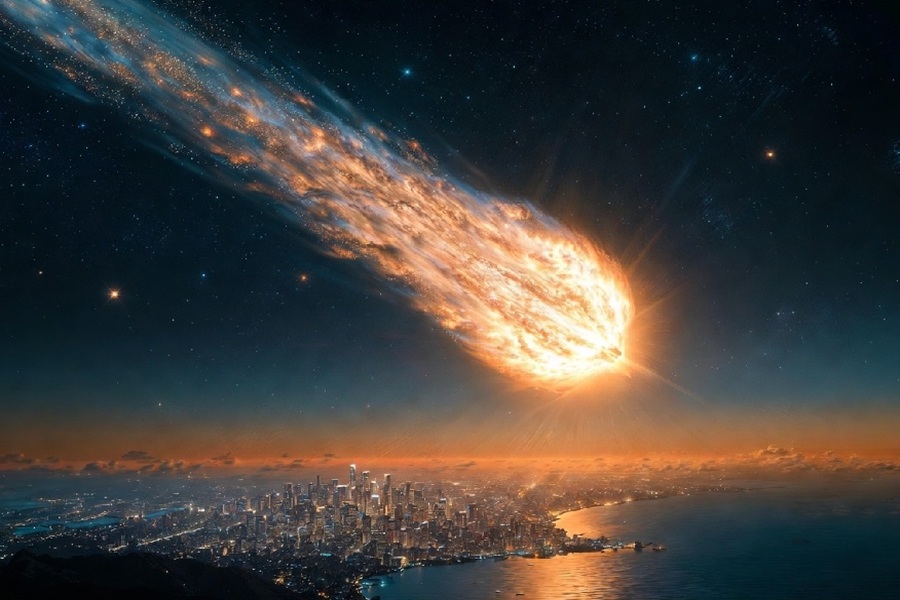
NASA has verified that the weekend sonic boom heard and felt across a large part of the northeastern U.S. was indeed a bolide and provide some facts and stats on what happened. While this bolide is confirmed, the unusual explosion heard over South Carolina days ago remains a mystery with no government entity coming up with a rationale for what happened there.
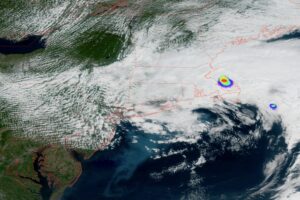
NASA confirmed a fireball, also known as a bolide, zoomed over New England at 2:06 pm local time on Saturday, May 30, 2026. The meteor was about 5 feet in diameter with a mass of 5.6 metric tons and entered Earth’s atmosphere at roughly 42,000 mph. The meteor traveled through the atmosphere from northwest to southeast for 26 miles before breaking up at an altitude of 31 miles and producing a meteorite fall into Cape Cod Bay. NASA says that based on the latest data, the energy released at breakup is estimated to be equivalent to about 230 tons of TNT, which accounts for the sonic boom.
Ahead of this new confirmation from NASA, citizen scientists reported what they experienced to a variety of online outlets. Shortly after 2pm on Saturday, people across the northeast reported seeing, hearing, or feeling a streaking meteor and/or sonic boom. As of press time, the American Meteor Society reports that 36 observers from New Jersey, Delaware, Maryland, New York, Vermont, New Hampshire, Maine, Massachusetts, and nearby areas in Canada observed a fireball.
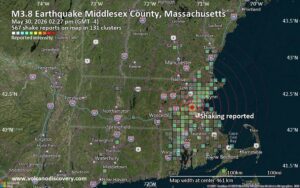
At about the same time, equipment on-board the GOES-East weather satellite detected a large and bright area just east of Boston. The Group Flash Count Density or Flash Extent Density is a satellite product from the Geostationary Lightning Mapper (GLM) on the GOES weather satellite. Distributed by CIRA and NOAA, it maps the total number of lightning flashes within grid cells over time, helping meteorologists track intensifying, severe thunderstorms. But with no thunderstorms in the vicinity of Boston at the time of this recorded flash event, it was assumed to be a bolide.
While USGS didn’t report an earthquake, they did log a sonic boom event. USGS released a statement saying, “This event is a widely felt sonic boom from a suspected bolide. Unlike earthquakes which occur at discrete location in the earth, sonic boom events occur along a linear path in the atmosphere. Therefore, the location provided is an approximation. While recorded on seismic sensors, traditional earthquake magnitudes are not appropriate for measuring atmospheric events. No magnitude is assigned.”
Another mysterious explosion today, this time near Boston, Massachusetts. Unlike Thursday’s sonic boom in South Carolina, this even lt in New England is likely the result of a bolide. https://t.co/5UpHLK6h01
— the Weatherboy (@theWeatherboy) May 30, 2026
A bolide is a very bright meteor that can be seen over a wide area. It’s typically used to describe meteors that are exceptionally bright, sometimes even brighter than the planet Venus in the night sky. A defining characteristic of a bolide is its tendency to explode or fragment in the atmosphere, often resulting in a bright flash and sometimes a sonic boom.
The American Meteor Society is not to be confused with the American Meteorology Society which is an organization for professional meteorologists that track the weather. Meteorology is named after the Greek word “meteoron” which, in ancient times, referred to anything observed in the sky, including weather phenomena.
While today we associate “meteor” with rocks from space, in ancient Greece, it encompassed a broader range of atmospheric occurrences like rain, snow, and even rainbows. Aristotle’s book “Meteorologica” covered topics we now call weather and climate, thus giving the name to the field of meteorology.
A similar mysterious explosion and sonic boom was heard/felt over South Carolina on Thursday. However, unlike this confirmed incident in New England, there were no sightings of a fireball and the GOES-East weather satellite didn’t detect anything unusual in the atmosphere over South Carolina at the time of the event.
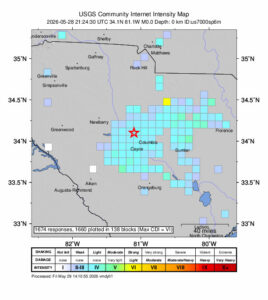
NASA says they believe the explosion happened because of something Earth-based. “We have no eyewitness reports of a fireball and no satellite detections of a meteor over the area at the time,” said Bill Cooke, lead for NASA’s Meteoroid Environments Office, about the South Carolina event. The American Meteor Society, which also tracks and reports on meteor sightings, also said they saw no evidence of a space-based event behind the boom.
At 5:24 pm, people around the greater Columbia metro area started reporting hearing and feeling a large explosion. USGS confirmed the presence of the boom but because their equipment is calibrated to measure earthquakes and not sonic booms, they declared it a 0.0 magnitude seismic event and broadly painted it as a “sonic boom” event.
Scientists have yet to determine what created this widespread heard/felt explosion over South Carolina yesterday. NASA says it wasn’t a meteor. https://t.co/IH0hVUjrGg
— the Weatherboy (@theWeatherboy) May 29, 2026
The sudden explosive bang and resulting vibrations triggered widespread inquiries and reports across multiple counties, though no official cause or source has been publicly identified by authorities including those tied to the U.S. military.
A sonic boom is a massive, thunder-like noise caused by shock waves when an object travels through the air faster than the speed of sound. As an object moves through the air, it pushes air out of the way, creating continuous ripples of pressure waves that travel outward at the speed of sound. When the object reaches supersonic speeds it moves faster than its own sound, outrunning the pressure waves it is creating These pressure waves pile up and compress in front of the object, eventually merging into a single, massive, cone-shaped shock wave. As this cone trails behind the object and sweeps across the ground, observers hear it as a sudden, loud explosion or boom.
The South Carolina Emergency Management Division also confirmed the sonic boom but was unable to confirm its source.
USGS released this statement: “This event is not an earthquake. The recorded waves and eyewitness reports are consistent with a sonic boom. Because earthquake magnitude scales are calibrated for seismic waves that travel through the Earth, our standard magnitude calculation methods do not apply to sonic booms. Therefore, we manually assigned a magnitude of 0.0. Given that the source of a sonic boom is moving, the location and origin time are also approximate and are based on the arrival times of the sound waves at seismic stations, as well as the locations of eyewitness reports.”
