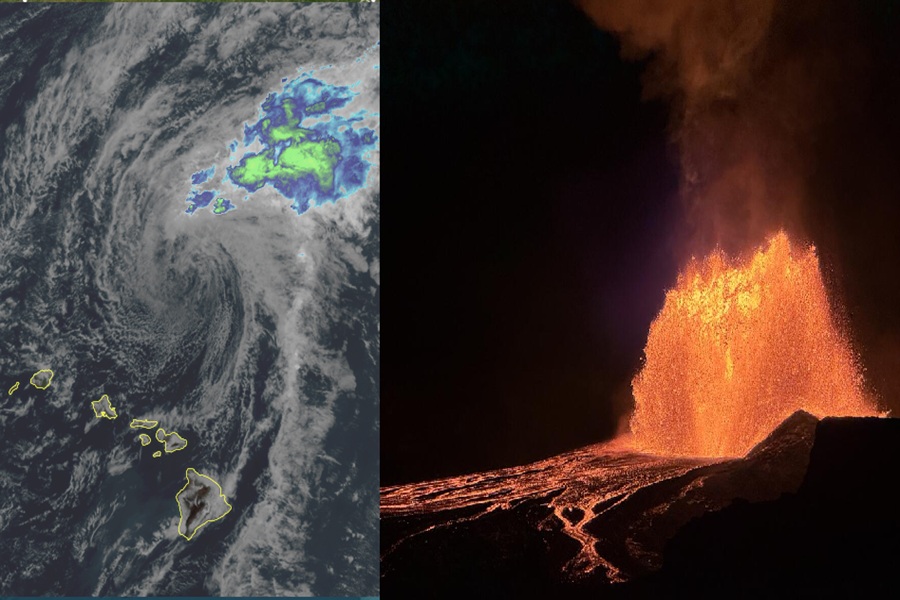
A lot of Earth Science has unfolded in Hawaii over the last 24 hours, with numerous earthquakes, an erupting volcano, and the nearby passing of the remnants of a hurricane. According to USGS, there were 17 earthquakes on or around Hawaii over the last 24 hours; none were of any consequence and ranged in intensity from a magnitude 1.7 to a 3.6. Fausto, now downgraded to a remnant low pressure area after becoming a tropical storm last night, continues to move away from Hawaii but continued to pound the state during the overnight hours with rough surf generated in its stronger days. And Kilauea Volcano erupted for the 52nd time in a series which started in December 2024, delighting people who came out to view the lava fountains under a full moon during the overnight hours.
The Central Pacific Hurricane Center in Honolulu, through the National Hurricane Center in Miami, Florida, issued its final bulletin on Fausto at 5 am Hawaii time today. In that final report, Fausto’s center was roughly 285 miles north of Hilo on the Big Island of Hawaii and about 225 miles northeast of Honolulu on the island of Oahu. At that time, the system had winds of 35 mph and was moving to the west-northwest away from Hawaii at 13 mph. The minimum central pressure was up to 1008 mb or 29.77″.
The National Weather Service office in Honolulu reports that nearshore buoys are showing a rapid decline in the east swell that was generated by Fausto. As a result, the High Surf Advisory that had been up for portions of the islands has been canceled.
While Fausto was passing to the north of Hawaii, Kilauea Volcano in Hawaii started to erupt. The eruption began at 7:10 pm last night and ended at 2:36 am today. During this eruption, lava fountain heights reached roughly 500 feet into the air above ground from the north vent of the volcano. According to USGS, the south vent never fountained during this episode. The maximum plume height was approximately 19,000 feet above mean sea level. Tephra fall was restricted to primarily the closed area inside Hawaii Volcanoes National Park to the southwest of the active volcanic vents.
Kīlauea has been erupting episodically since December 23, 2024, from two vents (north and south) in Halema‘uma‘u. Lava fountaining episodes, which generally last for less than 12 hours, are separated by pauses that can be longer than three weeks. Hawaii Volcano Observatory (HVO) continues to closely monitor Kīlauea and is in contact with Hawai‘i Volcanoes National Park and the Hawai‘i County Civil Defense Agency about eruptive hazards. HVO believes another eruption event is likely in the coming days but has not yet issued a prediction of when that would occur.
